How to Hire a Domain Broker: Step-by-Step Guide
Learn how to hire a domain broker, including steps to choose the right expert, negotiation tips, and what to expect from the process.
 Michael Gargiulo
Premium Domain Broker
Pay less. Earn more. Stay anonymous.
Looking to buy or sell a domain? We can help.
Hiring the Right Domain Broker Saves Thousands and Weeks of Frustration
Look for anonymous negotiation, escrow-backed transfers, and a commission structure tied to closing. Ask about transaction history, outreach methods, and conflict disclosure. The right premium domain broker can help you buy a premium domain or sell one without overpaying or leaving money on the table. VPN.com has advised on over $100M in portfolio and transactions through exactly this approach.
Who Actually Needs a Domain Broker
Not every purchase requires a broker. A $12 registration on Namecheap needs no middleman. But certain situations demand professional help.
Stealth acquisitions protect your identity from price inflation. From what we see, high-profile brands and public figures pay substantially more — often several times more — when sellers know who is buying. A broker keeps your name off the table entirely.
Unlisted domains require detective work. Brokers use WHOIS databases, registrar channels, and industry contacts to locate owners behind privacy shields. Most buyers lack these tools.
High-value deals above $5,000 carry real financial risk. Brokers negotiate better terms and handle escrow. Time-sensitive deals tied to product launches or campaigns need speed. VPN.com typically closes in 30–90 days, with urgent deals possible in under 14.
Skip the broker if the domain shows a “Buy Now” price on Sedo or Afternic. Skip it if the owner responds quickly and lists a fair price publicly.
Buyer Broker vs. Seller Broker: Know the Difference
A buyer broker represents you, the acquirer. You pay their commission, typically 10% to 20% of the purchase price. Their job is to find the owner, negotiate the lowest defensible price, and close fast.
A seller broker represents the domain owner. The seller pays from proceeds, usually 10% to 20%. Their job is to maximize sale price through multi-channel outreach to qualified buyers.
Dual representation creates conflicts. One broker handling both sides risks bias unless both parties consent in writing with a clear fee split. Reputable brokerages disclose dual roles upfront.
How a Broker Operates from First Call to Transfer
The process follows six steps. Each one reduces your risk.
Discovery. The broker identifies domain owners using WHOIS records, registrar channels, LinkedIn, and industry contacts. Privacy shields do not stop experienced brokers.
Valuation. They assess worth based on domain length, TLD, brandability, search volume, CPC data, traffic history, and comparable sales. This prevents overpaying.
Outreach. Anonymous contact protects your identity. Named outreach builds trust with cooperative sellers. VPN.com tailors the approach to each deal.
Negotiation. Brokers negotiate from market data and structure the deal to close. Skilled negotiators save buyers 15% to 40% off initial asking prices. VPN.com saved $798K on its own VPN.com acquisition, buying a $1.775M asking price domain for $976K.
Escrow. Payments go through Escrow.com or equivalent services. Funds release only after the domain transfers successfully.
Transfer. The broker manages authorization codes, registrar pushes, and DNS confirmation. The domain lands in your account before money changes hands.
What to Look for When Hiring a Broker
Five criteria separate professionals from amateurs.
Transaction volume. Ask for total deal value, not just deal count. VPN.com has advised on over $100M in portfolio and transactions across hundreds of deals. Volume proves negotiation skill.
Anonymity guarantee. Your identity should stay hidden from the first outreach email. If a broker cannot promise this, walk away.
Escrow requirement. Every legitimate broker uses escrow. No exceptions. Wire transfers directly to a broker or seller signal fraud.
Clear fee structure. Commissions should be stated upfront in writing, and across the industry buy-side fees typically run 10% to 20%. VPN.com charges 15%–35% with a minimum of $5,000 — typically 15% on a premium acquisition, higher as deal size falls — and no retainer or upfront fee; you pay only after the domain transfers. No hidden charges.
Communication cadence. Many brokers commit to weekly updates. Ask what reporting looks like before signing an agreement. VPN.com contacts you when there is something worth your time, which in a quiet negotiation can mean less often than weekly — and more often than weekly when a deal is moving.
Red Flags That Should Stop a Deal
Avoid any broker who demands full payment before closing. Legitimate brokers collect commission only after the domain transfers.
Refuse brokers who will not disclose comparable sales data. Without comps, you cannot verify fair pricing. This is how buyers overpay by 50% or more.
Watch for pressure tactics. Fake competing offers, artificial deadlines, and “act now” urgency are manipulation tools. Good brokers present data and let you decide.
Skip brokers with no verifiable transaction history. Ask for references from past clients. Check DN Journal and Domain Name Wire for rankings.
Questions to Ask Before Signing
- How many domains have you brokered above $10,000?
- Will my identity stay anonymous throughout the process?
- What escrow service do you use?
- What is your commission rate, and when is it due?
- How do you value a domain before negotiating?
- What is your average days-to-close?
- Do you represent the seller on any current listings?
How VPN.com Compares to Other Brokerages
VPN.com operates on a no-fee-until-close model. You pay nothing unless the deal completes. The buy-side commission is 15%–35% with a minimum of $5,000, typically 15% on a premium acquisition.
The $100M+ portfolio and transaction track record includes premium names like university.com. The VPN.com team bought its own brand domain for $976K, negotiating $798K off the asking price. That savings exceeds most brokers’ entire annual volume.
Every acquisition starts anonymously. Outreach, valuation, and negotiation happen without revealing your identity. The typical timeline runs 30–90 days from signed agreement to completed transfer.
Start Your Domain Acquisition Today
The right broker pays for themselves through savings at the negotiation table. The wrong one costs you time, money, and possibly the domain itself.
Contact VPN.com’s brokerage team to start a confidential acquisition. No fee until close. Anonymous from the first call.
Resources for this page
Charts and reference images from our research, free to view and share.
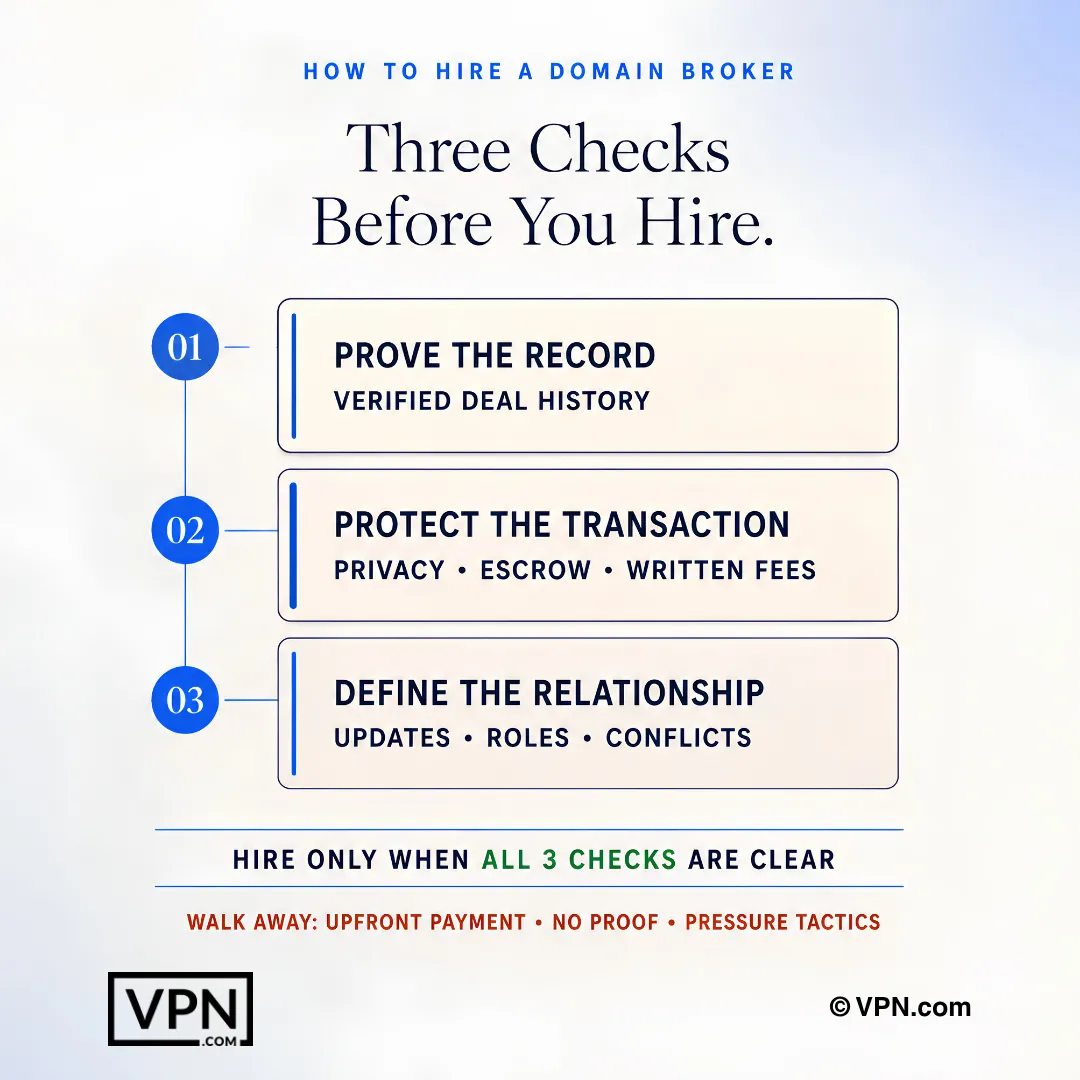
Hire a broker only after confirming their deal record, transaction safeguards, fees, roles, and communication process.
Explore domain brokerage
Buy Premium Domain: Expert Broker Service
Buy premium domain names through our broker service. We've advised on over $100M in portfolio and transactions with zero fees until closing. Start your confidential purchase today.
Confidential Domain Acquisition: Buy Domains Anonymously
Acquire premium domains without revealing your identity. VPN.com's confidential brokerage protects your leverage and keeps negotiations private.
Domain Valuation: How Much Is Your Domain Worth?
Get an accurate domain valuation from VPN.com. We assess comparable sales, traffic, brand potential, and market demand to price your domain correctly.
Sell Premium Domain Names for Maximum Value
Sell your premium domain with expert broker representation. We've advised on over $100M in portfolio and transactions and negotiate top prices with zero upfront fees.
.com vs .xyz: The Real Differences Every Brand Should Know
Not sure whether to choose .com vs .xyz for your brand? We cover trust SEO email deliverability and cost to help you make a clear decision right now.
Domain Name and URL: What's the Difference?
Learn the key differences between domain name and URL. Understand how each works and why getting them right matters for your website's SEO and security.
Frequently Asked Questions
Who actually needs to hire a domain broker instead of buying directly?
You need one for stealth acquisitions, unlisted domains, or deals above $5,000, where financial risk and identity exposure matter. High-profile buyers routinely pay several times more once a seller knows who’s asking. Skip a broker if the domain already lists a “Buy Now” price on Sedo or Afternic, or the owner responds fast with a fair public price.
What’s the difference between a buyer broker and a seller broker?
A buyer broker represents the acquirer, paid a 10% to 20% commission by the buyer, and works to find the owner and close at the lowest defensible price. A seller broker represents the domain owner, paid from proceeds at the same 10% to 20% range, and runs multi-channel outreach to maximize sale price. Dual representation requires written consent from both parties.
What are the six steps a broker follows from first contact to transfer?
The process runs discovery, valuation, outreach, negotiation, escrow, and transfer. Discovery uses WHOIS records, registrar channels, and LinkedIn to find owners behind privacy shields. Valuation weighs domain length, TLD, and comparable sales. Negotiation leverages market data, escrow releases funds only after transfer, and the broker manages authorization codes and DNS confirmation before money changes hands.
How does escrow protect both parties in a broker-led domain deal?
Escrow.com or an equivalent service holds the buyer’s funds and releases them only after the domain successfully transfers to the buyer’s account. This is why every legitimate broker requires it with no exceptions. Wire transfers sent directly to a broker or seller, bypassing escrow entirely, are a clear signal of fraud rather than a normal shortcut.
How much commission does a domain broker charge?
Commissions typically run 10% to 20% of the purchase price on both buy-side and sell-side deals. VPN.com specifically charges 15%–35% buy-side with a minimum of $5,000 — typically 15% on a premium deal, higher as deal size falls — on a no-fee-until-close model, meaning you pay nothing unless the deal completes. Get the exact rate and payment timing stated in writing before signing any brokerage agreement.
Are there retainer fees or upfront costs before a broker closes a deal?
VPN.com charges no retainer and no upfront fee, so you pay only the buy-side commission and only after the domain successfully transfers to your account. Some brokers do charge upfront retainers, which is why any fee should be disclosed in writing before you commit. A broker who demands full payment before closing is a red flag worth walking away from.
How does a broker keep my identity anonymous during outreach and negotiation?
Your identity stays hidden from the first outreach email through negotiation, since a seller who knows a high-profile buyer is asking will, in our experience, inflate the price several times over. Brokers contact owners anonymously by default and only switch to named outreach when it builds trust with a cooperative seller. If a broker cannot guarantee this anonymity from the start, that’s a reason to walk away.
What happens if a broker represents both the buyer and seller in the same deal?
Dual representation creates a real conflict of interest, since one broker negotiating for both sides risks bias toward whichever side pays more or closes faster. Reputable brokerages disclose dual roles upfront and require written consent from both parties with a clear fee split. Before signing, ask directly whether the broker represents the seller on any current listings.
How does a broker value a domain before starting negotiations?
Brokers assess worth using domain length, TLD, brandability, search volume, CPC data, traffic history, and comparable recent sales, which prevents you from overpaying without market context. Refuse any broker who won’t disclose comparable sales data, since buyers without comps have overpaid by 50% or more. Check DN Journal or Domain Name Wire for a broker’s verifiable track record.
How much can a skilled broker actually save me off the asking price?
Skilled negotiators typically save buyers 15% to 40% off the initial asking price using market data and creative deal structures. VPN.com’s own acquisition of its brand domain illustrates this: the team negotiated a $1.775M asking price down to $976K. That kind of savings is a direct result of comparable-sales data and disciplined negotiation, not guesswork.
How long does the domain acquisition process typically take?
Most deals close in 30–90 days from signed agreement to completed transfer, covering discovery, valuation, outreach, negotiation, escrow, and transfer. Urgent deals tied to product launches or campaigns can close in under 14 days when speed is the priority. Ask any broker for their average days-to-close before signing an agreement.
What if my domain purchase is time-sensitive, tied to a product launch?
Time-sensitive deals still typically close in under 14 days when urgency is the priority, compared to the standard 30–90-day window. Flag the deadline to your broker upfront so outreach and negotiation are structured around speed rather than maximizing every dollar of savings. Escrow and transfer steps still apply even on an accelerated timeline.
What red flags should make me walk away from a broker?
Walk away from any broker who demands full payment before closing, refuses to share comparable sales data, or uses pressure tactics like fake competing offers and artificial deadlines. Also skip brokers with no verifiable transaction history, no escrow requirement, or no written commission structure. Ask for client references and check DN Journal or Domain Name Wire for their track record.
Premium Domain Broker
Pay less. Earn more. Stay anonymous.
Looking to buy or sell a domain? We can help.
Get Started