Confidential Domain Acquisition: Buy Domains Anonymously
Acquire premium domains without revealing your identity. VPN.com's confidential brokerage protects your leverage and keeps negotiations private.
Premium Domain Broker
Pay less. Earn more. Stay anonymous.
Looking to buy or sell a domain? We can help.
Anonymous Domain Purchase: Why Confidential Acquisition Saves You Six Figures
A confidential domain broker contacts sellers without revealing your identity, preventing the price inflation that happens the moment a seller discovers a well-funded buyer. This is the core of how VPN.com, as your premium domain broker, helps you buy a premium domain discreetly. We have advised on over $100M in portfolio and transactions using anonymous acquisition methods that keep your name hidden from the first call through final transfer.
Revealing Your Identity Costs You Real Money
Domain sellers adjust prices based on who is buying. A Fortune 500 company pays more than an unknown LLC. This is not speculation. It happens in every negotiation where buyer identity leaks.
When VPN.com acquired VPN.com for $976K, anonymity saved $798K at the negotiation table. The seller never knew the buyer’s full budget or strategic intent. That single tactic preserved 44% of the expected purchase price.
Three specific risks emerge when your identity becomes known during a domain purchase:
Price inflation hits immediately. Sellers research buyers within minutes. From our experience, a startup with $20M in funding is quoted several times more than an unidentified buyer — often three to five times — and public companies face steeper markups still. One leaked detail can add six figures to an asking price.
Competitors gain intelligence for free. Your domain search history signals your next product line, market entry, or rebrand. If a competitor learns you are pursuing “FinanceAI.com,” they now know your strategic direction. They can register adjacent domains or beat you to market.
Brand strategy leaks before launch day. Stealth-mode startups lose their advantage the moment a domain inquiry traces back to their founder. Journalists, competitors, and investors all monitor domain activity. One WHOIS lookup can unravel months of quiet planning.
How VPN.com Runs a Fully Confidential Acquisition
Our process eliminates every point where your identity could surface. Here is exactly how it works across a typical 30–90-day engagement.
Step 1: You contact us through the confidential intake form. We collect your target domain, budget range, and timeline. This information stays inside our secure systems. No third parties see it.
Step 2: We approach the seller as VPN.com. Our brokers contact domain owners directly. They reference our brokerage credentials and $100M+ portfolio and transaction history. Your name never enters the conversation. The seller negotiates with our team, not with you.
Step 3: Negotiation happens behind a wall. Our brokers use proprietary valuation data to anchor pricing. We counter inflated asks with market comparables. The seller has zero leverage because they cannot research your company, your funding, or your urgency.
Step 4: We close through a secure escrow process. Payment moves through escrow with entity names that trace back to our brokerage structure. Domain transfer completes. WHOIS records update to your specifications, often with privacy protection enabled.
You pay no fee until the deal closes. Our commission runs 15%–35% on buy-side acquisitions — typically 15% on a premium deal, higher as deal size falls, minimum $5,000. That percentage pays for itself when anonymity prevents a $200K price markup on a $500K domain.
Who Needs Stealth Domain Acquisition
This service exists for buyers who cannot afford identity exposure. Three groups use it most.
Public companies planning rebrands or product launches. A publicly traded company searching for a new brand name creates market speculation. Stock price movements, analyst reports, and competitor responses all follow. Anonymous acquisition eliminates that chain reaction entirely.
Celebrities and public figures. High-profile individuals pay a “fame tax” on every purchase. Domain sellers who discover a celebrity buyer inflate prices by 200% to 500%. Our brokers remove that variable from the equation.
Startups in stealth mode. Pre-launch companies operate under NDAs for a reason. A domain purchase that links back to a founder’s name can trigger competitor awareness months before a product ships. We have helped dozens of stealth startups secure premium domains without a single identity leak.
VPN.com vs. Buying on a Public Marketplace
Public marketplaces like Afternic, Sedo, or GoDaddy auctions expose buyer identity at multiple stages. Here is a direct comparison.
| Factor | Public Marketplace | VPN.com Confidential Broker |
|---|---|---|
| Seller sees buyer identity | Yes, often at inquiry | Never |
| Price inflation risk | High | Eliminated |
| Negotiation leverage | Buyer disadvantage | Broker-controlled |
| WHOIS exposure | Immediate on transfer | Privacy-protected |
| Average timeline | Weeks to months | 30–90 days |
| Fee structure | Platform fees plus markups | 15%–35% commission on close only |
Public platforms also create a paper trail. Your inquiry history, bidding patterns, and account details all become data points. Sophisticated sellers cross-reference this data to identify buyers and adjust pricing.
VPN.com creates no public trail. Every interaction routes through our brokerage team. The seller sees a professional domain broker with a proven track record. Nothing more.
The $798K Proof Point
When VPN.com needed to acquire its own domain, we used the same confidential process we offer clients. The domain VPN.com carried an initial asking price far above its market value.
Our team approached the seller anonymously. We anchored the negotiation with comparable sales data. We controlled the timeline and never revealed the buyer’s budget ceiling.
Final purchase price: $976K. Estimated savings from anonymous negotiation: $798K. That result came from the same playbook every client gets access to.
Start your confidential acquisition today.
Your Next Domain Acquisition Should Be Invisible
Every day you search for a domain under your own name, you risk inflating the price. Every marketplace inquiry creates a data point that sellers exploit.
VPN.com has advised on over $100M in portfolio and transactions using confidential methods. We saved $798K on our own domain purchase. We deliver the same anonymous process to every client.
Submit your confidential domain request now. Anonymous from the first call. No fee until close.
Resources for this page
Charts and reference images from our testing, free to view and share.
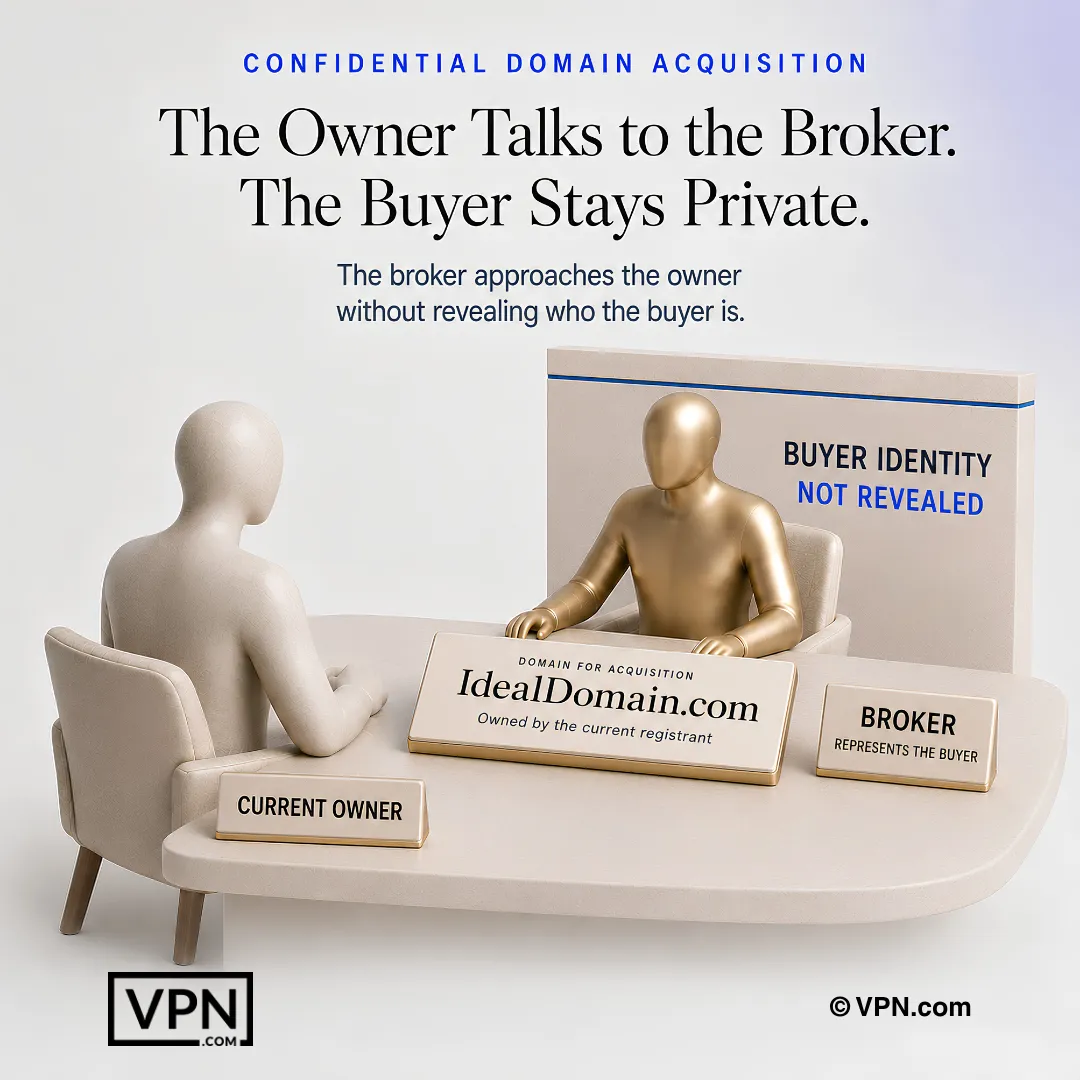
The broker approaches and negotiates with the owner without disclosing the identity of the underlying buyer.
Explore domain brokerage
Buy Premium Domain: Expert Broker Service
Buy premium domain names through our broker service. We've advised on over $100M in portfolio and transactions with zero fees until closing. Start your confidential purchase today.
Domain Valuation: How Much Is Your Domain Worth?
Get an accurate domain valuation from VPN.com. We assess comparable sales, traffic, brand potential, and market demand to price your domain correctly.
Sell Premium Domain Names for Maximum Value
Sell your premium domain with expert broker representation. We've advised on over $100M in portfolio and transactions and negotiate top prices with zero upfront fees.
.com vs .xyz: The Real Differences Every Brand Should Know
Not sure whether to choose .com vs .xyz for your brand? We cover trust SEO email deliverability and cost to help you make a clear decision right now.
Domain Name and URL: What's the Difference?
Learn the key differences between domain name and URL. Understand how each works and why getting them right matters for your website's SEO and security.
Artificial Intelligence Domains: Buy AI Domains & Names
Explore artificial intelligence domains and AI-focused names. Learn pricing drivers, SEO and branding value, and how a broker helps you buy safely.
Frequently Asked Questions
How does VPN.com keep my identity hidden when buying a domain?
VPN.com’s brokers contact the seller directly under the VPN.com name, citing our $100M+ portfolio and transaction history, and your identity never enters the conversation. You submit your target domain, budget, and timeline through a confidential intake form that stays inside our secure systems. The seller negotiates with our team, not with you, from first contact through final transfer.
Can a domain seller figure out who I am during negotiations?
No, if the process is run correctly. VPN.com’s brokers negotiate as the buyer of record, so sellers cannot research your company, funding, or urgency. WHOIS records are updated to your specifications after close, often with privacy protection enabled, which prevents the exposure that happens immediately on public marketplace transfers.
Why does a seller quote a higher price once they know who’s buying?
Sellers research buyers within minutes and price accordingly. In the deals we have run, a startup with disclosed funding is often quoted three to five times more than an unidentified buyer, and public companies face steeper markups still. Celebrities and public figures pay what we would call a fame tax: once a seller identifies a high-profile buyer, we have seen asking prices multiply several times over.
What’s the actual dollar impact of anonymous negotiation versus buying directly?
It can be substantial. When VPN.com acquired VPN.com for $976K, negotiating anonymously preserved 44% of the expected purchase price because the seller never learned the buyer’s full budget or strategic intent. On a $500K domain, the page notes identity exposure can add up to a $200K markup, which is the exact leverage a confidential broker eliminates.
How much does confidential domain acquisition cost through VPN.com?
VPN.com charges 15%–35% on buy-side acquisitions, typically 15% on a premium deal and higher as deal size falls, and you pay nothing until the deal closes. That structure differs from public marketplaces like Afternic, Sedo, or GoDaddy auctions, which layer platform fees plus markups on top of an already-inflated asking price once your identity is exposed.
How long does a confidential domain acquisition take?
A typical engagement runs 30–90 days from intake to closed transfer. That covers the confidential intake form, anonymous seller outreach, negotiation using proprietary valuation data, and closing through a secure escrow process. This compares to public marketplace timelines of weeks to months, though marketplace deals expose your identity at multiple stages along the way.
What happens at each stage of a confidential acquisition?
The process runs four steps. You submit your target domain, budget, and timeline through a confidential intake form; VPN.com’s brokers approach the seller directly, referencing our $100M+ portfolio and transaction history without naming you; negotiation happens using market comparables to counter inflated asks; and closing runs through secure escrow with WHOIS updated to your specifications afterward.
Why is a public marketplace listing risky for a stealth-mode startup?
Public marketplaces expose buyer identity at inquiry, and your search history itself signals strategic intent. If a competitor learns you’re pursuing a specific domain, they can register adjacent names or beat you to market. VPN.com has helped dozens of stealth startups secure premium domains without a single identity leak by routing every interaction through its brokerage team instead.
Is confidential brokerage worth it for a company planning a public rebrand?
Yes, for publicly traded companies especially. A public company’s domain search can trigger stock price speculation, analyst reports, and competitor responses the moment it surfaces. VPN.com’s anonymous acquisition process eliminates that chain reaction by keeping the buyer’s identity out of every seller conversation, from first contact through the escrow-based close.
How does VPN.com counter an inflated asking price without revealing my budget?
Brokers anchor negotiations with proprietary valuation data and market comparables rather than reacting to the seller’s ask. Because the seller cannot research your company, funding, or urgency, they have no leverage to justify inflation. This is the same approach used on VPN.com’s own $976K acquisition, which preserved 44% of the expected purchase price.
Does WHOIS expose my identity once the domain transfer completes?
Not by default in a confidential acquisition. VPN.com closes through secure escrow using entity names tied to its brokerage structure, and WHOIS records update to your specifications after transfer, often with privacy protection enabled. Public marketplace transfers, by contrast, expose buyer identity in WHOIS immediately on completion.
What’s the difference between buying on Afternic or Sedo versus using VPN.com?
On public marketplaces, sellers see your identity often at first inquiry, price inflation risk is high, and fees stack platform charges on top of markups. VPN.com’s brokers negotiate anonymously, control the timeline, and charge a single commission of 15%–35% only on close. The comparison table on this page frames it as broker-controlled leverage versus buyer disadvantage.
Premium Domain Broker
Pay less. Earn more. Stay anonymous.
Looking to buy or sell a domain? We can help.
Get Started