Premium Domain Broker
Pay less. Earn more. Stay anonymous.
- No fee until we close
- $100M advised in portfolio and transactions
Request received.
Thank you. We have your details.
VPN.com wasn't for sale. We bought it anyway, and saved $798K.
Track Record
A sample of our portfolio
.com vs .xyz: The Real Differences Every Brand Should Know
Not sure whether to choose .com vs .xyz for your brand? We cover trust SEO email deliverability and cost to help you make a clear decision right now.
 Michael Gargiulo
Bottom Line: Choose .com for trust, authority, and broad audience appeal in regulated or conservative industries; choose .xyz for modern branding with tech-savvy audiences — if the brand name has long-term value, secure both at minimal extra cost.
Choosing between .com and .xyz is not a technical question. It is a strategic one. The domain extension you pick signals something to every person who sees it. In simple terms, your domain extension helps people quickly judge how credible and professional your website is.
.com has been the default for four decades. It carries weight that no newer extension can replicate overnight. .xyz launched in 2014 and has carved out a real niche among tech startups, Web3 projects and innovation-forward brands. Both extensions are legitimate. Both can rank well in search. Both can be secured properly. But they do very different things for your brand, depending on your audience and the level of trust your business requires.
This guide lays out the real differences between .com and .xyz so you can make a clear decision.
Quick Answer: Should You Choose .com or .xyz?
- Choose .com if trust, authority and broad audience appeal matter most. This includes finance, healthcare, legal services, enterprise SaaS and any business that needs immediate credibility with conservative customers or regulators.
- Choose .xyz if you are building something modern, budget is a constraint and your audience skews toward tech-savvy or innovation-oriented users. It works well for startups, Web3 projects, creator brands and experimental sub-brands.
- Buy both if the brand name has long-term value. Using .com as your primary domain while holding .xyz for campaigns or product experiments gives you protection and flexibility without meaningful extra cost.
| Feature | .com | .xyz |
|---|---|---|
| Launched | 1985 | 2014 |
| Trust level | 70%+ user trust (UK survey) | 22% seen as innovative, 10% uncertain |
| Consumer preference | 68% prefer for trusted businesses | Growing in tech/Web3 communities |
| Availability | ~75% of 3-letter names taken | 5M+ registrations; still high availability |
| Avg. secondary market price | ~$27,000 (2023 NameBio) | ~$1,200 (2023 NameBio) |
| Annual registration cost | Standard registrar pricing | $10–$100/year |
| SEO (direct) | No ranking advantage | Equal per Google’s John Mueller |
| Email deliverability | Lower risk at launch | May face heightened ISP scrutiny; requires proper SPF/DKIM/DMARC |
| Best for | Finance, healthcare, legal, enterprise | Startups, AI, Web3, creator brands |
What Separates .com from .xyz?
- .com was introduced in 1985 as one of the original top-level domains. It stands for “commercial” and was built for businesses. Over time it became synonymous with the internet itself. Today it remains the most registered and most recognized TLD in the world.
- .xyz launched in 2014 as an open alternative. Its name comes from the last three letters of the alphabet, designed to represent unlimited possibilities rather than any specific industry. It gained visibility when Alphabet used abc.xyz as its corporate domain. It has since become a go-to extension for blockchain companies, AI startups and creative brands.
The core difference is perception. .com signals establishment. .xyz signals innovation. Neither is inherently superior, but the audience reading your URL will respond to each one differently.
Trust and Brand Perception: .com Leads, .xyz Gains Ground
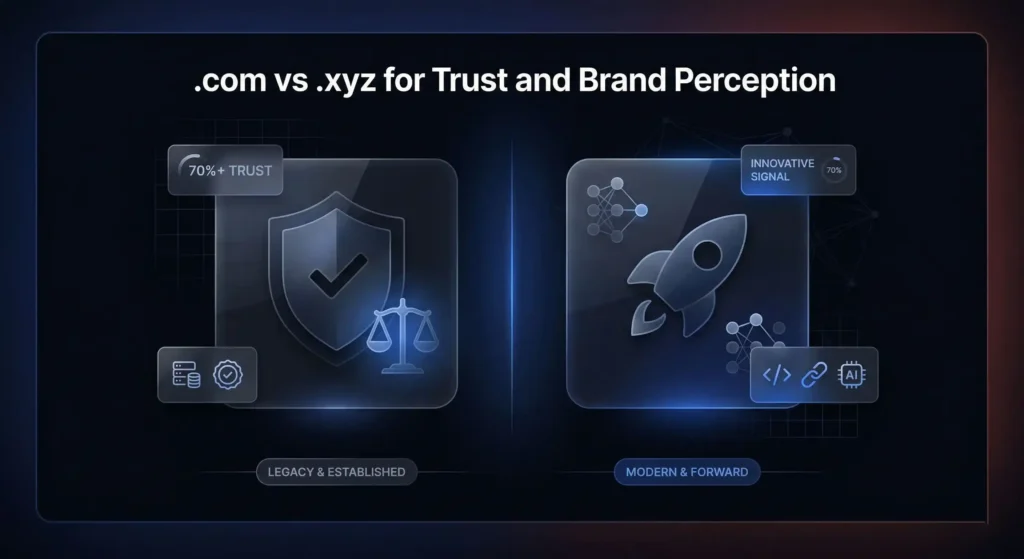
This is where the two extensions diverge most clearly.
Customer trust
Decades of conditioning have trained users to associate .com with legitimacy. A UK survey cited in research from the Register. Domains found that over 70% of internet users trust companies using .com more than those using newer or less familiar extensions. That is not a small gap. When users encounter an unfamiliar extension, they are more likely to pause before clicking, sharing or buying.
A 2024 GoDaddy survey found that 68% of consumers prefer .com for businesses they trust while 22% view .xyz as innovative. The remaining 10% shows that a meaningful portion of users are simply uncertain about newer extensions.
Investor and regulatory optics
In regulated industries, the default expectation is .com. A fintech startup pitching investors with a .xyz domain is not disqualified. But it does introduce a question that a .com would not. Compliance teams and procurement departments in enterprise companies are often conditioned to view .com as the standard. Deviating from that standard adds a small but real friction that accumulates over time.
Modern brand positioning
For brands targeting developers, crypto users, AI builders or digital-native audiences the calculus shifts. Alphabet using abc.xyz is not a coincidence. It signals that the company is not bound by convention. Brands like Starship.xyz and Art.xyz use the extension to communicate forward-thinking identity without explanation. In these communities, .xyz often reads as intentional rather than cheap.
The honest summary: .com provides trust by default. .xyz builds trust only once you have earned it with everything else around the domain.
How Each TLD Affects SEO Performance
The direct algorithmic answer is straightforward. Google’s John Mueller has confirmed that domain extensions do not directly affect search rankings. A .xyz domain can rank just as well as a .com domain with the same content and backlink profile. Google treats all generic TLDs equally.
That said, there are two indirect ways your choice of extension can affect SEO outcomes.
Click-through rate differences
When two results appear side by side in search, users are measurably more likely to click the .com link. A lower click-through rate signals to Google that your result is less relevant. That compounds over time. This is not an insurmountable disadvantage but it is a real one in competitive niches.
Backlink acquisition friction
Building links to a .xyz domain can face slightly more friction with some editors and publications. Most professional writers will not care about your TLD but any hesitation in the link-building process slows your authority growth.
The practical verdict: TLD choice accounts for a tiny fraction of your SEO outcome. Content quality, backlink authority, page speed and user experience drive the vast majority of your ranking performance. A well-executed .xyz site will beat a neglected .com in search every time.
One important caution: some .xyz domains have historically been associated with spam due to low registration costs attracting bad actors. In a 2024 SEO case study published on silicon.nyc, a site using a .xyz domain saw over 1,100 pages remain unindexed despite technical optimization efforts. While this is not universal, it highlights that domain history and TLD reputation can create indexing friction worth auditing.
Email Deliverability and Security Considerations
This is the section most domain guides get wrong by being too optimistic. The reality is nuanced and important.
The TLD reputation problem
Mail servers perform an initial assessment of a sender’s TLD before evaluating the specific domain’s history. According to deliverability specialists at Suped, extensions like .xyz may appear on internal blocklists at some mail providers due to their historical association with higher levels of spam.
Because the extension was very cheap to register for several years, spammers used and burned through .xyz domains at scale. That history created a shared reputation problem that legitimate senders may inherit. Industry reports from Spamhaus and Mailchimp’s deliverability documentation note that newer or heavily abused TLDs can face elevated filtering thresholds at major ISPs, though the degree varies by provider and sending reputation.
One well-documented case involved Spot Virtual, a company that used spot.xyz as its primary domain. Beyond email issues, the company found that including a .xyz link in a text message caused silent delivery failures on multiple carrier networks. After switching to spotvirtual.com, their email open rates rose from 70% to 86% and meeting conversions increased significantly.
Authentication is necessary but not sufficient
Proper SPF, DKIM and DMARC setup will help any domain including .xyz. Spamhaus itself has confirmed that spam filters are primarily triggered by domain reputation, not the extension alone. But the important nuance is that a .xyz domain may start its life under heightened scrutiny from certain ISPs and filtering services.
New domains are typically watched for spammy behavior for approximately the first 30 days after registration. Sending bulk email immediately after registering a .xyz domain is a fast path to blacklisting.
Practical guidance for .xyz email senders
If you are committed to a .xyz primary domain, follow these steps without exception:
- Set up SPF records including only the services you send from
- Use 2048-bit DKIM keys for every sending service and rotate them twice per year
- Implement DMARC starting at p=quarantine with a 20% policy, then move to p=reject once your authentication is aligned
- Warm up gradually. Start with small volumes sent to engaged recipients. Keep complaint rates below 0.1%
- Use a subdomain, such as mail.brand.xyz, for campaigns. Keep transactional mail on your primary domain
- Monitor reputation in Google Postmaster Tools from day one
.com security threats differ
.com domains face a different threat profile. Premium .com names are prime targets for cybersquatting and phishing because their credibility makes imitation valuable. A financial services company using Payments.com should monitor for lookalike domains and strictly enforce DMARC to prevent email fraud involving spoofed versions of the domain.
The honest summary: for email-dependent businesses, .com is the lower-risk choice at launch. A .xyz domain can be made to work but it requires more setup effort and may carry real deliverability risk if shortcuts are taken.
Cost, Availability, and Acquisition Difficulty
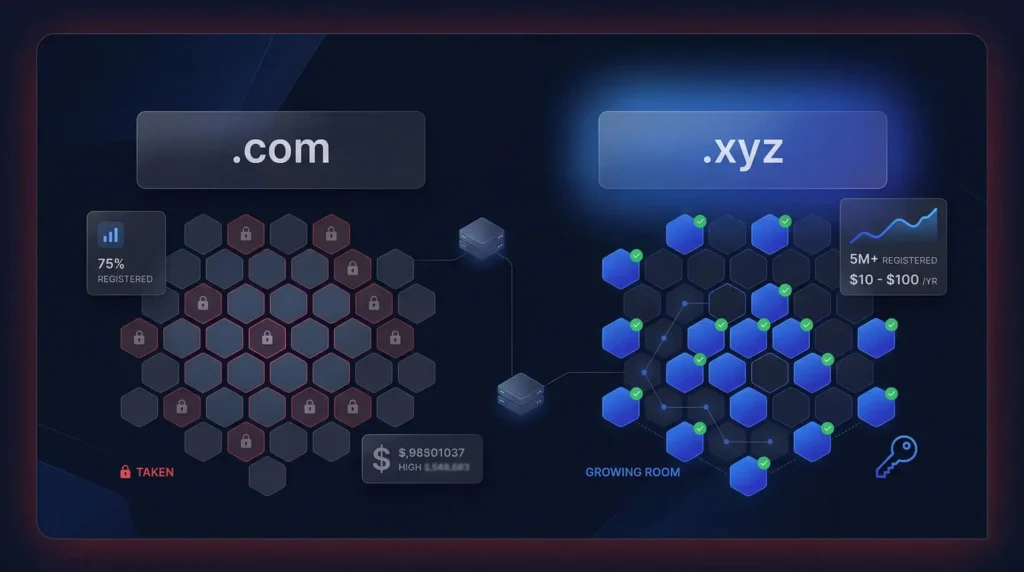
This section is where .xyz has a clear structural advantage.
The .com scarcity problem
According to research, roughly 75% of three-letter names and the most common English words in .com are already registered. Acquiring a short premium .com requires either buying it on the secondary market or hiring a broker to acquire a domain that is already taken.
Average .com sale prices on the secondary market ran around $27,000 according to a 2023 NameBio report. Top-tier single-keyword domains sell for millions. The domain eth.com sold for $2 million through brokerage services.
The .xyz cost advantage
Standard .xyz registrations cost between $10 and $100 per year. Premium .xyz names exist but the market is far less saturated. The average .xyz resale price was around $1,200, according to the same 2023 NameBio data. For a bootstrapped startup or side project, this cost difference is significant.
By June 2025, the .xyz registry had surpassed 5 million registrations, marking more than 1 million new registrations in a single year. Availability remains high for creative and branded names that would cost tens of thousands in .com.
When a premium .com is worth the price
The case for paying a premium for .com strengthens when your business depends on direct type-in traffic, when you are in a regulated industry, when you are targeting an audience that skews older or less technically sophisticated, or when investors and enterprise customers are evaluating your brand at first impression. In those scenarios, the .com is not a vanity purchase. It is infrastructure.
Which TLD Fits Your Industry Best?
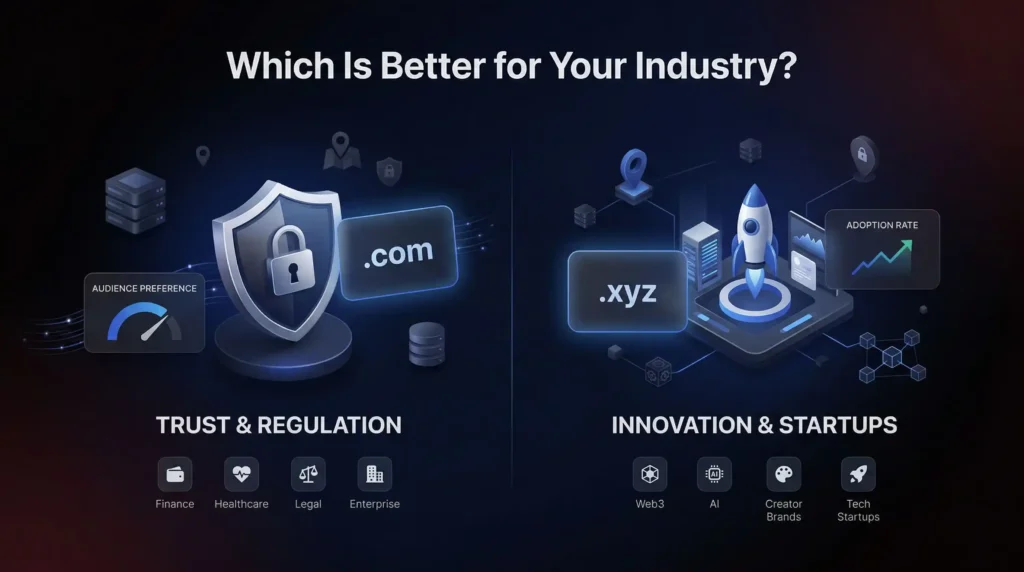
Choosing between .com and .xyz depends heavily on your industry, your audience and how much trust you need to establish before a visitor takes action.
Finance, Healthcare, Legal and Enterprise
These industries are built on trust. Customers transfer money, share personal health data and sign binding agreements. They need to believe before they act. A .com domain does not guarantee trust, but it removes a potential friction point that a .xyz domain introduces.
Regulators in these spaces also operate with conservative mental models. A healthcare startup using a .xyz domain is not automatically at a disadvantage with regulators but there is no upside either. The safer play is .com.
Startups, AI, Web3, and Creator Brands
This is the natural home of .xyz. Audiences in these communities are domain-literate. They understand that .xyz is a deliberate choice, not a fallback. Alphabet’s use of abc.xyz helped normalize the extension in tech circles and that normalization has continued. Blockchain projects, developer tools and AI product studios have all built credible brands on .xyz.
The key: the product and brand experience need to be excellent. A .xyz domain gives you no grace period for a mediocre website. The bar for immediate professional credibility is higher because you cannot lean on the extension itself.
eCommerce and SaaS
Here, the answer depends on your target customer. A SaaS product selling to enterprise procurement teams or regulated industries needs a .com domain. The people making purchasing decisions in those organizations are risk-averse. A .com domain signals lower risk.
A direct-to-consumer SaaS or a niche eCommerce store targeting a younger, tech-forward audience has more flexibility. If the .com equivalent is prohibitively expensive and the brand is strong enough to carry a .xyz, the decision becomes more commercial than strategic. Many successful SaaS products have launched on .io and .xyz and later migrated to .com as revenue allowed. That is a reasonable sequence.
Should You Register Both Extensions?
If the brand name matters, there is a strong case for holding both.
Brand protection
Owning both extensions prevents competitors or bad actors from registering the companion domain. For any brand with real equity, this is inexpensive insurance given that .xyz registrations cost less than $100 per year.
Redirect strategy
If you operate primarily on .com, you can redirect .xyz to consolidate SEO authority and traffic. Users who type your domain with the wrong extension land in the right place. This has no SEO penalty when done with a proper 301 redirect.
Campaign and sub-brand flexibility
Using .xyz for specific campaigns, developer communities or experimental products while maintaining .com for your core brand creates clean separation. A SaaS company could run Software.com for enterprise customers and Dev.xyz for its open-source community without confusing either audience.
Future optionality
If your company expands into Web3, blockchain or innovation-forward verticals, having the .xyz already registered protects that future path. The cost of doing this now is minimal compared to acquiring it from a speculative holder later.
Domain Selection Checklist for Your Brand
Use this checklist to make a clear decision:
- Who is your primary audience? If they are older than 40, work in regulated industries or are unfamiliar with newer domain extensions, choose .com. If they are developers, crypto users, designers or digital natives, .xyz is viable.
- Do you need instant trust without any brand-building? If yes, choose .com. First-visit trust matters most in financial services, healthcare and B2B enterprise sales.
- Are you targeting conservative industries? Finance, law, insurance, government-adjacent. Choose .com. No exception is worth the compliance friction.
- Is the budget a real constraint? If the .com you want is unavailable or costs more than your monthly operating budget, a strong .xyz is better than a compromised .com that does not match your brand.
- Is the .com worth acquiring through a broker? For high-value brands the premium .com often pays for itself in reduced friction over time. If you are raising funding, selling to enterprises or building a brand with long-term equity, the investment is usually justified.
- Do you want optionality? Buy both. The .xyz costs almost nothing to hold and gives you protection and flexibility.
When a Domain Broker Adds Real Value
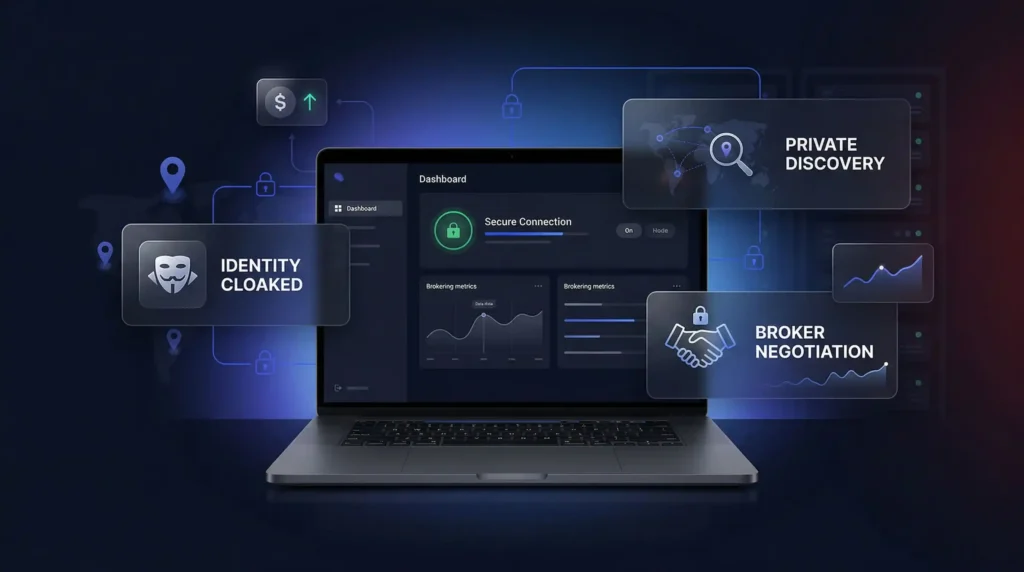
Premium .com domains are rarely available for hand-registration. When the domain you want is owned by someone else, a broker adds real value.
Stealth acquisition
If you approach a domain owner directly as an identified buyer, the price increases. Brokers negotiate without revealing who the buyer is. This keeps the transaction from becoming inflated by perceived demand.
A fintech company pursuing a high-value payments-related .com without a broker is almost certainly overpaying. A broker keeps your identity hidden and prevents sellers from inflating the price based on who is asking.
Off-market discovery
Not every domain that could be acquired is listed for sale. Brokers have networks and relationships that surface domains before they hit public marketplaces. This is particularly useful for exact-match .com names in competitive verticals.
Valuation and negotiation
Knowing what a domain is worth prevents overpaying. Brokers familiar with your industry can assess comparable sales and negotiate from a position of market knowledge rather than guesswork.
The right time to use a broker is when the .com you want matters enough to your brand that you would pay a significant premium. If you are in the naming stage of a new venture and have flexibility in brand name, the open market and standard registrars are sufficient.
Final Verdict
If trust and authority are your priority, choose .com. The familiarity, the credibility with conservative audiences and the lower friction across email, search and enterprise sales are all real and measurable advantages.
If flexibility and modern branding are more important and your audience understands the extension, .xyz can work well. It is affordable, widely available and increasingly recognized in tech and Web3 spaces.
If the brand matters and budget allows, secure both. Use .com as your foundation and .xyz as a strategic asset for protection, campaigns or future product lines. That combination costs very little and gives you the most room to grow.
References
- IANA. n.d. .com Domain Delegation Data. Retrieved September 30, 2026 from https://www.iana.org/domains/root/db/com.html.Archived: Wayback Machine snapshot
- IANA. n.d. .xyz Domain Delegation Data. Retrieved September 30, 2026 from https://www.iana.org/domains/root/db/xyz.html.Archived: Wayback Machine snapshot
- ICANN. n.d. About the Program. Retrieved September 30, 2026 from https://newgtlds.icann.org/en/about/program.Archived: Wayback Machine snapshot
- A. Ramaswamy. 2021. WTF is .xyz? TechCrunch (December 28, 2021). Retrieved September 30, 2026 from https://techcrunch.com/2021/12/28/wtf-is-xyz/.Archived: Wayback Machine snapshot
Resources for this page
Charts and reference images from our research, free to view and share.
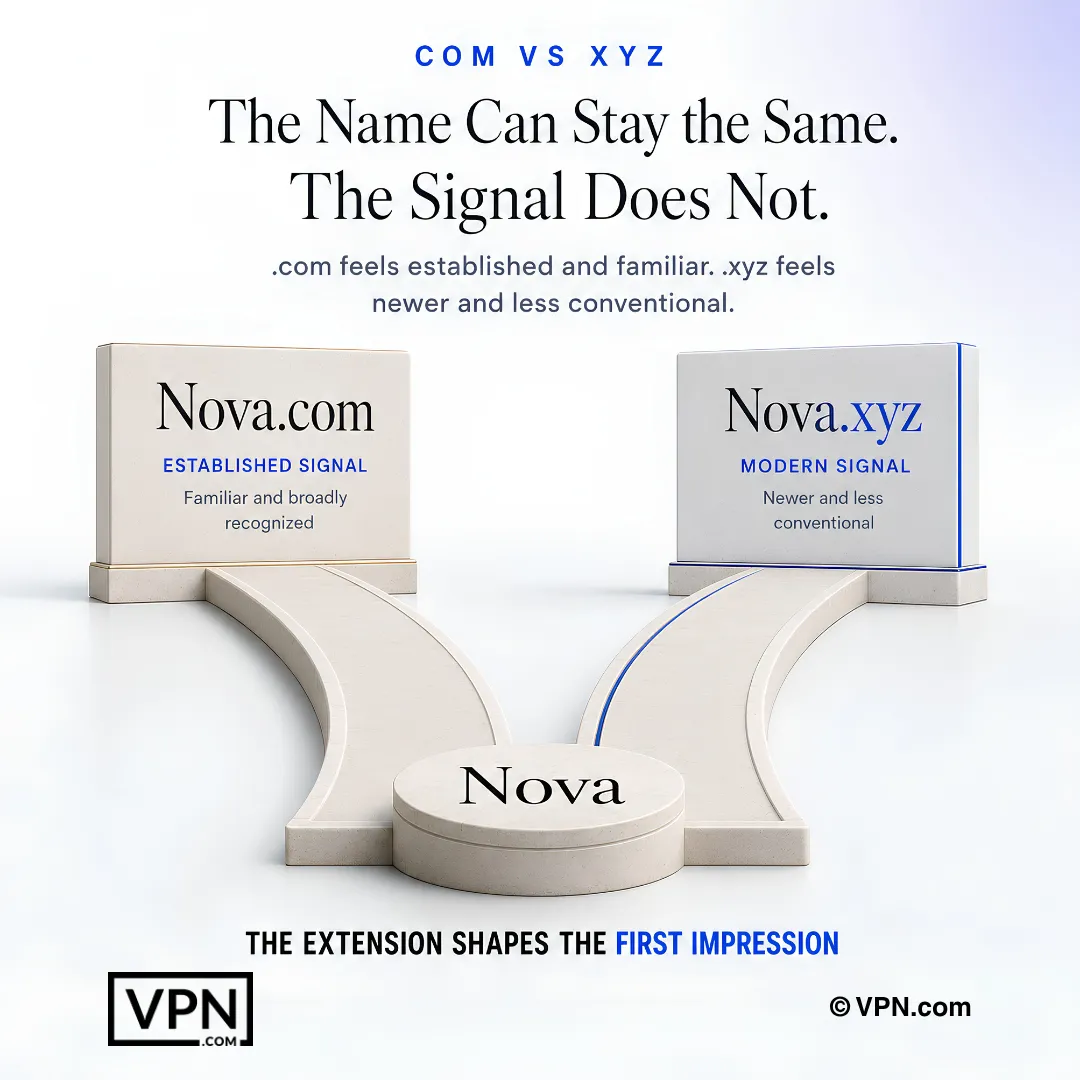
The brand name may remain unchanged, but the extension influences the first signal customers receive.
Explore domain brokerage
Buy Premium Domain: Expert Broker Service
Buy premium domain names through our broker service. We've advised on over $100M in portfolio and transactions with zero fees until closing. Start your confidential purchase today.
Confidential Domain Acquisition: Buy Domains Anonymously
Acquire premium domains without revealing your identity. VPN.com's confidential brokerage protects your leverage and keeps negotiations private.
Domain Valuation: How Much Is Your Domain Worth?
Get an accurate domain valuation from VPN.com. We assess comparable sales, traffic, brand potential, and market demand to price your domain correctly.
Sell Premium Domain Names for Maximum Value
Sell your premium domain with expert broker representation. We've advised on over $100M in portfolio and transactions and negotiate top prices with zero upfront fees.
Domain Name and URL: What's the Difference?
Learn the key differences between domain name and URL. Understand how each works and why getting them right matters for your website's SEO and security.
Artificial Intelligence Domains: Buy AI Domains & Names
Explore artificial intelligence domains and AI-focused names. Learn pricing drivers, SEO and branding value, and how a broker helps you buy safely.
Frequently Asked Questions
Does choosing .xyz instead of .com actually hurt my search rankings?
Not directly. Google’s John Mueller has confirmed domain extensions don’t factor into rankings, so a .xyz site with the same content and backlinks as a .com competitor can rank identically. The indirect risks are lower click-through rates in search results and, per a 2024 case study on silicon.nyc, one .xyz site left over 1,100 pages unindexed due to TLD reputation friction.
Why does .com still carry more consumer trust than .xyz?
Four decades of conditioning built that trust. A UK survey cited by Register Domains found over 70% of internet users trust .com businesses more than newer extensions, and a 2024 GoDaddy survey found 68% of consumers prefer .com for companies they trust, versus 22% who view .xyz as innovative and 10% who remain uncertain.
What specifically causes .xyz domains to run into email deliverability trouble?
Mail servers evaluate TLD reputation before assessing an individual domain’s history. Deliverability specialists at Suped note .xyz can appear on internal blocklists at some providers because its low registration cost historically attracted spammers at scale. Spamhaus and Mailchimp confirm heavily abused TLDs face elevated filtering, though proper SPF, DKIM and DMARC setup mitigates most of this risk.
What happened when Spot Virtual switched from spot.xyz to spotvirtual.com?
Their email open rates rose from 70% to 86% after the switch, and meeting conversions increased significantly. Before migrating, the company also found that sharing a spot.xyz link in text messages caused silent delivery failures across multiple carrier networks, an issue that disappeared once they moved to the .com domain.
How long should I wait before sending bulk email from a new .xyz domain?
New domains are typically monitored for spammy behavior for roughly the first 30 days after registration, so sending bulk email immediately is a fast path to blacklisting. Warm up gradually with small volumes to engaged recipients, keep complaint rates below 0.1%, and start DMARC at p=quarantine with a 20% policy before moving to p=reject once authentication is stable.
Is it common for companies to start on .xyz and migrate to .com later?
Yes. Many SaaS products have launched on .xyz or .io and migrated to .com once revenue allowed, treating the switch as a reasonable growth-stage sequence rather than a failure of the original choice. If you plan this path, register the matching .com early and hold it, since acquiring it later from a third party costs far more.
How does .xyz’s cost compare to .com on the secondary market?
.xyz is dramatically cheaper to acquire. Standard .xyz registrations run at a low annual cost with high availability, backed by over 5 million total registrations and more than 1 million added in a single year through June 2025. By contrast, 2023 NameBio data shows .com resale prices on the secondary market run far higher than .xyz’s average, since roughly 75% of three-letter .com names are already taken.
Is it worth registering both .com and .xyz for the same brand?
Yes, if the brand name has long-term value. Holding both costs very little since .xyz registration is inexpensive, and it protects against competitors or bad actors grabbing the companion domain. A common setup is running .com as the primary site while pointing .xyz to it with a 301 redirect, which consolidates SEO authority with no penalty.
What can a premium .com domain like eth.com actually sell for?
Premium single-keyword .com names can sell for millions of dollars, as eth.com did through a brokered sale. That reflects the broader scarcity problem: roughly 75% of three-letter names and common English words in .com are already registered, pushing buyers who want a strong short domain into the secondary market or a broker-negotiated acquisition instead of standard registration.
How does using a broker prevent me from overpaying for a domain?
Brokers negotiate without revealing who the actual buyer is, which keeps sellers from inflating the asking price once they sense corporate or well-funded demand. A fintech company approaching a premium payments-related .com owner directly, without a broker, is almost certainly going to pay more than if the inquiry had come through an anonymous intermediary.
When does hiring a domain broker actually make sense over standard registration?
Use a broker once the .com you want is already owned by someone else and matters enough to your brand to justify a real premium. Brokers offer off-market discovery of domains never publicly listed, plus comparable-sales valuation expertise that prevents overpaying. If you’re still in the naming stage with brand-name flexibility, standard registrars are sufficient.
Which industries should default to .com instead of .xyz?
Finance, healthcare, legal services and enterprise SaaS should default to .com. These sectors depend on customers transferring money, sharing health data or signing binding agreements, and regulators and procurement teams in these spaces are conditioned to expect .com as standard. A .xyz domain isn’t disqualifying here, but it adds friction with no offsetting upside.
Can a .xyz domain still work for a startup or Web3 brand despite its spam reputation?
Yes, if the brand and execution are strong. Alphabet’s use of abc.xyz helped normalize the extension among developers, crypto users and AI builders, where .xyz often reads as an intentional signal rather than a shortcut. The tradeoff is that .xyz gives no grace period. Because the brand can’t lean on the extension for credibility, the product and site quality carry the entire trust burden.