Every great brand started
with the right name.
VPN.com wasn't for sale. We bought it anyway, and saved $775K.
Anonymous from the first call. No fee until we close.
Thank you. Your request has been received.
Our brokerage team is reviewing your submission for . You'll receive a personal follow-up from a senior broker within one business day.
Something went wrong
We couldn't process your request at this time. Please try again or contact us directly.
Frequently Asked Questions
A premium domain can shape how a business is perceived before anyone reads a single word on the website.
The right name builds trust faster, looks more authoritative and creates a stronger position in the market. The challenge is that most high-value domains are already owned, rarely priced rationally and difficult to acquire without experience.
This is where a domain broker becomes essential.
VPN.com helps businesses, founders and investors secure premium domains through confidential outreach, structured negotiation and a process designed to reduce risk while improving deal outcomes.

What is a Domain Broker?
A domain broker is a specialist who facilitates the purchase or sale of domain names that are not openly available for sale. When a desirable name is already registered, there is no “Buy Now” button.
A broker becomes the professional intermediary who locates the owner, initiates confidential contact, negotiates a fair price and manages the entire transaction through secure escrow. Not sure if you need one? Here’s how to decide if a domain broker is right for you.
We protect buyer anonymity so sellers cannot research your company and inflate the asking price. For sellers, we screen out lowball investors and connect you only with serious end-user buyers who can pay true market value. Every step is designed to minimize risk, maintain confidentiality and maximize outcome.
Why Hire a Premium Domain Broker?
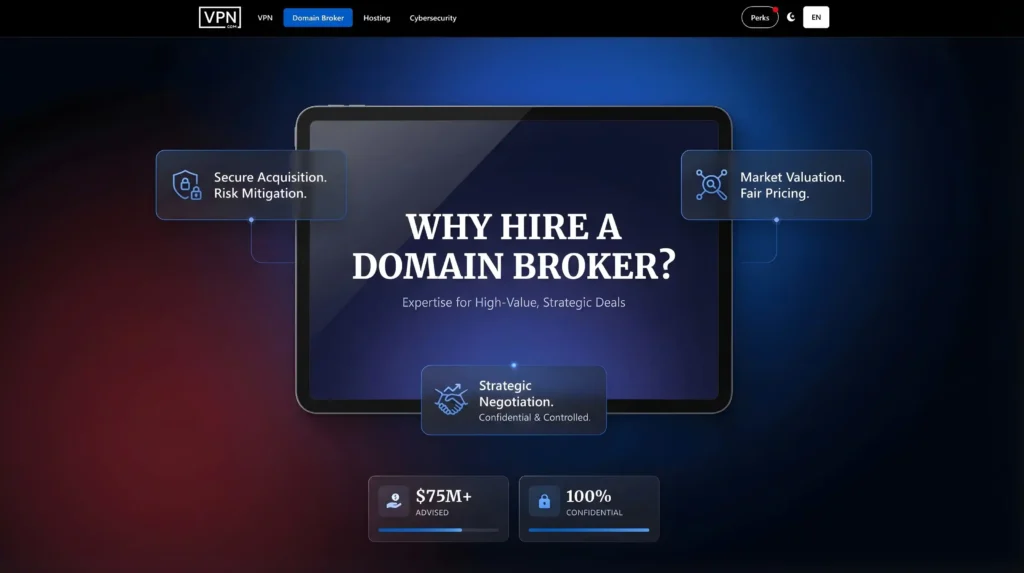
Most companies buy or sell a high-value domain only once or twice in their lifetime. Professional domain investors and portfolio holders, by contrast, transact dozens of times per year. This experience gap frequently costs buyers hundreds of thousands of dollars or even millions.
Businesses hire a premium domain broker when:
- The ideal domain is already registered and the owner cannot be reached through normal channels
- Sellers may research the buyer’s brand, funding round or industry and dramatically increase the price
- The buyer lacks current market comps and does not know what the name is truly worth in today’s economy
- A single misstep in negotiation or contract language can add six or seven figures to the final cost
- Escrow, transfer and legal language carry risks that only experienced professionals can fully mitigate
A skilled broker converts a high-stakes, one-time transaction into a controlled, strategic process that protects your brand equity and delivers measurable ROI.
Buy-Side vs Sell-Side Domain Brokerage
VPN.com provides expert representation on both sides of the transaction.
Buy-Side Services
We help you acquire premium domains that are already taken, hidden behind privacy protection or strategically held. We manage the narrative, shield your identity and negotiate terms that align with your brand and budget rather than the seller’s assumptions.
Sell-Side Services
We help you monetize unused premium domains that are accumulating renewal fees or receiving only lowball offers. Our network reaches serious end-user buyers who value the name for its branding potential, not just speculative resale. We position the asset, run a controlled process and maximize your exit value.
Our Core Domain Brokerage Services
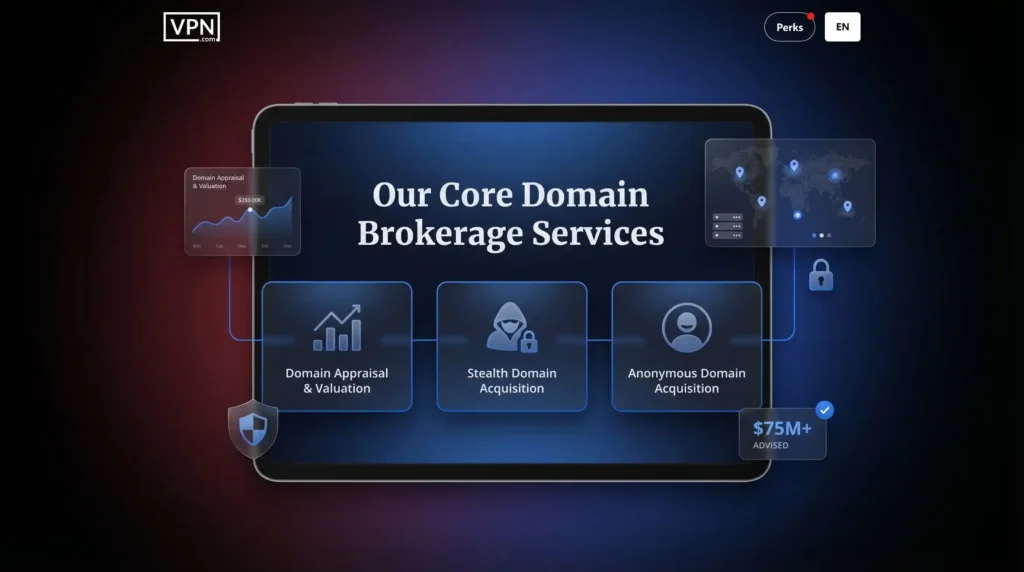
Most domain problems don’t stop at buying or selling. In many cases, the real challenge is determining a domain’s value, changing your domain name without losing brand equity or buying it without putting yourself in the spotlight.
At VPN.com, we provide specific solutions to all these issues.
Domain Appraisal & Valuation
We deliver independent, data-backed valuations grounded in actual sales comps, keyword metrics, brand strength, industry demand and current market conditions. This gives you pricing confidence before negotiations begin and prevents both overpaying and underselling valuable digital assets.
Stealth Domain Acquisition
Our most discreet service. Your identity, company name and intentions remain completely hidden throughout outreach and negotiation. This prevents price inflation and increases success rates on tightly held or strategically important domains.
Anonymous Domain Acquisition
We structure the purchase so your ownership details are shielded in public WHOIS records after closing. This reduces the risks of spam, solicitation and brand impersonation while maintaining full regulatory compliance.
Secure Escrow & Transfer Management
Every transaction is routed through vetted escrow services. We handle all paperwork, verify transfer codes and ensure a clean title to protect both parties.
The Domain Brokerage Process
Our process is designed for transparency and speed. It typically follows six stages: initial consultation and goal-setting, comprehensive valuation and strategy development, discreet owner outreach, structured negotiation with clear leverage points, contract and escrow coordination and final transfer with post-sale support.
Most acquisitions close within 30–90 days, although complex or high-value deals may take longer. Throughout, you receive regular updates while we maintain complete confidentiality.
Why Choose VPN.com as Your Premium Domain Broker?
VPN.com is not a passive marketplace, registrar upsell or DIY tool. We are a specialized premium brokerage focused exclusively on category-defining names valued at $100,000 and above.
- No upfront fees: We earn a modest 15% commission only when a deal successfully closes. Our incentives are perfectly aligned with yours.
- Proven expertise: Led by Michael Gargiulo (1,000+ domains transacted) and VP Sharjil Saleem, our team understands precise-match domains, negotiation psychology, market timing and cybersecurity implications.
- Cybersecurity advantage: We help clients choose domains that shrink their attack surface by preventing typosquatting and phishing vectors that exploit weak or similar-sounding names.
- 97% success rate: Across buy- and sell-side transactions for major brands in tech, finance, gaming and international markets.
Domain Broker vs Marketplace vs DIY Outreach
When a domain can shape your entire brand, how you pursue it matters.
| Factor | VPN.com Brokerage | Public Marketplaces | DIY Outreach |
| Anonymity | ✓ | ✕ | ✕ |
| Professional Valuation | ✓ | ✕ | ✕ |
| Active Reach & Outreach | ✓ | ✕ | ✕ |
| Negotiation Power | ✓ | ✕ | ✕ |
| Transaction Safety | ✓ | ✓ | ✕ |
| Time & Resource Efficiency | ✓ | ✕ | ✕ |
| Overall Success Rate | ✓ | ✕ | ✕ |
Our Results and Domain Success Stories
In the case of premium domains that you entrust to a broker, you would want to see evidence of their ability to deliver. This is what VPN.com has accomplished with customers in the gaming, financial, tech and international brands.
Stats at a glance:
- $75M+ in domain transactions
- 97% success rate in securing or selling premium names
- 1000+ domains bought and sold by our leadership team
- Deals ranging from $100K to multi-million dollars
| Case Study | Challenge | Result |
| Meet.com (Huuuge Inc.) | Needed a category-defining domain for a gaming community that the owner wasn’t selling and previous attempts had failed. | Acquired Meet.com, significantly boosting Huuuge’s digital presence in online gaming. |
| Asset.com | Financial client needed a global brand asset from an owner with no interest in selling. | Closed a multi-million-dollar deal, securing one of the most powerful domains in finance. |
| DXB.com | Buyer required a premium three-letter .com tied to Dubai rare, expensive and notoriously difficult to acquire. | Completed acquisition of DXB.com, securing an elite global brand asset. |
Ready to Secure the Right Domain?
If the domain you want is already taken or you are looking to sell a premium asset at its true value, VPN.com is ready to help. We handle every detail, discreet outreach, expert negotiation, secure transfer and post-sale support with complete transparency and professionalism.
Tell us your goal (acquire or sell) and we will provide an honest assessment and clear next steps with no pressure and no hidden terms.