Astrill has two tiers: Personal ($12.50/mo for 2-year) and VIP ($20/mo for 2-year). VIP adds unlimited devices and router support. All plans backed by 7-day money-back guarantee.
All plans and add-ons
Compare all plans
Pick a billing period and compare every tier side by side.
Show prices for
1 MonthStandard plan★ Recommended
Best for Short-term testing, flexibility, or travel without commitment
A plain-language breakdown of everything in the plans above: what each feature is, who it helps, and whether it is worth paying for.
Server networkIncluded in 1 Month, 1 Year and 2 Years
What it isA global network of servers you can route your connection through.
What it does for youConnect to a nearby server for the fastest speeds, or one abroad to watch content and reach sites as if you were in that country.
Simultaneous devicesIncluded in 1 Month, 1 Year and 2 Years
What it isHow many devices you can protect on one account at the same time.
What it does for youCover your phone, laptop, tablet, and more without logging out of one to use another.
Obfuscation (stealth mode)Included in 1 Month, 1 Year and 2 Years
What it isA mode that disguises your VPN traffic so it looks like ordinary internet traffic.
What it does for youHelps you stay connected on networks that actively detect and block VPNs, such as some workplaces, schools, and heavily censored countries.
No-logs policyIncluded in 1 Month, 1 Year and 2 Years
What it isA policy, ideally independently audited, of not recording what you do online.
What it does for youMeans there is no browsing history on the VPN’s side to hand over, leak, or sell.
Dedicated IPIncluded in 2 Years
What it isA private IP address that is yours alone.
What it does for youFewer security checks and captchas, and easier access to systems that allow-list known addresses.
The valueUsually a paid add-on. Worth it if you log into work tools or run a server.
All plans include:
5 Simultaneous Connections300+ servers in 56 countriesStealth VPN for ChinaRouter app included24/7 live chat support
Compared
Astrill VPN compared with other VPNs
Swap any column to see how Astrill VPN stacks up against another provider.
Side-by-side comparison of Astrill VPN with other VPN providers
Astrill VPN is a censorship-bypass specialist built for China and other restrictive regions. Its proprietary Stealth protocol disguises VPN traffic as ordinary HTTPS, surviving deep packet inspection that kills most competitors. At $30 per month, it charges 3 to 5 times more than mainstream providers for a narrowly focused product.
Founded in 2009, Astrill optimized hard for one customer profile. The company developed two proprietary protocols, Stealth and OpenWeb, specifically to penetrate state-level firewalls. When China tightens its Great Firewall before sensitive political dates, Astrill historically maintains connectivity while mainstream VPNs go dark.
That singular focus comes with trade-offs everywhere else. A 68/100 Trust Score puts it at #17 of 22 providers we review. The server network, privacy practices, speed performance, and pricing all lag behind competitors that cost a fraction of the price. Astrill solves one problem exceptionally well. It solves most other problems poorly.
Astrill VPN Speed and Performance
Astrill’s Stealth protocol prioritizes evading deep packet inspection over raw throughput, so expect added latency. That trade-off tells only part of the story, but it creates noticeable lag during video calls, gaming, and real-time collaboration.
That added latency makes Astrill a weak fit for tasks that depend on responsive connections. Video conferences and live streaming on Twitch will suffer.
Protocol choice matters significantly with Astrill. The Stealth protocol prioritizes obfuscation over raw throughput. It wraps traffic in layers of disguise that add overhead. OpenWeb performs faster for general browsing but offers less protection against deep packet inspection. WireGuard and OpenVPN are available as standard options, but they defeat the purpose of choosing Astrill in the first place. If you don’t need obfuscation, faster providers exist at lower prices.
For users inside China, context changes the calculus. A modest connection that actually works behind the Great Firewall beats a very fast connection that gets blocked entirely. Speed benchmarks measured from unrestricted networks miss this critical reality. The relevant comparison is not Astrill versus NordVPN in London. It is Astrill versus no internet access at all.
Astrill VPN Security and Privacy
Astrill’s jurisdiction changed in 2026. Its terms of service named Seychelles law from at least January 2020 through at least March 2026, and many reviews still call Astrill Seychelles-based. The September 2026 terms say Astrill is a brand of Veloxee Corp., a company based in Vaduz, Liechtenstein, governed by Liechtenstein law, and we found no announcement of the change. That link between brand and company rests on Astrill’s own statement. We have not assessed how Liechtenstein law applies to user data requests, so jurisdiction is not a proven privacy advantage, and the company’s own logging behavior matters more than where it is registered.
Session Logging Remains the Primary Concern
Astrill’s privacy notice says the company keeps session data while a VPN session is active, including your IP address, connection time, device type, and application version. It also says it keeps the last 20 connection records per account, covering time, duration, country, device type, and app version. The September 2026 notice says those records contain the registered e-mail address, which the February 2026 version did not. That is retained information that can link your account to your VPN usage.
Compare this to Mullvad, which retains nothing and survived a police raid with nothing to produce. NordVPN says its no-logs policy has been independently audited. We found no independent security audit of Astrill. No third party has verified what the company does or does not store.
Encryption and Protocol Details
Astrill supports AES-256 encryption across its protocols. The Stealth protocol layers obfuscation on top of OpenVPN, making traffic appear as standard HTTPS. A kill switch exists on desktop clients and blocks internet traffic if the VPN connection drops. DNS leak protection is built into the apps.
These are competent security features. They meet industry standards without exceeding them. The absence of an independent audit, combined with the session data Astrill says it keeps, means you are trusting Astrill’s word rather than verified evidence. For users in China who need a functioning VPN, that trade-off may be acceptable. For privacy-focused users with other options, it should not be.
Astrill VPN Streaming and Content Access
User reports indicate Astrill accesses Netflix, Disney+, Hulu, and BBC iPlayer, though results are inconsistent across server locations and we have not independently verified them. Treat streaming reliability as anecdotal rather than guaranteed.
The 300+ servers across 56 countries provide reasonable geographic coverage for streaming. However, competitors like ExpressVPN and NordVPN maintain 3,000 to 6,000+ servers and deliver more consistent results. Astrill lacks the dedicated streaming server infrastructure that larger providers have built.
SmartDNS is not available as a standalone feature. Users who want to access streaming on devices that don’t support VPN apps, like smart TVs or gaming consoles, have fewer options with Astrill. Router-level installation works but adds complexity.
The Stealth protocol’s added latency creates buffering issues on high-definition streams. 4K content requires sustained bandwidth and low latency, and Astrill is better at the former than the latter. Expect occasional buffering, especially on servers geographically distant from your location.
Astrill VPN Device Compatibility
Astrill offers native apps for Windows, macOS, iOS, Android, and Linux. Router support covers common firmware including DD-WRT, Tomato, and ASUS Merlin. The 5 simultaneous device limit sits below the industry average. NordVPN allows 10. Surfshark allows unlimited.
The desktop apps are functional but dated. The interface lacks the polish of competitors like ExpressVPN or CyberGhost. Navigation works. Settings are accessible. But the design reflects a product that prioritized protocol engineering over user experience.
Mobile apps receive mixed user feedback. The iOS app performs adequately. The Android app occasionally requires manual reconnection after network switches. Neither app matches the stability of top-tier competitors.
Browser extensions are not available. This limits flexibility for users who want to route only browser traffic through the VPN while keeping other applications on their direct connection. The router installation option partially compensates by covering all devices on a network, but it consumes 1 of 5 allowed connections.
Who Should Use Astrill VPN
Astrill serves one audience exceptionally well: people who live in, work in, or travel to China and need reliable internet access. Business travelers making regular trips to mainland China will find Astrill’s Stealth protocol more reliable than most alternatives. Expatriates in China who need consistent access to Western services represent the core customer base.
Users in Iran, Russia, Turkmenistan, and other countries with aggressive VPN blocking may also benefit. Astrill’s obfuscation technology was built specifically for these environments. If your government actively blocks VPN protocols, Astrill’s track record matters more than its raw speed.
Everyone else should look elsewhere. The $30 monthly price buys less capability than NordVPN at roughly $3 to $4 per month on a 2-year plan. The added latency makes it poor for gaming. The session logging makes it poor for serious privacy. The 300+ server count makes it limited for geographic flexibility.
If you want speed, choose a provider built around raw throughput. If you want privacy, choose a provider with verified no-logs policies. If you want streaming, choose a provider with dedicated streaming infrastructure. Astrill is the right tool for a specific job. It is the wrong tool for almost every other job.
Resources for this page
Charts and reference images from our research, free to view and share.
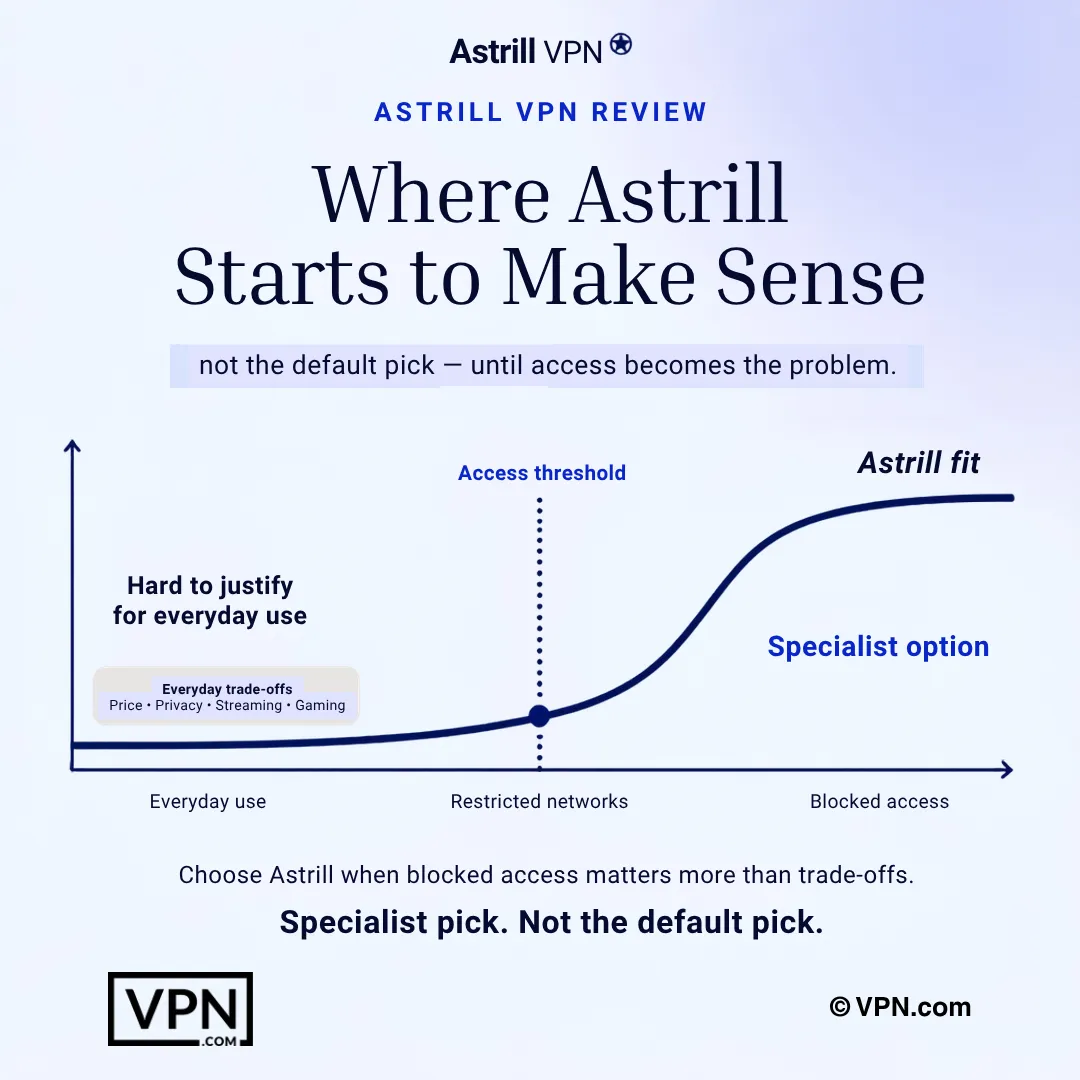
Astrill is a specialist VPN choice for access problems, not the default pick for everyday use.
How does Astrill VPN’s Stealth protocol bypass China’s Great Firewall?
Astrill’s proprietary Stealth protocol wraps OpenVPN traffic in layers that disguise it as ordinary HTTPS, letting it slip past the deep packet inspection China uses to detect VPN traffic. Astrill also offers OpenWeb, a faster proprietary protocol with less obfuscation. Founded in 2009, Astrill has historically maintained connectivity during Great Firewall crackdowns when mainstream VPNs go dark.
How fast is Astrill VPN?
Astrill scores 68/100 on our Trust Score, which draws on published third-party test data. We do not run our own speed tests. The Stealth protocol prioritizes evading deep packet inspection over raw throughput, so expect added latency and slower speeds than on providers built for performance.
Does Astrill VPN keep logs of my activity?
Yes, partially. Astrill’s privacy notice says it keeps session data, including your IP address, connection time, device type, and app version, while a session is active, and keeps the last 20 connection records per account. That policy has been revised in 2026, and no independent audit has ever verified what Astrill stores. Compare that to providers like NordVPN, which says its no-logs policy has been independently audited.
Is Astrill VPN legal, and where is the company based?
Yes, Astrill VPN is legal in most countries, including China, where using a VPN itself isn’t illegal even though the government restricts unlicensed providers. Astrill’s terms were governed by Seychelles law until 2026; the September 2026 terms say Astrill is a brand of Veloxee Corp. of Vaduz, Liechtenstein, governed by Liechtenstein law. Jurisdiction is not a proven privacy advantage, and no independent audit has verified how the company handles the session data it does collect.
How much does Astrill VPN cost?
Astrill’s cheapest rate is from $12.50/month on its longest 2-year plan, while its standard monthly rate runs $30/month, among the highest of any provider we’ve reviewed. That premium buys 300+ servers across 56 countries and 5 simultaneous device connections, roughly 3 to 5 times the cost of mainstream competitors for a network built around censorship bypass rather than broad server coverage.
Can I get a refund if Astrill VPN doesn’t work for me?
Astrill backs every plan with a 7-day money-back guarantee, shorter than the 30-day window many competitors offer. That narrow trial period matters if you’re testing whether the Stealth protocol actually holds up against your country’s specific censorship methods, since firewall behavior can shift and a week may not be enough to confirm reliable, long-term access.
How many devices can I connect with one Astrill VPN account?
Astrill’s standard plans cover 5 simultaneous device connections, below what providers like NordVPN (10) or Surfshark (unlimited) offer. Native apps exist for Windows, macOS, iOS, Android, and Linux, and router support covers DD-WRT, Tomato, and ASUS Merlin firmware, though installing on a router consumes one of your five allowed connections rather than counting separately.
Does Astrill VPN work with Netflix and other streaming services?
User reports indicate Astrill accesses Netflix, Disney+, Hulu, and BBC iPlayer, but results are inconsistent across server locations and we have not independently verified them. Astrill also lacks a standalone SmartDNS feature, so devices that can’t run VPN apps, like smart TVs or consoles, have fewer options here than with providers offering dedicated streaming infrastructure.
What security features does Astrill VPN actually include?
Astrill uses AES-256 encryption across its protocols, including Stealth, OpenWeb, WireGuard, and OpenVPN, plus a kill switch on desktop clients that blocks traffic if the connection drops, and built-in DNS leak protection. These are competent, industry-standard features, but Astrill has no independent security audit that we could find, so its no-logs and data-deletion claims remain unverified by any third party.
How should I set up Astrill VPN before traveling to China?
Download and install the Astrill app before entering mainland China, since both app stores and Astrill’s own site can become inaccessible once you’re behind the Great Firewall. Once installed, select the Stealth protocol rather than WireGuard or OpenVPN, since Stealth is purpose-built to disguise traffic as regular HTTPS and survive the deep packet inspection that blocks standard protocols.
What if Astrill VPN feels too slow for video calls or gaming?
Switch away from the Stealth protocol to OpenWeb, which trades some obfuscation for less overhead and faster performance. Astrill’s local servers are generally acceptable for casual play, though users report that titles like Call of Duty: Warzone and Rainbow Six Siege refuse to connect while Rocket League and Apex Legends work. A VIP server add-on offers lower latency for competitive play at extra cost.
What happens if Astrill gets blocked despite the Stealth protocol?
Try switching to the OpenWeb protocol as a backup, since it uses a different obfuscation profile than Stealth, or reconnect to Astrill’s China-specific Supercharged servers, built specifically for Great Firewall bypass. No VPN guarantees permanent access as censorship tactics evolve, but Astrill’s proprietary protocols have historically maintained connectivity during crackdowns when mainstream competitors have gone completely dark.
Evidence
Astrill says it is a brand of Veloxee Corp., a Liechtenstein limited company with registered seat in Vaduz, entered in the Liechtenstein commercial register on 9 December 2021. The register does not name Astrill, so the link between the brand and the company rests on the statement of Astrill.
We use cookies to understand how our site is used and, on some pages, to measure our ads. Accept to allow analytics cookies and personalized ads, or decline. If you decline, we only count visits without cookies. Privacy Policy