Is NordVPN Safe? Audits, Encryption & Privacy Review
Is NordVPN safe? Independent audit results, the 2018 server incident, Panama jurisdiction analysis, encryption protocols, and kill switch testing.
Most Secure VPNs



Is NordVPN Safe?
Yes. NordVPN uses AES-256 encryption, operates under Panama’s privacy-friendly jurisdiction, and has passed multiple independent audits including a full no-logs verification by Deloitte. A single server incident in 2018 exposed zero user data. NordVPN responded by migrating its entire infrastructure to RAM-only servers, strengthening its security posture significantly.
This page covers security in depth. For overall service performance and pricing, see our NordVPN review.
The 2018 Server Incident: What Actually Happened
In March 2018, an unauthorized party accessed a single NordVPN server in Finland. The attacker exploited a remote management tool left active by the data center provider. NordVPN did not install this tool. The data center did, without notifying NordVPN.
The attacker gained access to the server itself. They did not gain access to user credentials, browsing activity, or account information. The server held no activity logs because NordVPN’s no-logs policy meant none existed to steal.
NordVPN discovered the breach during an internal audit and disclosed it publicly in October 2019. The delay drew criticism. The company acknowledged the gap and used it as a catalyst for sweeping infrastructure changes.
How NordVPN Responded
NordVPN terminated its contract with the Finnish data center immediately. Then the company launched three major initiatives:
RAM-only server migration. NordVPN moved its entire network to diskless (RAM-only) servers. These servers cannot store data persistently. Every reboot wipes everything. Even physical seizure of a server yields nothing useful.
Bug bounty program. NordVPN partnered with HackerOne to let independent security researchers probe its systems continuously. Researchers earn rewards for discovering vulnerabilities before attackers do.
Independent audit program. NordVPN committed to regular third-party security audits. This created ongoing external accountability rather than one-time reassurance.
The 2018 incident affected one server out of thousands. No user data leaked. But NordVPN treated it as a reason to rebuild its infrastructure from the ground up. That response matters more than the incident itself.
NordVPN Audit Timeline
Trust claims without verification mean nothing. NordVPN has submitted to multiple independent audits by respected cybersecurity firms.
VerSprite Application Security Audit
VerSprite conducted a security assessment of NordVPN’s applications. The audit examined the VPN clients for vulnerabilities, code weaknesses, and potential attack vectors. VerSprite found issues typical of complex software. NordVPN patched them. The process established a baseline for ongoing application security testing.
Cure53 Infrastructure Assessment
Cure53[1], a Berlin-based security firm, performed an infrastructure-level audit. Their team examined NordVPN’s server configurations, network architecture, and backend systems. Cure53 identified areas for improvement and confirmed that the core infrastructure operated securely. NordVPN published the results publicly.
Deloitte No-Logs Verification (2022)
This audit carries the most weight for privacy-focused users. Deloitte, one of the Big Four accounting firms, conducted a full examination of NordVPN’s no-logs claims. Deloitte inspected server configurations, reviewed technical controls, and interviewed staff. NordVPN published the Deloitte audit findings[2] publicly.
The conclusion: NordVPN’s server infrastructure operates in line with its no-logs policy. The company does not store connection timestamps, session durations, IP addresses, browsing data, or bandwidth usage.
Ongoing Transparency
NordVPN publishes regular transparency reports[3] detailing government data requests. These reports consistently show the same outcome: NordVPN has no data to hand over. The reports also cover takedown requests, warrant canary status, and national security letters.
Panama Jurisdiction Protects User Privacy
NordVPN’s parent company, Tefincom S.A., operates under Panamanian law. This matters for three concrete reasons.
No mandatory data retention. Panama has no laws requiring VPN providers to store user activity or connection data. Many European and North American countries mandate retention periods of 6 to 24 months. Panama does not.
Outside intelligence-sharing alliances. Panama sits outside the Five Eyes, Nine Eyes, and Fourteen Eyes surveillance agreements. These alliances share intelligence data between member nations. A VPN based in the US, UK, Canada, or Australia faces potential compelled disclosure. NordVPN does not.
Practical effect on data requests. Foreign law enforcement agencies cannot compel a Panamanian company to produce records through their own legal systems. They must work through Panamanian courts. Even then, NordVPN maintains no logs to produce. The jurisdiction adds a structural barrier on top of the technical one.
AES-256 Encryption and Protocol Options
NordVPN encrypts all traffic with AES-256. This is the same encryption standard the US government uses for classified information. No known attack can brute-force AES-256 in any practical timeframe. Current estimates suggest it would take billions of years with existing computing power.
NordLynx Protocol
NordLynx is NordVPN’s default protocol. It builds on WireGuard, which delivers high speeds through a lean 4,000-line codebase. WireGuard alone has a privacy limitation: it requires storing static IP addresses on the server.
NordVPN solved this with a double NAT (Network Address Translation) system. The double NAT assigns a dynamic interface address to each session. When the session ends, the address disappears. This delivers WireGuard’s speed gains without its privacy tradeoff.
Performance benchmarks show NordLynx achieving speeds above 730 Mbps on gigabit connections. Latency stays low. The protocol handles streaming, gaming, and large downloads without bottlenecks.
OpenVPN
OpenVPN remains available for users who prefer a battle-tested protocol. It runs over both TCP and UDP. TCP provides reliability for restrictive networks. UDP delivers faster speeds for general use. OpenVPN’s open-source codebase has been audited extensively by the security community over two decades.
IKEv2/IPsec
IKEv2/IPsec works well on mobile devices. It reconnects quickly when switching between Wi-Fi and cellular networks. NordVPN pairs it with AES-256 encryption. This protocol suits users who move between networks frequently.
Kill Switch Prevents Data Leaks During Drops
VPN connections can drop. When they do, unprotected traffic can escape to your ISP. NordVPN’s kill switch prevents this.
The kill switch monitors your VPN connection continuously. If the tunnel drops, it blocks all internet traffic instantly. No data leaves your device until the VPN reconnects. NordVPN offers two kill switch modes:
App-level kill switch. This blocks internet access for specific applications when the VPN disconnects. Other apps continue working normally.
System-level kill switch. This blocks all internet traffic device-wide. Nothing gets through without the VPN. This is the more secure option for privacy-critical tasks.
DNS Leak Protection Keeps Queries Private
DNS requests translate domain names into IP addresses. Without protection, these requests can leak to your ISP even while connected to a VPN. NordVPN routes all DNS queries through its own encrypted DNS servers.
This prevents your ISP from seeing which websites you visit. It also blocks third-party DNS providers from logging your browsing patterns. Independent DNS leak tests consistently confirm NordVPN’s protection works as advertised.
Threat Protection Blocks Malware and Trackers
Threat Protection operates at the network level. It blocks known malicious domains before they load. It strips tracking parameters from URLs. It identifies and stops malware downloads.
Threat Protection works even when you are not connected to a VPN server. It functions as a standalone security layer on supported platforms. AV-TEST, an independent security institute, has certified Threat Protection’s malware-blocking capabilities.
The feature scans files during download. It checks URLs against constantly updated threat databases. It blocks intrusive ads that often serve as malware delivery vectors.
References
- Nordvpn. n.d. Cure53. https://nordvpn.com/blog/cure53-latest-security-assessment/.
- Nordvpn. n.d. Deloitte audit findings. https://nordvpn.com/blog/nordvpn-audit/.
- Nordvpn. n.d. transparency reports. https://nordvpn.com/blog/nordvpn-transparency-report/.
Resources for this page
Charts and reference images from our testing, free to view and share.
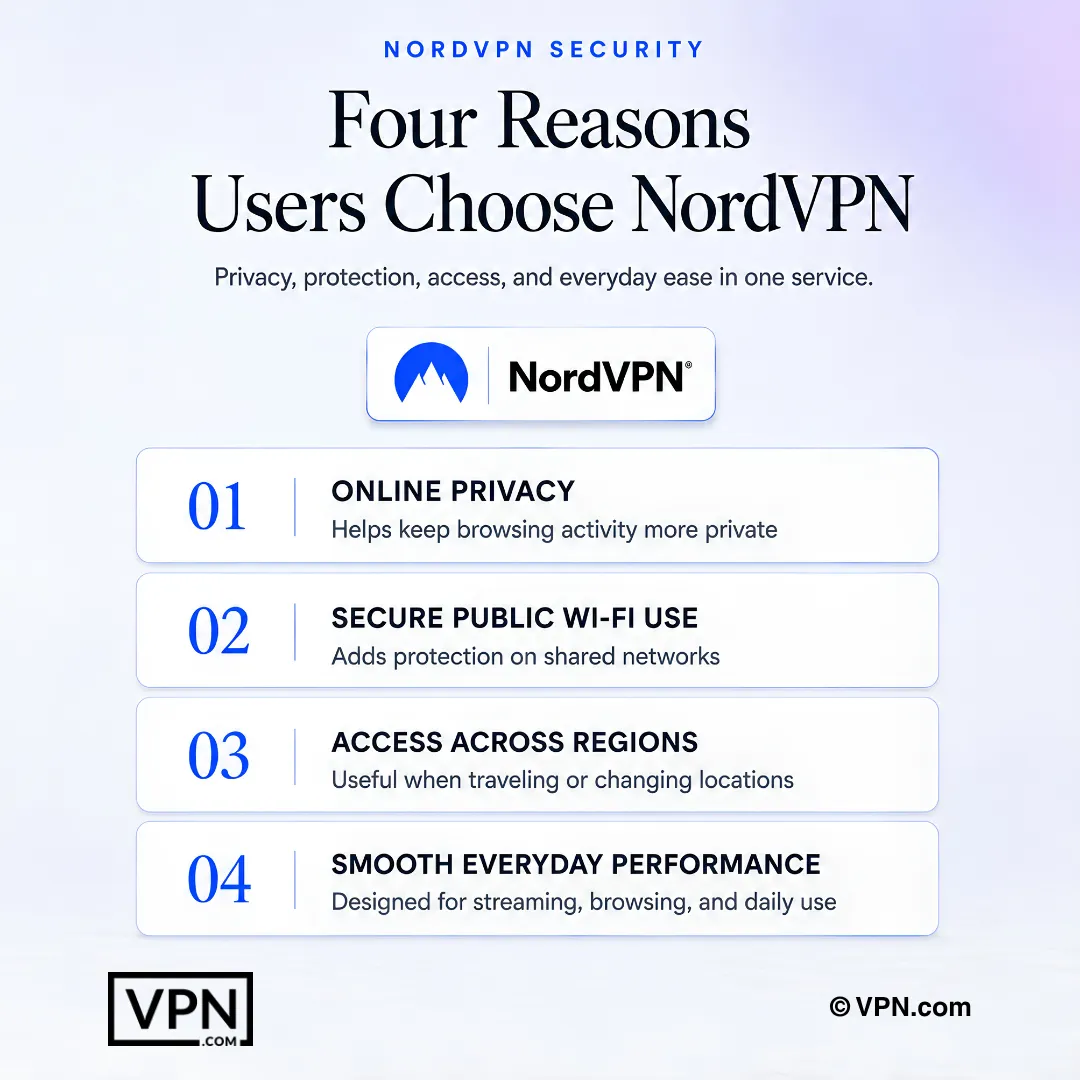
NordVPN’s security assessment rests on independent audits, modern encryption, and controls designed to prevent traffic and DNS exposure.
Frequently Asked Questions
Is NordVPN actually safe to use?
Yes. NordVPN encrypts traffic with AES-256, operates under Panama’s no-data-retention jurisdiction, and has passed independent audits from VerSprite, Cure53, and Deloitte’s 2022 no-logs verification. Its only security incident, a single server breach in Finland in 2018, exposed zero user credentials or browsing data since no logs existed to steal.
What exactly happened in NordVPN’s 2018 breach, and should it worry you now?
An attacker exploited a remote management tool the Finnish data center left active without NordVPN’s knowledge, gaining access to one server out of thousands with no user credentials, browsing logs, or account data on it. NordVPN disclosed it in October 2019, then migrated its entire network to RAM-only servers, added a HackerOne bug bounty, and committed to recurring third-party audits.
Which independent firms have audited NordVPN’s security and no-logs claims?
Three firms so far. VerSprite assessed NordVPN’s applications for code vulnerabilities and attack vectors, Cure53 audited server configurations and backend infrastructure, and Deloitte conducted a full 2022 no-logs verification confirming NordVPN stores no connection timestamps, IP addresses, session durations, or bandwidth data. All results are published publicly on NordVPN’s site.
Why does NordVPN operate from Panama, and what does that jurisdiction actually protect?
NordVPN’s parent, Tefincom S.A., is based in Panama specifically because the country has no mandatory data-retention laws and sits outside the Five Eyes, Nine Eyes, and Fourteen Eyes intelligence-sharing alliances. Foreign law enforcement must petition Panamanian courts to compel records, and even then NordVPN maintains no logs to hand over, per its Deloitte-verified no-logs policy.
What encryption does NordVPN use, and can it realistically be broken?
NordVPN uses AES-256, the same standard the US government applies to classified information, across all its protocols. No known method can brute-force AES-256 in a practical timeframe. Current estimates put a brute-force attempt at billions of years even with modern computing power, making the encryption itself effectively unbreakable with today’s technology.
What is NordLynx, and how does it fix WireGuard’s main privacy flaw?
NordLynx is NordVPN’s default protocol, built on WireGuard’s lean codebase for speed but modified to solve WireGuard’s core weakness: needing to store a static IP address per user on the server. NordVPN’s double-NAT system assigns each session a temporary address that disappears on disconnect, delivering WireGuard’s performance without leaving a persistent identifier behind.
How does NordVPN’s kill switch actually stop data leaks when a connection drops?
NordVPN’s kill switch monitors the VPN tunnel continuously and blocks all internet traffic the instant it drops, so nothing leaves your device unprotected until the connection restores. It offers an app-level mode that blocks only chosen applications and a system-level mode that blocks all device traffic, the stricter option for privacy-critical sessions like handling financial data.
Does NordVPN protect against DNS leaks that could expose my browsing to my ISP?
Yes. NordVPN routes all DNS queries through its own encrypted DNS servers rather than your ISP’s default resolver, preventing your provider or third-party DNS services from logging which sites you visit. Independent DNS leak tests referenced in NordVPN’s security documentation confirm this protection functions as advertised, with no leaks detected during testing.
What does NordVPN’s Threat Protection block, and does it work without the VPN connected?
Threat Protection blocks known malicious domains before they load, strips tracking parameters from URLs, and scans downloaded files for malware, all at the network level. It functions as a standalone security layer even when you’re not connected to a VPN server. AV-TEST, an independent security institute, has certified its malware-blocking capability.
How does NordVPN’s security stack up against ExpressVPN and ProtonVPN at a similar price?
All three start near the same price point (NordVPN from $3.49/month, ExpressVPN from $3.26/month, ProtonVPN from $3.49/month) and hold 30-day money-back guarantees, but audit depth differs. NordVPN’s Deloitte no-logs verification and Cure53 infrastructure audit sit alongside ExpressVPN’s PwC and Cure53 audits and ProtonVPN’s Securitum audit under Swiss jurisdiction. NordVPN ranks #1 of 22 in our Speed Lab, aggregated from independent labs; ExpressVPN ranks #8, ProtonVPN ranks #12.
Is there a way to test NordVPN’s security claims risk-free before committing?
Yes. NordVPN backs every plan with a 30-day money-back guarantee, giving you a full month to test the kill switch, DNS leak protection, and Threat Protection yourself before deciding. If NordVPN’s security features don’t hold up to your own scrutiny within that window, you can request a refund with no long-term commitment required.
Does securing multiple devices under one NordVPN account weaken its privacy protections?
No. A single NordVPN account covers 10 simultaneous device connections, and each connection runs the same AES-256 encryption, kill switch, and DNS leak protection independently. Adding devices doesn’t dilute security since NordVPN’s no-logs policy, verified by Deloitte in 2022, applies uniformly across every connected device rather than scaling risk with device count.
How can I confirm NordVPN’s kill switch is actually protecting me before trusting it?
Connect to a NordVPN server, then abruptly disconnect your Wi-Fi or unplug ethernet mid-session to force a drop. A working kill switch cuts all internet traffic instantly rather than falling back to your unprotected connection. NordVPN’s system-level kill switch blocks all device traffic, while the app-level version restricts only chosen apps, so test whichever mode you plan to rely on.
What should you do if you’re worried about a repeat of NordVPN’s 2018-style server incident?
Little action is needed on your end since NordVPN’s response addressed the root causes: it migrated its entire network to RAM-only servers that wipe data on every reboot, added a HackerOne bug bounty for continuous vulnerability testing, and committed to recurring third-party audits. If concerned, check NordVPN’s published transparency reports, which show no data available to hand over.