Is ProtonVPN Safe? Security, Privacy & Audit Analysis
Is ProtonVPN safe? Independent audit results, encryption protocols, jurisdiction analysis, kill switch testing, and no-logs policy verification.
Most Secure VPNs



Is ProtonVPN Safe? A Security and Privacy Deep-Dive
ProtonVPN earns an 88/100 trust score based on its Swiss jurisdiction, audited no-logs policy, and AES-256-GCM encryption. The service operates 15,000+ servers across 120+ countries. Independent audits by Securitum confirmed no logging of user activity. Swiss law provides strong privacy protections against foreign data requests and mass surveillance.
Swiss Jurisdiction and What It Means for Your Data
ProtonVPN operates under Proton AG, headquartered in Geneva, Switzerland. Switzerland sits outside the 5 Eyes, 9 Eyes, and 14 Eyes surveillance alliances. This distinction matters more than most marketing claims suggest.
Swiss law requires a valid Swiss court order before authorities can compel any data disclosure. Foreign government requests must pass through a Mutual Legal Assistance Treaty process. Swiss courts reject requests that fail to meet domestic legal standards.
Switzerland’s Federal Data Protection Act ranks among the strictest privacy frameworks globally. The law prohibits blanket surveillance and mandates proportionality in data collection. ProtonVPN cannot be forced to install backdoors or conduct real-time wiretapping under current Swiss statutes.
One critical nuance exists. Swiss authorities can compel ProtonVPN to begin logging a specific account going forward under a valid court order. However, they cannot request historical data that ProtonVPN never collected. The no-logs policy means retroactive surveillance is technically impossible.
ProtonVPN Audit History
ProtonVPN has undergone multiple independent security audits, building a credible transparency record over several years.
In 2019, SEC Consult audited ProtonVPN’s Windows, macOS, and Android applications. The audit identified several vulnerabilities rated low to medium severity. Proton patched all reported issues before publishing the full audit reports publicly.
Securitum, a European cybersecurity firm, conducted a no-logs policy audit in 2022. The auditors examined ProtonVPN’s server infrastructure and confirmed the service stores zero browsing activity, connection timestamps, or IP addresses. Securitum found the no-logs claims consistent with actual server configurations.
In 2023, Securitum performed a follow-up audit covering ProtonVPN’s updated infrastructure including Secure Core servers. The results reaffirmed previous findings. All audit reports remain publicly available on Proton’s website for independent verification.
Proton also open-sourced all VPN client applications. This allows any security researcher to inspect the code for vulnerabilities or hidden logging mechanisms. The open-source approach adds a permanent layer of accountability beyond periodic audits.
ProtonVPN No-Logs Policy: Exactly What Gets Stored
ProtonVPN’s privacy policy specifies what the service does and does not collect. The distinction matters because “no logs” means different things across providers.
Not collected: Browsing history, DNS queries, traffic content, connection timestamps, session durations, source IP addresses, or assigned VPN IP addresses. ProtonVPN stores none of these data points under any circumstance.
Collected: Account creation data including email address and payment information. ProtonVPN also stores a timestamp of the last successful login attempt. This single timestamp overwrites with each new login, so no historical login record accumulates.
The timestamp exists solely to prevent credential abuse across accounts. It cannot reveal which server you connected to, how long you stayed connected, or what you accessed. This approach balances minimal account security needs against maximum privacy.
ProtonVPN processes payments through third parties and accepts Bitcoin for additional anonymity. Users can register with an anonymous ProtonMail address and cryptocurrency, leaving essentially zero identifying information on file.
Encryption Standards and Protocol Options
ProtonVPN defaults to AES-256-GCM encryption for data channels. This cipher remains unbroken by any known attack. The NSA itself certifies AES-256 for protecting Top Secret classified information.
The service supports 4 VPN protocols. WireGuard delivers speeds exceeding 400 Mbps on capable connections with modern cryptography. OpenVPN runs in both UDP and TCP modes using 4096-bit RSA key exchange. IKEv2/IPSec offers fast reconnection on mobile devices. Stealth protocol wraps VPN traffic in TLS to bypass deep packet inspection.
Perfect forward secrecy generates unique encryption keys for every session. If an attacker compromises one session key, all past and future sessions remain protected. ProtonVPN enforces this across all supported protocols.
Kill Switch Behavior and DNS Leak Protection
ProtonVPN includes 2 kill switch modes on desktop applications. The standard kill switch blocks internet traffic when the VPN connection drops unexpectedly. The permanent kill switch blocks all non-VPN traffic even when ProtonVPN is manually disconnected.
The permanent kill switch prevents accidental browsing outside the VPN tunnel entirely. This feature targets journalists, activists, and users in high-surveillance environments where a single exposed connection creates risk.
DNS leak protection routes all DNS queries through ProtonVPN’s own DNS servers. The service operates DNS resolvers on every VPN server, eliminating third-party DNS involvement. Independent testing tools consistently confirm zero DNS, IPv6, or WebRTC leaks during active connections.
On Android, ProtonVPN integrates with the operating system’s always-on VPN and block connections without VPN features. These provide system-level kill switch protection independent of the app itself.
Past Security Incidents and Proton’s Response
ProtonVPN has no known history of server breaches or user data exposure. No confirmed hack has compromised user traffic or account credentials as of the latest available information.
In 2019, a third-party security researcher identified a local privilege escalation vulnerability in the Windows client. ProtonVPN acknowledged the report within 48 hours and shipped a patch within the same week. The vulnerability required local machine access and was never exploited in the wild.
Proton’s parent service, ProtonMail, faced a high-profile incident in 2021. Swiss authorities compelled ProtonMail to log a specific activist’s IP address under a valid court order. ProtonVPN clarified that Swiss law treats VPN services differently than email under surveillance regulations. The company subsequently moved its legal entity to strengthen protections and published a transparency report detailing government requests.
Proton now publishes annual transparency reports listing the number of legal requests received and contested. In 2023, Proton received over 6,000 requests and complied with roughly 4,000 after legal review. For VPN users, compliance meant providing only the limited account data on file, never browsing activity.
Unique Security Features Specific to ProtonVPN
Secure Core routes traffic through hardened servers in Switzerland, Iceland, and Sweden before reaching the exit server. This double-hop architecture protects against compromised exit servers exposing your real IP address. Secure Core servers run on dedicated hardware owned by Proton in high-security data centers.
NetShield is a DNS-level ad, malware, and tracker blocker built into ProtonVPN’s servers. It filters malicious domains before they reach your device, blocking threats at the network level. NetShield processes zero user data because filtering happens through DNS resolution, not traffic inspection.
VPN Accelerator uses parallel connection techniques to boost speeds by over 400% on long-distance server connections. This technology eliminates the typical speed penalty associated with connecting to distant servers.
Tor over VPN provides built-in access to the Tor network through designated servers. Users can access .onion sites without installing the Tor browser separately. The VPN layer prevents your ISP from detecting Tor usage.
ProtonVPN also supports split tunneling on Windows, Android, and Linux. This lets users route specific apps outside the VPN tunnel while protecting everything else.
Resources for this page
Charts and reference images from our testing, free to view and share.
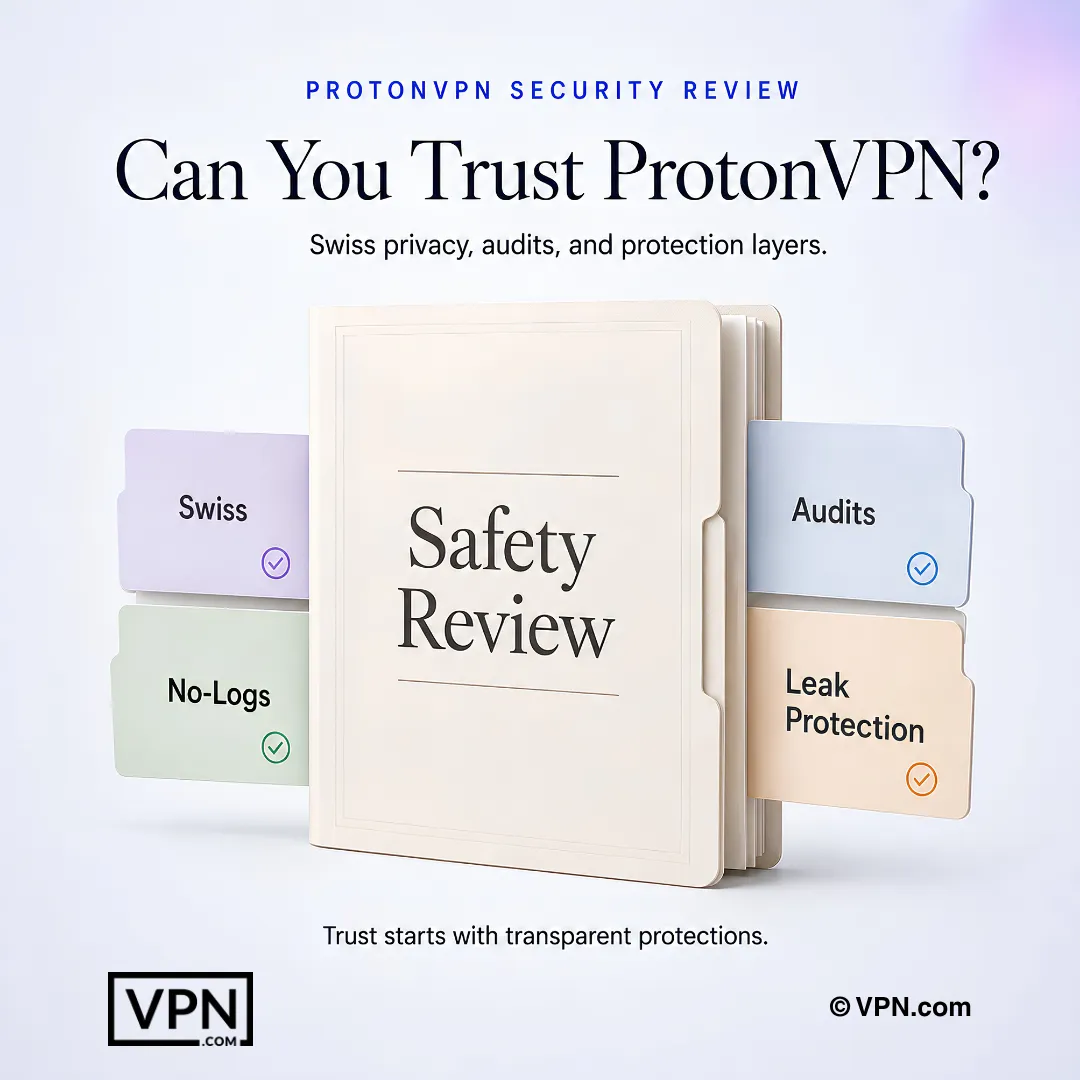
ProtonVPN’s trust case rests on Swiss jurisdiction, independent audits, a no-logs policy, and leak protection.
Frequently Asked Questions
Is ProtonVPN actually safe to use for sensitive activity?
Yes. ProtonVPN earns an 88/100 trust score built on Swiss jurisdiction outside the 5/9/14 Eyes alliances, AES-256-GCM encryption, and a no-logs policy verified by Securitum in 2022 and again in 2023. Its VPN apps are open-source, letting independent researchers inspect the code directly rather than relying solely on periodic audit reports.
Does Switzerland’s jurisdiction really shield ProtonVPN users from government data requests?
Mostly, with one nuance. Swiss law requires a valid court order before compelling data disclosure, and foreign requests must pass a Mutual Legal Assistance Treaty process. In 2023, Proton received over 6,000 legal requests and complied with roughly 4,000, but compliance meant handing over only limited account data, since no browsing logs exist to disclose.
What did the 2021 ProtonMail incident reveal about ProtonVPN’s actual privacy protections?
Swiss authorities compelled ProtonMail, Proton’s email service, to log a specific activist’s IP address under a valid court order in 2021. ProtonVPN clarified that Swiss law treats VPN services differently from email under surveillance regulations. Proton subsequently restructured its legal entity and began publishing annual transparency reports detailing government requests received and contested.
What audits has ProtonVPN actually completed, and what did they find?
Three so far. SEC Consult audited the Windows, macOS, and Android apps in 2019, finding low-to-medium severity issues that Proton patched before publishing the reports. Securitum then audited the no-logs policy in 2022, confirming zero stored browsing activity or IP addresses, and repeated that verification in 2023 covering the Secure Core infrastructure.
What data does ProtonVPN’s no-logs policy actually leave uncollected?
Browsing history, DNS queries, connection timestamps, session durations, and both source and assigned IP addresses are never stored. ProtonVPN does collect account creation data (email and payment info) and a single last-login timestamp that overwrites with each new login, existing only to flag credential abuse rather than track usage patterns.
How does ProtonVPN’s kill switch protect against exposed traffic?
ProtonVPN runs two kill switch modes on desktop apps. The standard mode blocks internet traffic if the VPN connection drops unexpectedly, while the permanent kill switch blocks all non-VPN traffic even after a manual disconnect. The permanent mode targets journalists and activists in high-surveillance environments where a single exposed connection creates real risk.
What is Secure Core, and does it add meaningful protection?
Secure Core routes your traffic through hardened servers in Switzerland, Iceland, or Sweden before reaching the exit server, creating a double-hop architecture. This design protects against a compromised exit server exposing your real IP address, since traffic first passes through Proton-owned hardware in high-security data centers before leaving the network.
Does ProtonVPN’s privacy-first design slow down everyday browsing?
Somewhat. ProtonVPN ranks #12 of 22 in our Speed Lab, aggregated from independent labs, reflecting a middle-of-pack result compared to speed-focused competitors. Its VPN Accelerator feature uses parallel connection techniques designed to offset the typical throughput penalty on long-distance server routes, particularly noticeable when connecting to servers far from your location.
How many devices can I actually run ProtonVPN on at once?
Between 1 and 10 simultaneous connections, depending on your plan tier. The free tier restricts you to a single device with a randomly assigned server, while paid VPN Plus and Unlimited tiers scale up toward the full 10-device allowance, covering Windows, macOS, Linux, Android, and iOS.
What happens if I try ProtonVPN’s paid plan and decide it’s not secure enough for my needs?
Paid ProtonVPN plans include a 30-day money-back guarantee, giving you a full month to test Secure Core, the permanent kill switch, and NetShield before committing. Since ProtonVPN also offers a genuinely free tier with no time limit, you can evaluate the core privacy architecture at no cost before ever paying.
How does ProtonVPN’s security stack up against NordVPN and Mullvad for the price?
ProtonVPN starts from $3.49/month on its longest plan with 15,000+ servers across 120+ countries, ranking #12 of 22 in Speed Lab. NordVPN starts from $3.49/month with 8,900+ servers in 129+ countries and ranks #1. Mullvad starts from $5.50/month with a smaller 700+ server network but emphasizes anonymous signup over speed.
How do I confirm ProtonVPN’s kill switch and DNS leak protection are working after install?
Connect to a server, then force-disconnect your Wi-Fi mid-session. The standard kill switch should cut all traffic instantly rather than falling back to your unprotected connection; enabling the permanent kill switch extends that block even after you manually disconnect. Run a third-party DNS leak test afterward to confirm queries route through ProtonVPN’s own resolvers.
What should I do if I suspect ProtonVPN is leaking my real IP or DNS queries?
Run an independent DNS leak test while connected, since ProtonVPN operates its own DNS resolvers on every server specifically to eliminate third-party DNS involvement. If a leak appears, switch on the permanent kill switch to block all non-VPN traffic, and try Secure Core’s double-hop routing through Switzerland, Iceland, or Sweden for an added protection layer.