Data Protection: Tips, Strategies & Cybersecurity Guide
Protect your data with proven data protection strategies, tips, and cybersecurity measures for individuals and businesses.
 Michael Gargiulo
Bottom Line: Data theft causes financial loss, identity theft, and reputational harm to individuals and businesses alike. Protecting against it requires encryption, strong passwords, multi-factor authentication, regular software updates, and employee security awareness training.
Data protection focuses on the technical safeguards, tools, and strategies that prevent unauthorized access to sensitive information. It covers encryption, access controls, breach prevention, and incident response.
Note: This page covers the security and technical side of protecting data. For legal rights, GDPR compliance, consumer privacy frameworks, and regulatory obligations, see our data privacy guide.
Strong data protection builds trust between individuals and the organizations that handle their information. The rapid growth of cloud services, remote work, and connected devices has expanded the attack surface for cybercriminals. A proactive security posture helps prevent breaches and empowers users to operate online with confidence.
Why Data Protection Matters: The Threat of Data Theft
Data theft is the unauthorized access, extraction, and misuse of valuable information. Cybercriminals, malicious insiders, and competitors all target sensitive data for financial gain or exploitation.
Understanding who steals data and what they target provides essential context for building effective defenses. The goal is not just awareness but action: every threat category maps directly to a specific protection strategy.
Data Most Targeted by Thieves
Personal Data
Identity theft ranks among the fastest-growing cybercrimes. Attackers use social engineering and phishing to trick individuals into sharing passwords, credit card numbers, or Social Security numbers. Once stolen, this data fuels financial fraud. Victims face drained bank accounts and damaged credit histories. Recognizing these tactics is the first step toward prevention.
Corporate Data
Intellectual property, trade secrets, and strategic plans give companies their competitive edge. A single breach can expose proprietary processes, client lists, or product roadmaps. The 2023 IBM Cost of a Data Breach Report[1] found the average breach cost reached $4.45 million globally. Protecting corporate data requires layered defenses across networks, endpoints, and employee behavior.
How Data Thieves Operate
Attackers use multiple methods to breach defenses:
- Malware: Trojans, viruses, worms, and ransomware infiltrate systems to extract or encrypt data. Learn more about types of malware.
- Social Engineering: Phishing attacks and spear-phishing trick users into revealing credentials or installing malicious software.
- Physical Theft: Dumpster diving, shoulder surfing, and stealing hardware (laptops, USB drives) remain common attack vectors.
Each method demands a specific countermeasure, covered in the strategies section below.
Consequences of a Data Breach
Data theft creates cascading damage for businesses and individuals:
- Financial loss: Direct costs include forensic investigation, legal fees, regulatory fines, and customer notification. The average ransomware payment exceeded $1.5 million in 2023.
- Reputational damage: Customers and partners lose trust. Rebuilding credibility takes years.
- Legal liability: Violations of HIPAA, GDPR, or CCPA trigger penalties that can reach tens of millions of dollars.
- Competitive disadvantage: Leaked trade secrets or strategic plans hand rivals an unearned edge.
Implementing stronger safeguards helps prevent one of the most common forms of data-related financial crime.
Data Protection Strategies
This section breaks down the core technical and procedural safeguards that form a complete defense. Each strategy addresses a specific attack vector identified above.
Encrypt Data at Rest and in Transit
Encryption transforms readable data into ciphertext that only authorized parties can decode. Two primary types exist:
- Symmetric encryption uses a single shared key for both encryption and decryption. AES-256 is the current standard, used by governments and financial institutions worldwide.
- Asymmetric encryption uses a public/private key pair. TLS 1.3 secures web traffic using this method. The public key encrypts; only the matching private key decrypts.
The National Institute of Standards and Technology (NIST)[2] publishes encryption standards and guidelines that define minimum requirements for federal agencies and serve as benchmarks for private organizations. Apply encryption to stored files, databases, email, and all data in transit across networks.
Enforce Strong Passwords and Credential Management
Password security remains a frontline defense. A password manager generates unique, complex credentials for every account and stores them in an encrypted vault. This eliminates weak or reused passwords that attackers exploit through credential-stuffing attacks.
Best practices include:
- Minimum 12-character passwords with mixed character types
- Unique passwords for every service
- Never storing passwords in plaintext or shared documents
Enable Multi-Factor Authentication (MFA)
Two-factor authentication (2FA) requires proof of identity from two independent sources. The first factor is typically a password. The second is a physical device (security token or phone) or biometric scan.
Common MFA methods include:
- Hardware security keys (YubiKey, Titan) that generate one-time codes
- Authenticator apps (Google Authenticator, Authy) that produce time-based codes
- SMS codes sent to a registered phone number (less secure due to SIM-swapping risks)
Even if an attacker steals a password, MFA blocks access without the second factor. The Cybersecurity and Infrastructure Security Agency (CISA)[3] recommends MFA for all accounts, especially email, banking, and administrative systems.
Deploy Anti-Virus and Anti-Malware Software
Anti-virus and anti-malware tools provide real-time scanning that detects viruses, worms, Trojans, ransomware, and spyware. These solutions use signature databases and behavioral analysis to identify threats before they execute.
Keep definitions updated daily. Schedule full system scans weekly. For Apple users, find comprehensive security tips at VPN for iPhone.
Keep Software Updated and Patched
Unpatched software is the single largest attack vector for known exploits. Attackers reverse-engineer public security patches to target systems that haven’t updated.
- Enable automatic updates on all operating systems and applications
- Prioritize critical and high-severity patches within 48 hours of release
- Maintain an inventory of all software to ensure nothing falls through the cracks
Implement Firewall Protection
Firewalls control traffic between trusted internal networks and untrusted external sources. Types include:
- Packet-filtering firewalls that inspect individual data packets
- Stateful inspection firewalls that track active connections
- Next-generation firewalls (NGFW) that add deep packet inspection, intrusion prevention, and application awareness
Configure firewalls using the principle of least privilege: block all traffic by default and allow only what is explicitly needed. Review rules quarterly.
Monitor with Intrusion Detection and Prevention Systems
Intrusion Detection Systems (IDS) analyze network traffic and alert administrators to suspicious patterns. Intrusion Prevention Systems (IPS) go further by automatically blocking detected threats.
Endpoint Detection and Response (EDR) solutions extend this monitoring to individual devices, detecting malware that bypasses perimeter defenses. Organizations should deploy both network-level and endpoint-level monitoring for comprehensive visibility.
Incident Response and Recovery
Build an Incident Response Plan
An Incident Response Plan defines exactly who does what when a breach occurs. An effective plan includes:
- A designated Incident Response Team with skills in system analysis, digital forensics, and communications
- Clear escalation procedures and communication templates
- Defined roles for containment, eradication, recovery, and post-incident review
Organizations that test their incident response plan through tabletop exercises reduce breach costs by an average of $232,000, according to IBM’s research[1].
Perform Regular Data Backups
Backup best practices include:
- 3-2-1 rule: Keep 3 copies of data on 2 different media types with 1 stored offsite
- Encrypt all backup data
- Test restoration procedures quarterly to verify backup integrity
- Store backups in air-gapped or immutable storage to protect against ransomware
Security Audits and Employee Training
Conduct Regular Security Audits
Security audits identify vulnerabilities before attackers do. Types include:
- Vulnerability assessments that scan systems for known weaknesses
- Penetration testing that simulates real-world attacks to test defenses
- Compliance audits that verify adherence to regulatory requirements
Schedule vulnerability scans monthly and penetration tests annually at minimum.
Train Employees on Security Awareness
Human error remains the leading cause of data breaches. The Verizon 2023 Data Breach Investigations Report[4] found that 74% of breaches involved a human element.
Effective training programs cover:
- Phishing recognition and reporting procedures
- Safe browsing habits and USB device policies
- Internal data handling and classification rules
- Password hygiene and MFA enrollment
Run phishing simulations quarterly. Track click rates and target repeat offenders with additional coaching.
Develop Security Policies and Procedures
Written policies set clear expectations for data handling, access control, acceptable use, and incident reporting. Review and update policies annually or whenever regulations change. Ensure every employee acknowledges and signs updated policies.
Legal and Regulatory Compliance
Understanding applicable laws is essential for any data protection program. Key regulations include:
HIPAA (Health Insurance Portability and Accountability Act)
Enacted in 1996, HIPAA[5] requires healthcare providers, insurers, and their business associates to protect patient health information. Compliance mandates include data encryption, access restrictions, audit trails, and secure disposal of medical records. Patients can file complaints with the Department of Health and Human Services for privacy violations. Civil and criminal penalties apply for non-compliance.
GDPR (General Data Protection Regulation)
The EU implemented GDPR[6] on May 25, 2018, replacing the 1995 Data Protection Directive. It requires organizations handling EU residents’ personal data to obtain explicit consent, explain data usage clearly, and provide mechanisms for data access, correction, and deletion. GDPR defines two key roles:
- Controller: The entity that determines why and how personal data is processed
- Processor: A third party that processes data on behalf of the controller
Fines reach up to €20 million or 4% of global annual revenue, whichever is higher.
CCPA and Other U.S. State Laws
The California Consumer Privacy Act and similar state-level laws grant residents rights over their personal data. The FTC[7] also enforces data security requirements across industries.
Comply with Security Frameworks
Cybersecurity frameworks provide structured approaches to implementing defenses. Major frameworks include:
- NIST Cybersecurity Framework[8]: Organized around five functions (Identify, Protect, Detect, Respond, Recover), widely adopted across industries
- ISO 27001: International standard for information security management systems
- CIS Critical Security Controls: Prioritized set of 18 actions that address the most common attack vectors
Certifications like ISO 27001 and SOC 2 demonstrate compliance to partners and customers, building trust and reducing third-party risk.
Best Practices Summary
| Protection Layer | Method | Protects Against |
|---|---|---|
| Encryption | AES-256 at rest, TLS 1.3 in transit | Interception, theft |
| Access Control | Passwords, MFA, role-based access | Unauthorized logins |
| Software Updates | Patch within 48 hours of release | Vulnerability exploits |
| Firewall | Packet-filtering, NGFW | Unauthorized network access |
| IDS/IPS | Real-time traffic monitoring | Intrusions, lateral movement |
| Employee Training | Phishing simulations, security policies | Social engineering, human error |
| Data Backups | 3-2-1 rule, encrypted offsite storage | Ransomware, accidental loss |
| Incident Response Plan | Defined team and tested procedures | Damage containment, recovery |
Tip: Encryption is the foundation of data protection. Even if attackers breach your perimeter, encrypted data stays unreadable without the key. Use encryption for both stored files and data in transit, and apply multi-factor authentication as a second barrier against credential theft.
Conclusion
Data theft poses a significant and growing threat to personal and professional security. The technical strategies outlined here provide a layered defense: encryption protects data at the core, access controls limit exposure, monitoring detects threats early, and incident response plans minimize damage.
The future of data protection depends on continuous improvement. Artificial intelligence, zero-trust architectures, and advanced encryption techniques will shape the next generation of defenses. Organizations and individuals who invest in these safeguards today build resilience against tomorrow’s threats.
References
- IBM. 2023. Cost of a Data Breach Report 2023. https://www.ibm.com/reports/data-breach.Archived: Wayback Machine snapshot
- NIST. 2016. Cryptography. Retrieved September 30, 2026 from https://www.nist.gov/cryptography.Archived: Wayback Machine snapshot
- Cybersecurity and Infrastructure Security Agency CISA. n.d. More than a Password. Retrieved September 30, 2026 from https://www.cisa.gov/MFA.Archived: Wayback Machine snapshot
- Verizon Business. 2023. 2023 Data Breach Investigations Report (DBIR). https://www.verizon.com/business/resources/reports/dbir/.Archived: Wayback Machine snapshot
- U.S. Department of Health and Human Services. n.d. HIPAA Home. https://www.hhs.gov/hipaa/index.html.Archived: Wayback Machine snapshot
- General Data Protection Regulation (GDPR). 2016. General Data Protection Regulation (GDPR) – Legal Text. Retrieved September 30, 2026 from https://gdpr-info.eu/.Archived: Wayback Machine snapshot
- Federal Trade Commission. n.d. Privacy and Security. Retrieved September 30, 2026 from https://www.ftc.gov/business-guidance/privacy-security.Archived: Wayback Machine snapshot
- NIST. 2013. Cybersecurity Framework. Retrieved September 30, 2026 from https://www.nist.gov/cyberframework.Archived: Wayback Machine snapshot
Resources for this page
Charts and reference images from our research, free to view and share.
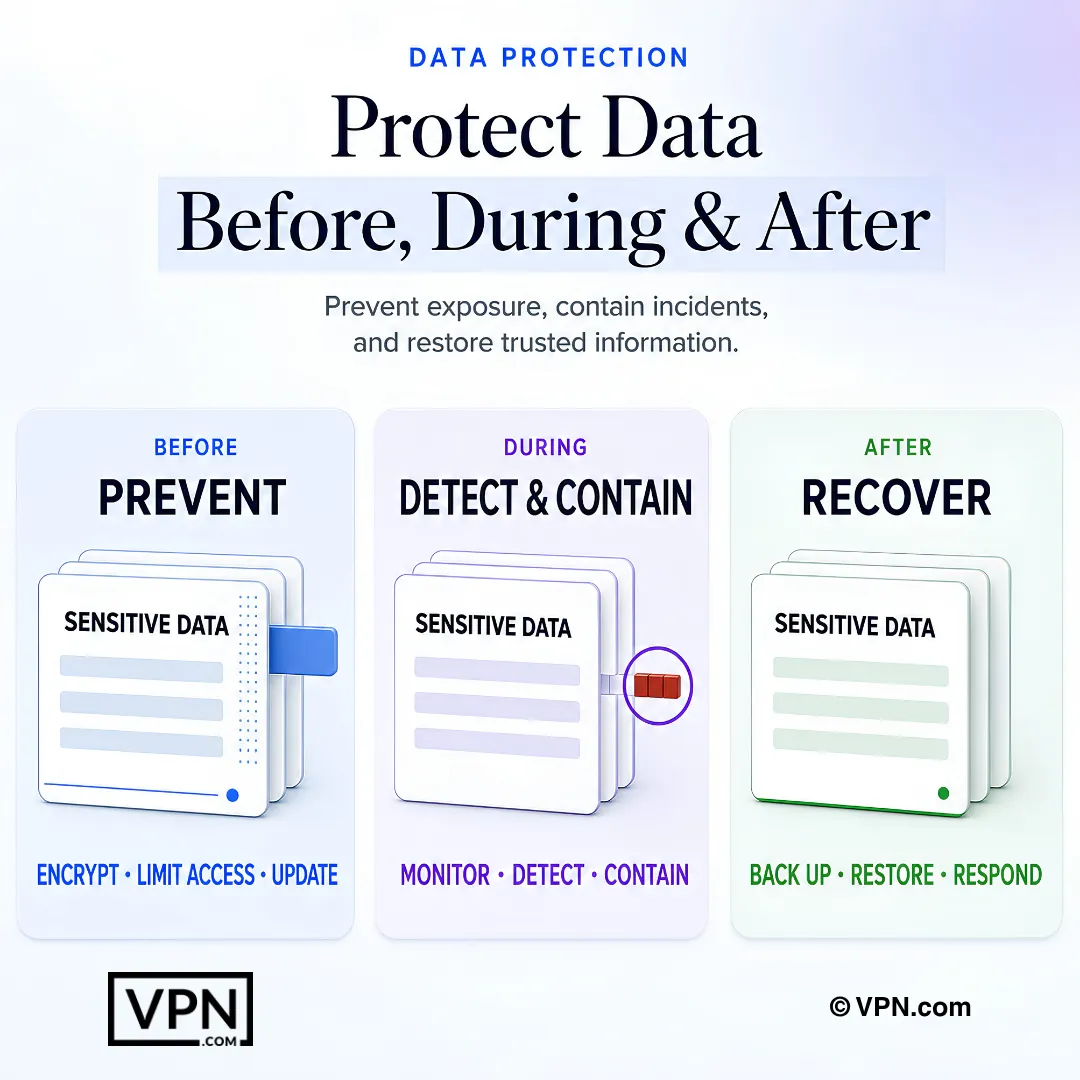
Complete data protection prevents exposure, contains active incidents, and restores trusted information afterward.
Frequently Asked Questions
What is data protection and how does it differ from data privacy?
Data protection covers the technical safeguards, tools, and strategies that prevent unauthorized access to sensitive information: encryption, access controls, breach prevention, and incident response. Data privacy covers legal rights and regulatory obligations like GDPR compliance and consumer frameworks instead. This guide focuses on the security and technical side; legal and regulatory details live on the site’s separate data privacy guide.
What data do thieves target most, and how do they steal it?
Thieves target personal data (passwords, credit card numbers, Social Security numbers) and corporate data (intellectual property, trade secrets, client lists). They steal it through three main methods: malware like trojans and ransomware, social engineering like phishing and spear-phishing, and physical theft such as stolen laptops, USB drives, or shoulder surfing. Each method demands a specific countermeasure.
What does a data breach actually cost a business?
The average data breach cost businesses $4.45 million globally in 2023, according to IBM’s Cost of a Data Breach Report. Ransomware payments alone averaged over $1.5 million that year. Consequences cascade further into legal liability, with HIPAA, GDPR, or CCPA violations triggering fines reaching tens of millions, plus reputational damage that takes years to rebuild.
How does encryption protect data at rest and in transit?
Encryption converts readable data into ciphertext that only authorized parties can decode. Symmetric encryption, like AES-256, uses one shared key and is the current standard for governments and financial institutions. Asymmetric encryption uses a public/private key pair, as TLS 1.3 does to secure web traffic. NIST publishes the standards defining minimum requirements for both methods.
What makes multi-factor authentication effective against stolen passwords?
MFA requires proof of identity from two independent sources, typically a password plus a physical device or biometric scan, so a stolen password alone can’t grant access. Options include hardware keys like YubiKey, authenticator apps like Google Authenticator, and SMS codes, though SMS is weaker due to SIM-swapping risk. CISA recommends MFA on all accounts, especially email and banking.
What’s the difference between anti-virus, firewalls, and IDS/IPS?
They defend different layers. Anti-virus and anti-malware software scans in real time for viruses, trojans, and ransomware using signature databases and behavioral analysis. Firewalls, including packet-filtering and next-generation types, control network traffic under a least-privilege model. IDS/IPS and EDR monitor for suspicious activity at the network and device level, with IPS automatically blocking detected threats.
Do I actually need a password manager, or are strong passwords enough?
A password manager is a core defense because it generates unique, complex credentials for every account and stores them in an encrypted vault, eliminating the weak or reused passwords that credential-stuffing attacks exploit. Pair it with 12-character-minimum passwords using mixed character types, and never store credentials in plaintext or shared documents.
What is the 3-2-1 backup rule, and why does it matter?
The 3-2-1 rule means keeping 3 copies of your data on 2 different media types with 1 copy stored offsite. Best practice also calls for encrypting all backup data, testing restoration procedures quarterly, and using air-gapped or immutable storage specifically because it protects backups from ransomware that targets connected drives.
How often should vulnerability scans and penetration tests run?
Schedule vulnerability assessments monthly and penetration tests at least annually. Vulnerability assessments scan systems for known weaknesses, penetration testing simulates real-world attacks, and compliance audits verify adherence to regulations like HIPAA or GDPR. Certifications such as ISO 27001 and SOC 2 demonstrate these audits to partners and reduce third-party risk.
Why does employee security training matter so much?
Human error is the leading cause of breaches: Verizon’s 2023 Data Breach Investigations Report found 74% of breaches involved a human element. Effective programs run quarterly phishing simulations, track click rates, and coach repeat offenders, while covering safe browsing, USB device policies, data classification rules, and MFA enrollment, backed by written policies employees sign annually.
What is an incident response plan and why does it matter?
An incident response plan defines exactly who does what when a breach occurs, including a designated response team skilled in forensics and communications, clear escalation procedures, and defined roles for containment, eradication, recovery, and post-incident review. IBM’s research found organizations that test their plan through tabletop exercises cut breach costs by an average of $232,000.
What regulations require data protection, and what are the penalties?
Three major frameworks apply. HIPAA, enacted in 1996, requires encryption and access restriction for patient health data, with civil and criminal penalties for violations. GDPR, effective since May 25, 2018, mandates consent and data rights for EU residents’ data, with fines up to €20 million or 4% of global annual revenue. CCPA grants California residents similar rights, enforced alongside FTC data security requirements.
How do frameworks like NIST CSF or ISO 27001 help structure a defense?
They give organizations a structured approach instead of ad hoc fixes. The NIST Cybersecurity Framework organizes defenses around five functions: Identify, Protect, Detect, Respond, and Recover. ISO 27001 is the international standard for information security management systems, and the CIS Critical Security Controls prioritize 18 actions against the most common attack vectors. ISO 27001 and SOC 2 certifications signal this compliance to partners.