




Why use a VPN for gaming?
A VPN creates an encrypted tunnel for your internet traffic. It hides your location and protects your connection from outside interference. Here’s why that matters for gaming:
- Keep lag predictable: A VPN usually adds a little delay, but it stops the peak-hour throttling that causes spikes. On a nearby server running WireGuard or NordLynx, the overhead stays small. If you’re unsure which protocol to use, our WireGuard vs OpenVPN comparison breaks down the speed and security differences.
- Access region-locked content: Certain games, DLC, or early releases may only be available in specific countries. Publishers like Valve enforce regional store restrictions on Steam[1], and a server in the target region can give you access where the store’s terms allow it.
- Prevent DDoS attacks: Competitive gamers are frequent targets. According to Cloudflare’s DDoS threat report[2], gaming and gambling remain among the most-attacked industries by volume. A VPN hides your real IP address, so a denial-of-service attack hits the VPN server instead of your home connection.
- Stop ISP throttling: Some internet providers deliberately slow gaming traffic during peak hours. A VPN hides your activity, so your ISP cannot single out your game traffic.
A VPN won’t help every player equally. If your base connection is already optimal with low ping to nearby servers, you may notice a small amount of added latency from encryption overhead. For most players dealing with throttling, DDoS risk, or region locks, the trade-off is worth it.
What the FBI says about paying for a VPN
“Consider paying for a VPN service. Many VPN apps are free to you because they make money by sharing your information with third parties.”
FBI Portland Field Office, October 29, 2019[3]
The FBI publishes criteria and does not endorse any provider.
Using a gaming VPN on your phone
A phone changes four things about gaming with a VPN. Check each one before you pick a provider.
- Battery: A VPN encrypts your traffic, which can use more battery. Connect only for play sessions, and plug in for long ones.
- Wi-Fi to cellular switching: Your connection can drop for a moment when your phone changes network. Turn on the kill switch, so game traffic never leaves your phone unprotected during the gap.
- Mobile ping: Cellular can be less steady than Wi-Fi, and a VPN adds a little delay on top. Pick a nearby server and test your ping on both networks.
- Lobby exposure: Other players in a mobile lobby can see your IP address, as they can on PC. A VPN shows them the server’s IP instead, so an attack hits the server, not your phone.
NordVPN, ExpressVPN, Surfshark and CyberGhost all have iOS and Android apps, and all four list a kill switch. Surfshark allows unlimited connections, so your phone and tablet take no extra device slots. For app-by-app picks, see our best VPN for Android and best VPN for iPhone guides.
Best VPNs for gaming compared
Our Trust Score rank combines our Trust Score with published results from selected third-party review sites. We don’t run our own speed tests.
| VPN | Trust Score rank | Servers | Connections | Price |
|---|---|---|---|---|
| NordVPN | #1 of 22 | 7,130 | 10 | $3.49/mo |
| ExpressVPN | #2 of 22 | 3,000+ | 10–14 (by plan) | $2.99/mo |
| Surfshark | #3 of 22 | 4,500+ | Unlimited | $2.49/mo |
| CyberGhost | #3 of 22 | 9,600+ | 7 | $2.19/mo |
NordVPN: best overall
NordVPN holds the #1 Trust Score rank of 22 and runs its own NordLynx protocol, built on WireGuard. It operates 7,130 servers across 150 countries. Meshnet allows private gaming sessions with friends on a secure network. NordWhisper hides VPN usage from networks that block VPN traffic.
ExpressVPN: best for easy setup
3,000+ servers in 113 countries, running ExpressVPN’s own Lightway protocol. MediaStreamer, its Smart DNS feature, works on consoles that can’t run VPN apps, though it does not encrypt traffic or hide your IP. Apps cover routers, PC, Mac and mobile.
CyberGhost: best for dedicated gaming servers
Over 11,500 servers, including a gaming category the app can pick from for you. Its simple interface suits people new to VPNs. CyberGhost holds the #3 Trust Score rank of 22.
Surfshark: best budget option
4,500+ servers in 100+ countries with unlimited simultaneous connections. Your entire household can game on one account. Camouflage Mode hides VPN traffic from ISPs and network administrators.
VPN guides by gaming platform
This page covers general gaming VPN recommendations. For platform-specific setup instructions, server picks, and troubleshooting, see our dedicated guides:
- Best VPN for PlayStation (PS4 & PS5): router setup, hotspot sharing, and NAT type fixes for Sony consoles
- Best VPN for Xbox: Xbox-specific network configuration and recommended server locations
Fixing common VPN problems in games
Having VPN trouble during online matches? Try these fixes:
- Lag spikes: Pick a server closer to the game’s data center. Switch to WireGuard or NordLynx for lower overhead.
- Can’t connect: Try a different server or contact your provider’s support team.
- Slow speeds: Use NordLynx (NordVPN) or Lightway (ExpressVPN). Avoid OpenVPN for real-time gaming.
References
- Valve Corporation. n.d. Steam Subscriber Agreement. Retrieved September 30, 2026 from https://store.steampowered.com/subscriber_agreement/.Archived: Wayback Machine snapshot
- Cloudflare. n.d. DDoS threat report for 2024 Q4. https://radar.cloudflare.com/reports/ddos-2024-q4.Archived: Wayback Machine snapshot
- Federal Bureau of Investigation. 2019. Oregon FBI's Tech Tuesday: Building a Digital Defense Using Virtual Private Networks. FBI Portland Field Office, press release (October 29, 2019). Retrieved September 30, 2026 from https://www.fbi.gov/contact-us/field-offices/portland/news/press-releases/oregon-fbis-tech-tuesday-building-a-digital-defense-using-virtual-private-networks.Archived: Wayback Machine snapshot
Resources for this page
Charts and reference images from our research, free to view and share.
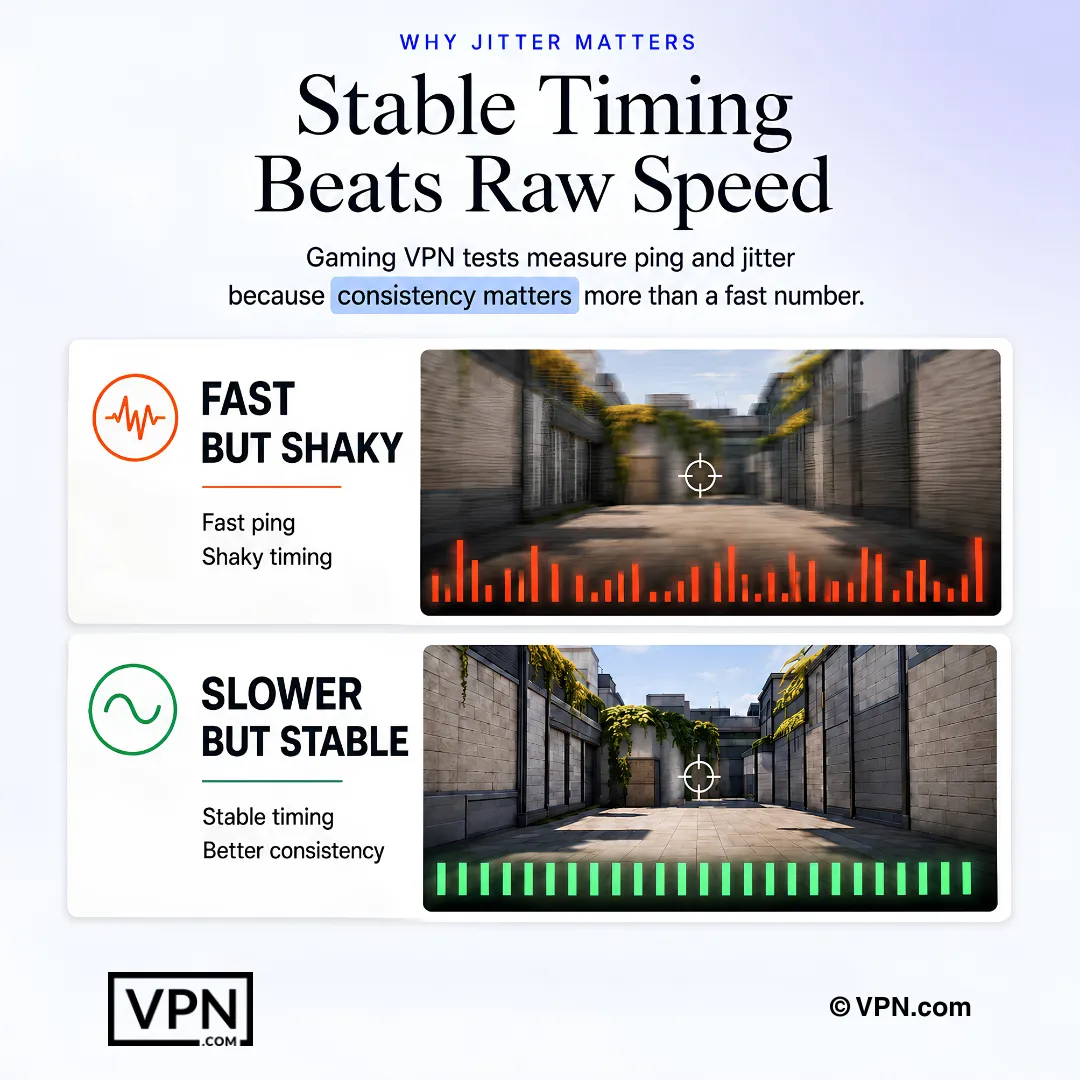
Low jitter and consistent timing can matter more to gameplay than the fastest headline ping.