Best VPN for Streaming: Bypass Blocks & Stream in 4K
Find the best VPN for streaming with our detailed comparison of speed, libraries & pricing. Tested on all major platforms. Start streaming today!
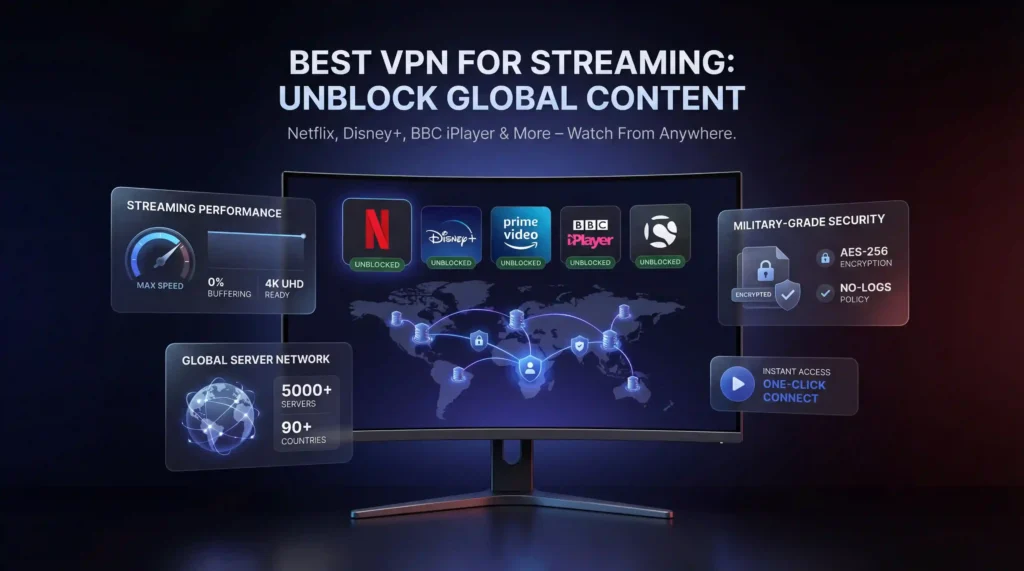
Geo-blocking is no longer an occasional annoyance. It is a built-in limitation of every major streaming platform. The same Netflix account delivers completely different libraries depending on your location, and services like BBC iPlayer, Hulu, and YouTube TV restrict access entirely outside specific regions.
A VPN is the only reliable way to bypass these restrictions, but most VPNs fail at streaming. Platforms actively detect and block VPN traffic, and most providers cannot keep up. Slow speeds, buffering, and “proxy detected” errors are still the norm with average services.
We tested leading VPN providers across multiple regions, devices, and streaming platforms, including Netflix, Disney+, BBC iPlayer and Amazon Prime Video. We measured real-world speed loss, access consistency and long-term reliability, not just one-time success.
This guide breaks down the best VPN for streaming based on those results, focusing on the few services that actually work consistently without sacrificing speed or privacy.
Best VPN for Streaming (Quick Picks)
Don’t have time to read the full guide? Here are our top VPN picks for streaming, ranked by performance, ease of use and value.
- Best Overall VPN for Streaming: NordVPN
- Best for Beginners: ExpressVPN
- Best Value VPN for Streaming: SurfShark VPN
- Best for Privacy: Proton VPN
- Best for Streaming Beginners: CyberGhost VPN
Quick Comparison
Here’s a head-to-head look at how the top VPNs for streaming compare across the metrics that matter most speed retention, Netflix library access, device support, pricing and ideal use case.
| VPN | Speed Loss | Netflix Libraries | Simultaneous Connections | Starting Price | Best For |
| NordVPN | ~6% | 17+ | 10 | $3.39/mo | Overall best |
| ExpressVPN | ~8–18% | 18 | 14 | $3.49/mo | Beginners |
| Surfshark | ~6–21% | 9+ | Unlimited | $1.78/mo | Value/Families |
| Proton VPN | ~8–16% | 20+ | 10 | $2.99/mo | Privacy-focused |
| CyberGhost | ~15% | Multiple | 7 | $2.03/mo | Ease of use |
Best VPN for Streaming: Our Top Choices
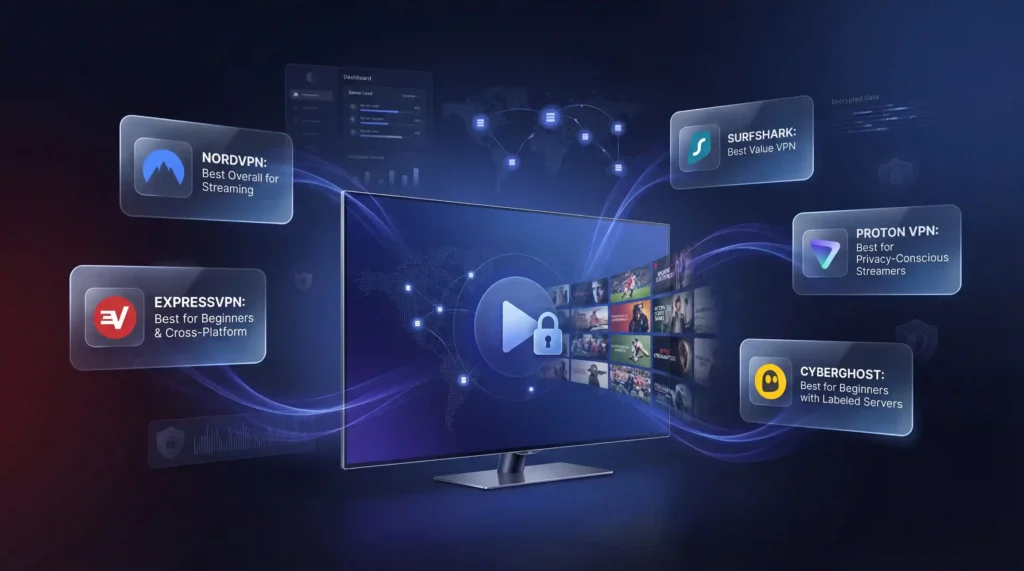
Here is our shortlist of the best VPN for streaming based on comprehensive testing. Each of these services passed our streaming tests across all major platforms and performed well on speed, privacy and ease of use.
1. NordVPN: Best Overall VPN for Streaming
Servers: 9,000+ across 129 countries | Speed Loss: Under 6% in recent tests | Simultaneous Connections: 10 | Starting Price: $3.39/month (2-year plan) | Money-Back Guarantee: 30 days
NordVPN is the fastest VPN we tested by a wide margin. Independent speed tests clocked over 1,200 Mbps on nearby servers with under 6% speed loss. That kind of performance means zero buffering even on 4K streams.
The secret is NordLynx. It is a proprietary protocol built on WireGuard that delivers near-native internet speeds without sacrificing encryption. For streaming specifically, the built-in SmartPlay feature combines VPN routing with Smart DNS so you never have to manually hunt for a working server. We connected to a US server and Netflix US loaded instantly. We switched to the UK and BBC iPlayer followed without touching a single setting.
NordVPN unblocked 17 Netflix regional libraries in our testing and worked perfectly across Disney+, Prime Video, Hulu and Max. Privacy is equally strong in the Panama jurisdiction, RAM-only servers and multiple Deloitte and PwC audits of its no-logs policy.
Best for: Anyone who wants the fastest and most reliable streaming VPN without compromise.
Want to test NordVPN’s industry-leading speeds yourself? Start your subscription through our link and get 30 days risk-free to stream Netflix, Disney+ and more from anywhere. Get NordVPN now.
Now 68% off.
 Nordvpn
2. ExpressVPN: Best for Beginners and Cross-Platform Streaming
Servers: 3,000+ across 105 countries | Speed Loss: Around 8–18% depending on server distance | Simultaneous Connections: 14 | Starting Price: $3.49/month (2-year plan) | Money-Back Guarantee: 30 days
ExpressVPN unblocked 115 streaming services and 18 Netflix regional libraries, the highest count of any VPN we tested. Its apps are the most polished in the industry. One button connects you. Server recommendations for streaming appear automatically. There is genuinely no learning curve.
The Lightway protocol handles long-distance connections better than most rivals. We streamed 4K content from Europe to Asia and the US to Australia without buffering. MediaStreamer (Smart DNS) extends streaming access to devices that cannot run VPN apps like Apple TV and gaming consoles.
One heads-up: ExpressVPN discontinued its router app for third-party routers. The app now only works on ExpressVPN’s own Aircove hardware.
Best for: New VPN users who want maximum streaming compatibility with zero configuration.
3. Surfshark: Best Value VPN for Streaming
Servers: 4,500 across 100 countries | Speed Loss: Around 6–21% depending on protocol and server | Simultaneous Connections: Unlimited | Starting Price: $1.78/month (2-year plan) | Money-Back Guarantee: 30 days
Surfshark costs about half as much as NordVPN and ExpressVPN and it still delivers genuinely competitive streaming performance. The unlimited simultaneous connections policy is the real differentiator. One subscription covers every device in your household with no cap.
For Android users, Surfshark has an exclusive GPS spoofing feature. Apps like YouTube TV use GPS coordinates rather than IP addresses to detect your location. Standard VPNs cannot handle this. Surfshark’s GPS spoofer is the only mainstream solution for GPS-based geo-restrictions. It also unblocked 22-plus Netflix libraries in some test scenarios more than most premium rivals.
Best for: Families and budget-conscious users who need unlimited devices covered.
Surfshark is the best VPN for streaming if you have a household of multiple devices or a tight budget. The unlimited connections policy and genuinely fast speeds make it an excellent value at any price, let alone the $1.78/month entry point.
4. Proton VPN: Best for Privacy-Conscious Streamers
Servers: 18,000+ across 129 countries | Speed Loss: Around 8–16% in tests | Simultaneous Connections: 10 | Starting Price: $2.99/month (2-year plan) | Money-Back Guarantee: 30 days (prorated) | Free Plan: Available (limited servers)
Proton VPN is the only streaming-capable VPN that also sets the standard for privacy. Founded by CERN scientists and based in Switzerland, it operates under some of the world’s strongest data protection laws outside the EU and all surveillance alliances. All apps are open source, so anyone can audit the code for security flaws.
Streaming performance exceeded our expectations. Proton VPN unlocked 20-plus Netflix regional libraries and handled Prime Video, Disney+ and Hulu smoothly across all major platforms. The VPN Accelerator feature boosted our speeds by up to 50% on some servers. There is also a free plan with unlimited data, the best free VPN option available, though it does not support streaming geo-unblocking.
Best for: Users who refuse to trade privacy for streaming access.
5. CyberGhost: Best for Streaming Beginners with Labeled Servers
Servers: 11,500+ across 100+ countries | Speed Loss: Around 15% in tests | Simultaneous Connections: 7 | Starting Price: $2.03/month (2-year plan) | Money-Back Guarantee: 45 days
CyberGhost has standout feature is its labeled streaming servers. Instead of guessing which server works with BBC iPlayer or Netflix US, you search for a server dedicated to that exact platform and connect. The trial-and-error frustration that plagues other VPNs essentially disappears.
Its server network of over 11,500 is one of the largest available which helps maintain access over time as streaming platforms block IP addresses. Speed was around 86% retention in our tests, solid for HD and 4K content. CyberGhost is also the only VPN here with a 45-day money-back guarantee.
Best for: Streaming beginners who want labeled servers and a long trial window.
What Makes a VPN Good for Streaming?
Let’s take a look at what makes a VPN good for streaming, because it helps clarify exactly what separates a great streaming VPN from an average one. These are the four factors we weighted most heavily in our testing.
Unblocking Capability
This is the most important factor by a significant margin. A streaming VPN that cannot reliably access geo-restricted content is simply not useful for the job. Platforms like Netflix maintain separate content libraries in dozens of countries. BBC iPlayer is only accessible with a UK IP address. Disney+ shows different catalogs depending on your location.
A good VPN needs to consistently bypass these restrictions, not just once during a review test but over time and across multiple servers. The challenge is that this is a constant cat-and-mouse game. Streaming platforms regularly identify and block IP addresses associated with known VPN servers.
The best providers respond by rotating IPs and continuously updating server infrastructure. When evaluating any VPN for streaming, you should look for one that has a proven track record of maintaining access, not just a one-time result.
Speed and Connection Quality
VPN encryption and server routing always add some overhead to your connection. The question is how much. For HD streaming at 720p, you need at least 10 Mbps of stable throughput. For 4K content, the minimum is 25 Mbps, and 50 Mbps is recommended for a reliable experience without buffering.
The best VPNs keep speed loss well under 15% on nearby servers thanks to modern protocols like WireGuard and proprietary implementations built on top of it. A VPN that slows your connection by 50% or more is simply not viable for high-resolution streaming. We flagged any service that caused consistent buffering or forced quality drops during our testing.
Server Network
A large and geographically diverse server network matters for two reasons. First, it gives you access to more content libraries worldwide. Second, it means you can almost always find a server close enough to your physical location to maintain fast speeds while still appearing to be in your target country. Look for providers with servers in 100 or more countries and thousands of individual servers spread across those locations.
Device Compatibility
Most people stream on more than one device. Your laptop for travel. A smart TV at home. A tablet on the couch. A good streaming VPN needs apps for all of these platforms, including dedicated apps for streaming devices like Amazon Fire TV Stick and Apple TV. Some providers also offer Smart DNS as an alternative for devices that cannot run VPN apps natively.
Which Streaming Services Work with VPNs?
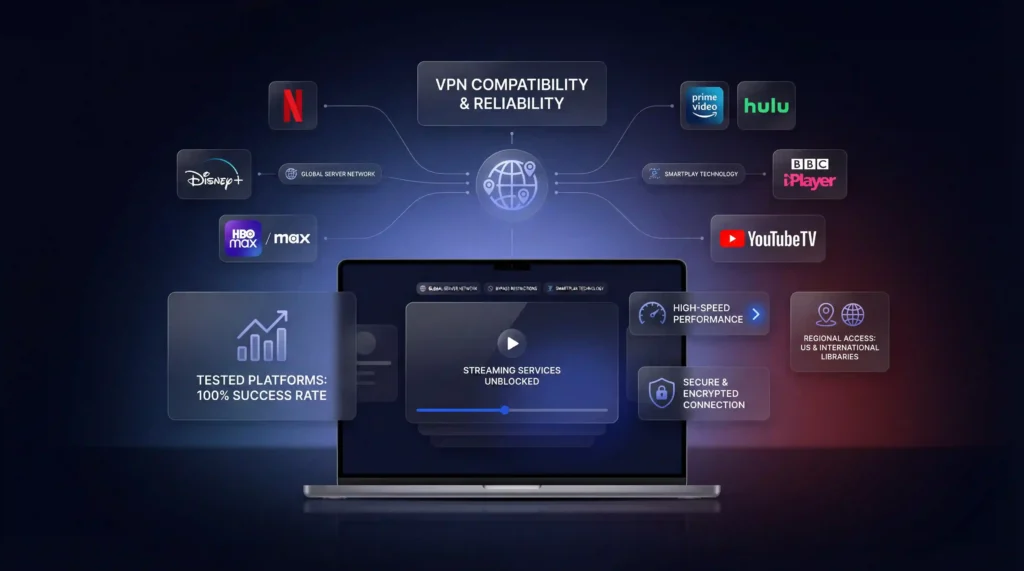
All five of our top picks work reliably with the most popular streaming platforms. Here is a breakdown of what we tested and confirmed is working.
- Netflix: Every VPN on our list unblocks the US Netflix library. NordVPN, ExpressVPN and Proton VPN provide the broadest access to international Netflix libraries, 17 to 20-plus regions respectively. Surfshark unblocks 9 or more libraries which is still more than adequate for most users. Netflix remains the most aggressively blocked platform for VPN traffic but these providers keep up with the restrictions effectively.
- Disney+: All five picks unblocked Disney+ during our testing. Surfshark stood out for exceptional consistency across different platforms and regions. Proton VPN had one noted issue with Disney+ on macOS but performed well elsewhere.
- BBC iPlayer: NordVPN and Surfshark were the most reliable. ExpressVPN has had some intermittent issues with BBC iPlayer in recent months but reported it is working again at the time of publication. CyberGhost’s labeled iPlayer servers made access straightforward.
- Amazon Prime Video: All five VPNs worked consistently with the Service across multiple regional libraries. This was one of the more consistent results across our testing.
- Hulu: All five picks are unblocked on Hulu. ExpressVPN and NordVPN were the most consistently reliable across different devices.
- HBO Max/Max: Unblocked by all five providers tested. NordVPN’s SmartPlay handled this automatically without requiring manual server selection.
- YouTube TV: Surfshark’s GPS spoofing on Android is the only reliable solution for YouTube TV which uses GPS location data rather than IP addresses. Other VPNs can unblock YouTube TV when it relies on IP detection but may fail on mobile apps.
- Sports streaming: VPNs allow you to bypass regional blackout restrictions on platforms like ESPN+ and regional sports networks. Connect to a server in a city where the game is not blacked out and you can watch live sports that would otherwise be restricted in your area. All five picks support this use case effectively.
How to Use The Best VPN for Streaming: Step by Step
Using the best VPN for streaming is straightforward once you have chosen a provider. Here is the process from start to finish.
Step 1: Choose and install your VPN.
Download the VPN app for your device directly from the provider’s website or your device’s app store. All five providers on our list have apps for Windows, macOS, iOS, Android, Fire TV, Apple TV and Android TV.
Step 2: Create your account and log in.
After downloading the app, sign in with the credentials you created at signup. Most VPNs remember your login between sessions, so you only need to do this once.
Step 3: Select your server location.
Open the app and choose a server in the country where the content you want to access is located. Want US Netflix? Connect to a US server. Want BBC iPlayer? Connect to a UK server. For the best speeds, choose a server that is geographically close to your actual location whenever possible.
Step 4: Open your streaming service.
Once connected, open your browser or streaming app. The platform will see your VPN’s IP address and grant you access to that region’s content library. If the service detects the VPN and blocks you, simply try a different server in the same country.
Step 5: Enjoy without buffering.
With a top-tier VPN like the ones on our list, streaming quality should be indistinguishable from a direct connection. If you notice a drop in quality, try a server that is physically closer to you or switch to a protocol like WireGuard for better performance.
VPN Streaming: What to Know Before You Subscribe
Before you commit to a streaming VPN, there are a few critical factors you need to understand from speed requirements to the legal landscape and hidden cost savings.
Speed Requirements for Different Streaming Quality
Understanding the minimum speed requirements helps you evaluate whether your internet connection plus VPN overhead will support the quality level you want.
- 480p (SD): 3 Mbps minimum
- 720p (HD): 5–10 Mbps
- 1080p (Full HD): 10–20 Mbps
- 4K (Ultra HD): 25 Mbps minimum/50 Mbps for reliable playback
The best VPN for streaming typically reduces your connection speed by under 15% on nearby servers. If you have a 100 Mbps connection and your VPN causes a 10% loss, you still have 90 Mbps, more than enough for 4K content on multiple devices simultaneously.
The Cat-and-Mouse Reality
No VPN can guarantee access to every streaming service forever. Streaming platforms constantly update their detection systems and block IP ranges associated with known VPN providers. The best VPN for streaming services respond by rotating their IP addresses and continuously updating their server infrastructure.
This is why choosing an established provider with a large server network and an active technical team matters so much that smaller or cheaper VPNs simply cannot keep up with these updates.
When a server stops working with a particular service, the fix is almost always as simple as switching to a different server in the same country. If that does not resolve it, contact your VPN’s live support team next. All five picks on our list offer 24/7 live chat support.
Is Using a VPN for Streaming Legal?
In the vast majority of countries, yes. VPN use is legal in the US, UK, Canada, Australia and throughout Europe. Using a VPN to avoid geo-restrictions does technically conflict with the terms of service of most streaming platforms but violating a platform’s terms of service is a civil matter between you and that platform and not a criminal issue. In practice, the worst outcome is the platform blocking your VPN’s IP address and asking you to disable it.
There are a small number of countries where VPN use is restricted or prohibited, including China, Russia, Iran and North Korea. If you are in one of these regions, you should research local laws carefully before using a VPN for any purpose.
Can a VPN Save You Money on Streaming Subscriptions?
This is an underappreciated benefit. Because content libraries vary by region, you may be able to access content in one country’s library that would normally require a separate streaming subscription in your home country. For example, certain titles available on Netflix in Japan may require a separate Paramount+ or Peacock subscription in the US. A VPN gives you access to those titles within your existing Netflix subscription.
Additionally, some streaming services and even VPN subscriptions themselves are priced lower in certain markets. While your mileage may vary depending on the platform’s billing restrictions, this is a legitimate way for some users to reduce their overall entertainment spending.
Now that you know what to look for, NordVPN checks every box: under 6% speed loss, 17+ Netflix libraries and 24/7 support all for $3.39/month. 30-day guarantee included. Claim your NordVPN discount.
Now 68% off.
Nordvpn
Choosing the Right VPN for Streaming: Decision Guide
- You want the absolute best performance: Go with NordVPN. The speed numbers are in a class of their own and SmartPlay handles streaming configuration automatically.
- You want the easiest setup experience: Choose ExpressVPN. The app is the most intuitive in the industry and it unblocks the highest number of streaming services we tested.
- You have multiple devices or a family household: Surfshark is the obvious pick. Unlimited simultaneous connections at the lowest price point on our list make it the best value by a significant margin.
- You prioritize privacy alongside streaming access: Proton VPN is the answer. Swiss jurisdiction open-source apps and 20-plus Netflix libraries in one package is a combination that nothing else on the market matches.
- You want the simplest server selection experience: CyberGhost’s labeled streaming servers remove all guesswork and the 45-day guarantee gives you the longest risk-free trial period.
Best VPN for Streaming: FAQs
The Bottom Line
The best VPN for streaming depends on what matters most to you but you genuinely cannot go wrong with any of the five providers on this list. They have all proven themselves in real-world testing across multiple streaming platforms, devices and geographic locations.
If we had to choose just one as the best VPN for streaming, it would be NordVPN. The combination of sub-6% speed loss, reliable access to 17-plus Netflix libraries, SmartPlay automation and rock-solid privacy credentials makes it the most complete streaming VPN available today. Its pricing is competitive and every plan comes with a 30-day money-back guarantee so you can test it without any financial risk.
For users on a tighter budget, Surfshark at $1.78/month with unlimited connections is genuinely exceptional value. And for anyone who takes digital privacy as seriously as content access, Proton VPN is the only provider that truly excels at both.
Whatever you choose, make sure to test it during the guarantee window using the specific streaming services you care about most. The VPN landscape changes quickly and the best way to know if a service works for your exact setup is to try it firsthand.