Are VPNs Legal? Global Laws, Risks and Safety Guide
Are VPNs legal and safe to use? Learn global laws, risks and restrictions plus how to choose a secure VPN. Protect your privacy get started today.
 Michael Gargiulo
Find your VPN
What will you mostly use a VPN for?
Pick one, then answer a few quick questions. We name the VPN that fits, and say why.
VPN for streaming
Question 1 of 3
What made you look for a streaming VPN?
24,238 VPN picks made through VPN.com in the last 30 days

Your match

NordVPN
App store ratings, part of the score
4.664.59

ProtonVPN
App store ratings, part of the score
4.614.70
VPN for privacy
Question 1 of 3
What made you look for a privacy VPN?
24,238 VPN picks made through VPN.com in the last 30 days
Your match
NordVPN
App store ratings, part of the score
4.664.59
ProtonVPN
App store ratings, part of the score
4.614.70
VPN for gaming
Question 1 of 3
What made you look for a gaming VPN?
24,238 VPN picks made through VPN.com in the last 30 days
Your match
NordVPN
App store ratings, part of the score
4.664.59
ProtonVPN
App store ratings, part of the score
4.614.70
VPN for free plans
Question 1 of 3
What made you look for a free VPN?
24,238 VPN picks made through VPN.com in the last 30 days
Your match
ProtonVPN
App store ratings, part of the score
4.614.70
NordVPN
App store ratings, part of the score
4.664.59
NordVPN7,213 serversNordVPN's privacy and security record is strong on process and mixed on proof
93 out of 100, built from two weighted parts
App store ratings, part of the score
4.664.59
Researched Oct 3, 2026Claims checked: 31Independent sources: 11Scores updated Oct 22, 2026
 ExpressVPN3,000+ servers
86 out of 100, built from two weighted parts
App store ratings, part of the score
4.684.69
Researched Oct 3, 2026Claims checked: 27Independent sources: 13Scores updated Oct 22, 2026
ProtonVPN20,000+ servers85 out of 100, built from two weighted parts
App store ratings, part of the score
4.614.70
Researched Oct 3, 2026Claims checked: 23Independent sources: 3Scores updated Oct 22, 2026
Bottom Line: VPNs are legal in most countries including the US, UK, EU, and Canada, but are restricted or banned in a growing number of countries including China, Russia, Iran, and North Korea. Always check local laws before connecting.
The short answer: yes. VPNs are legal in most countries, though the full picture is more nuanced. VPN laws vary by country and they are changing fast.
Governments that once ignored VPN use are now cracking down. New restrictions appeared in 2024 and 2025 that millions of users never saw coming.
This guide breaks down exactly where VPNs are legal, where they are restricted, and what makes a VPN safe to use. By the end you will know exactly where you stand.
What Is a VPN and Why Do People Use One?
A VPN (Virtual Private Network) creates an encrypted tunnel between your device and a remote server. When you connect through that tunnel, your internet traffic becomes invisible to your internet service provider (ISP), your government, and any third party trying to monitor your activity.
Your real IP address gets replaced with one belonging to the VPN server. Websites see a different location instead of your own.
People use VPNs for straightforward reasons:
- Protecting personal data on public Wi-Fi networks- Preventing ISPs from tracking and selling their browsing history
- Accessing geo-restricted content from streaming services- Securing business communications for remote teams
- Staying private in countries with heavy surveillance
VPNs are not just for tech-savvy users. Millions of everyday people rely on them. Businesses depend on them. Even the FBI recommends VPN use for greater online privacy. Take the next step in protecting your data with NordVPN, a simple, reliable solution trusted by millions worldwide.
VPN Legality by Country: Where Are VPNs Fully Legal?
Yes. VPNs are legal in most countries. Countries with high internet freedom like the US, Canada, and European nations have no VPN restrictions at all.
Here is a quick look at regions where VPN use is fully legal and widely accepted:
- United States: Legal with no restrictions. Used by both consumers and businesses daily.
- Canada: Legal. Widely used to protect against ISP tracking.
- United Kingdom: Legal. Common for both personal privacy and business security.
- European Union: Legal throughout all member states. EU regulations actually push VPN providers to maintain higher privacy standards, which benefits users through stricter no-logs policies and GDPR-compliant data handling.
- Australia: Legal. Often used to access global content libraries.
- Japan and South Korea: Legal with no restrictions in place.
If you live in or travel through any of these regions, you have nothing to worry about from a legal standpoint.
Where Are VPNs Restricted or Banned?
This is where things get more complicated. A small but growing number of countries either restrict or outright ban VPN use. The list has expanded in recent years.
| Country | Legal Status | What You Need to Know |
|---|---|---|
| North Korea | Illegal | Internet access is almost nonexistent. VPN use carries severe punishment. |
| Belarus | Illegal | Banned since 2015 alongside Tor and encrypted apps like Signal. Fines and jail time apply. |
| Turkmenistan | Illegal | The government required citizens to swear they would not use VPNs. Enforcement is strict. |
| Iraq | Illegal | Banned since 2014 under national security laws. ISPs must block VPN traffic. |
| Iran | Illegal | Iran passed a law in February 2024 banning unauthorized VPNs. Only government-approved services are permitted. |
| China | Restricted | Only state-licensed VPNs are allowed. China’s Great Firewall actively detects and blocks unauthorized VPN traffic. |
| Russia | Restricted | By July 2025, a new law will criminalize searching for content the government labels extremist via VPN. |
| UAE | Restricted | VPNs are legal for standard use but illegal when used for VoIP services like WhatsApp or Skype calls. |
| Oman | Restricted | Individual use requires prior government approval. Fines of up to $1,300 apply for violations. |
| India | Regulated | Legal to use but VPN providers must retain detailed user logs for a minimum of five years. |
Traveling to a restricted country? Download and configure your VPN before you arrive. VPN provider websites are often blocked in countries like China and Iran, making it impossible to sign up or download the app once you’re there. Use a provider with obfuscated servers (such as NordVPN’s Obfuscated Servers or Proton VPN’s Stealth protocol) which disguise VPN traffic as regular HTTPS to evade deep packet inspection systems like China’s Great Firewall.
Two newer developments are worth noting. In September 2024, Brazil’s Supreme Court ruled that users could be fined up to 50,000 reais (around $9,000) per day for using a VPN to access platform X (formerly Twitter), which had been banned in the country.
Why Do Governments Ban VPNs?
Governments ban or restrict VPNs for several interconnected reasons. The most common are:
- Censorship control: VPNs let users bypass national firewalls and access blocked content. News outlets, social media platforms, and opposition content all become reachable through a VPN. Authoritarian governments want to prevent exactly this.
- Surveillance: Encrypted VPN traffic makes it much harder for authorities to monitor citizens. Governments that rely on mass surveillance view this as a direct threat to national security.
- Political stability: During elections and protests, governments in countries like Russia and Myanmar crack down on VPN use. The goal is to prevent protesters from organizing and communicating freely.
- Economic interests: In some countries, blocking VPN services protects domestic telecoms from competition. The UAE restricts VoIP calls through VPNs to shield local telecom providers from cheaper international calling apps.
How Governments Enforce VPN Bans
If VPNs hide your activity, how do governments catch people using them? They rely on several powerful tools:
- Deep Packet Inspection (DPI): This technology inspects internet traffic on a packet-by-packet basis. It identifies patterns generated by VPN connections. ISPs use DPI to automatically detect and block VPN activity.
- National Firewalls: The most famous is the Great Firewall of China. It blocks access to VPN websites and intercepts VPN traffic before a connection can complete.
- ISP Reporting: In most restricted nations, ISPs monitor traffic and report suspected VPN usage to authorities.
- Government-Controlled VPNs: Countries like Russia only allow government-registered VPN providers. These services keep logs and give authorities backdoor access, which defeats the purpose of VPN privacy entirely.
Real-world enforcement is increasing. Multiple individuals in China received administrative penalties between 2020 and 2024 for bypassing the Great Firewall. In 2023, UAE authorities detained users specifically for making WhatsApp voice calls through a VPN.
Is Using a VPN Safe?
Legal status and safety are two different questions. In countries where VPNs are legal, using one is safe as long as you pick the right provider. Not every VPN meets the same standard. Some have been caught collecting and selling user data to advertisers.
Here is what separates a reliable VPN from a risky one:
- No-logs policy: A trustworthy VPN does not store any data about your internet activity. Look for providers that publish an independent audit report.
- AES-256 encryption: This is the gold standard used by banks and military organizations. If a VPN uses anything weaker, question it.
- Jurisdiction matters: VPN companies based in Panama, the British Virgin Islands, or Switzerland operate outside intelligence-sharing agreements like the Five Eyes alliance. Governments cannot easily compel them to hand over user data.- Kill switch: This feature cuts your internet connection if the VPN drops unexpectedly. Without it, your real IP address leaks until you notice the disconnection.
- Anonymous payment options: Providers that accept prepaid cards and cryptocurrency let you create an account without linking your real identity.
- Shared IP addresses: Most legitimate services route multiple users through the same IP address simultaneously. This makes it nearly impossible to trace any activity to a single person.
A VPN has limits. It does not protect against cookie tracking or phishing attacks. It fails if the VPN company itself logs data and complies with government requests. Your security depends entirely on the company operating the service.
If you want a VPN that meets these security standards, NordVPN is a trusted option that says its no-logs policy has been independently audited, with AES-256 encryption.
Does a VPN Make Illegal Activity Legal?
No. A VPN is a privacy tool, not a legal shield. Criminal activity conducted through a VPN remains illegal in every country where VPNs are fully permitted.
Pirating copyrighted material, hacking, committing fraud, and cyberstalking are all illegal with or without a VPN. Law enforcement agencies can request logs from VPN providers. Any logs that exist can be presented as evidence in court. Choose a genuinely no-logs provider if privacy matters to you.
Final Verdict
VPN use is lawful in all but a few countries. In most cases it ranks among the smartest privacy decisions you can make online. The key is staying informed. Laws around VPN use are tightening in several regions. What was a grey area in 2023 may be a clear restriction today.
Always read local laws before connecting. Pick a provider with a proven no-logs policy, strong encryption, and a solid reputation. Protecting your privacy is good. Protecting it the right way matters just as much.
References
- FBI. 2026. FBI Homepage. https://www.fbi.gov.Archived: Wayback Machine snapshot
- European Union. n.d. Your gateway to the EU, News, Highlights. Retrieved September 30, 2026 from https://europa.eu.Archived: Wayback Machine snapshot
- J. A. Donenfeld. n.d. WireGuard: fast, modern, secure VPN tunnel. Retrieved September 30, 2026 from https://www.wireguard.com.Archived: Wayback Machine snapshot
- OpenVPN. n.d. Secure VPN Solutions for Business & Remote Access. Retrieved September 30, 2026 from https://openvpn.net.Archived: Wayback Machine snapshot
- Netflix. n.d. Netflix - Watch TV Shows Online, Watch Movies Online. Retrieved September 30, 2026 from https://www.netflix.com.Archived: Wayback Machine snapshot
- HackerOne. n.d. HackerOne | Leader in Continuous Threat Exposure Management | Security for AI. Retrieved September 30, 2026 from https://www.hackerone.com.Archived: Wayback Machine snapshot
Resources for this page
Charts and reference images from our research, free to view and share.
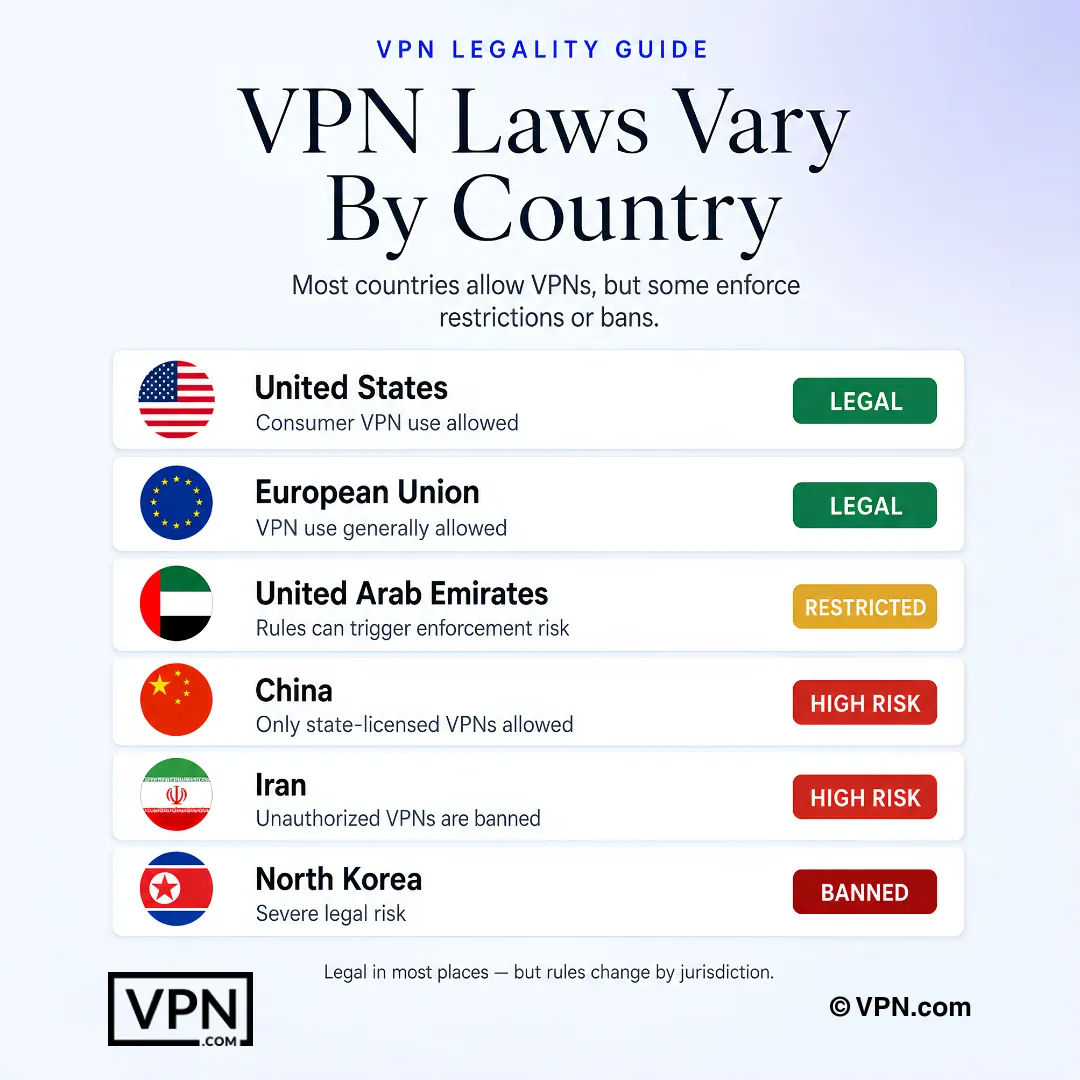
VPN rules change by jurisdiction, so legality should be checked by country before use.
Frequently Asked Questions
Is it illegal to use a VPN in the US, UK, EU, or Canada?
No. VPNs are fully legal in the US, UK, Canada, all EU member states, Australia, Japan, and South Korea, with no restrictions on personal or business use. EU regulations even push providers toward stricter no-logs standards under GDPR. If you live in or travel through these regions, there’s no legal risk from VPN use itself.
Which countries currently ban VPNs outright?
North Korea, Belarus, Turkmenistan, Iraq, and Iran all ban VPN use entirely. Belarus banned VPNs in 2015 alongside Tor and Signal, Iraq banned them in 2014 under national security law, and Iran passed a law in February 2024 permitting only government-approved services. Turkmenistan required citizens to swear they would not use VPNs, with strict enforcement.
What happens if I get caught using a VPN in China or Russia?
In China, only state-licensed VPNs are legal, and the Great Firewall’s deep packet inspection detects unauthorized traffic; multiple individuals received administrative penalties between 2020 and 2024 for bypassing it. In Russia, a law taking effect by July 2025 criminalizes searching for content the government labels extremist through a VPN, and only government-registered providers, which keep logs, are permitted.
Does using a VPN make illegal downloading or hacking legal?
No. A VPN is a privacy tool, not a legal shield, so piracy, hacking, fraud, and cyberstalking remain illegal everywhere VPNs are permitted. Law enforcement can request logs from providers that keep them, and any stored logs can become courtroom evidence. Choosing a genuinely no-logs provider, ideally one with a published independent audit, limits what could ever be handed over.
What’s the legal risk of using a VPN in the UAE, Oman, or India?
The UAE allows VPNs generally but bans using them for VoIP calls through apps like WhatsApp or Skype, and authorities detained users for this in 2023. Oman requires individual users to get prior government approval before connecting. India permits VPN use but requires providers to retain detailed user logs for a minimum of five years, weakening privacy protections.
Can using a VPN actually get me fined, like in Brazil?
Yes. Brazil’s Supreme Court ruled in September 2024 that users could be fined up to 50,000 reais per day for using a VPN to access platform X after it was banned nationally. This shows enforcement isn’t limited to authoritarian states, courts in countries with otherwise open internet policies can penalize VPN use tied to a specific banned platform.
How do governments actually detect and block VPN traffic?
Deep packet inspection (DPI) is the primary tool, examining data packet-by-packet to identify patterns unique to VPN connections, then blocking that traffic automatically. China’s Great Firewall combines DPI with blocking VPN provider websites outright. Some countries add ISP reporting requirements or restrict citizens to government-registered VPNs that log activity and grant authorities backdoor access.
What separates a safe, legal VPN from one that could get me in trouble?
A trustworthy VPN maintains a genuine no-logs policy backed by a published independent audit, uses AES-256 encryption, and operates from a jurisdiction such as Panama, the British Virgin Islands, or Switzerland, outside Five Eyes intelligence-sharing agreements. Some VPNs have been caught collecting and selling user data instead, which defeats the purpose entirely.
What does a kill switch protect me from if my VPN drops in a restricted country?
A kill switch cuts your internet connection the moment your VPN drops, preventing your real IP address from leaking while you’re unaware you’ve disconnected. NordVPN, ExpressVPN, and ProtonVPN all include kill switches verified to work during forced-disconnect testing. In a country where VPN use is monitored, that gap in coverage is exactly what deep packet inspection systems look for.
How should I prepare my VPN before traveling to a restrictive country?
Download and configure the app before you arrive, since VPN provider websites and app stores are often blocked once you’re inside countries like China or Iran. Choose a provider with obfuscated servers, such as NordVPN’s Obfuscated Servers or ProtonVPN’s Stealth protocol, which disguise VPN traffic as regular HTTPS to evade deep packet inspection systems like China’s Great Firewall.
What if my VPN gets blocked by China’s Great Firewall after I’ve already arrived?
Switch to obfuscated servers if your provider offers them, since the Great Firewall relies on deep packet inspection to flag standard VPN traffic patterns. NordVPN’s Obfuscated Servers and ProtonVPN’s Stealth protocol disguise your connection as regular HTTPS traffic specifically to get past this detection. Reinstalling or downloading the app once inside the country usually isn’t possible since provider sites are blocked there too.
How much does a reliable, no-logs VPN cost if I’m traveling to a country with VPN restrictions?
Pricing varies but stays affordable relative to the legal risk. NordVPN starts from $3.49/month on its longest plan with 7,213 servers across 150 countries, ExpressVPN starts from $2.99/month with 3,000+ servers in 113 countries, and ProtonVPN runs from $3.49/month with 20,000+ servers in 140+ countries. Each publishes audit material or says its no-logs claims have been audited.
Can I get a refund if a VPN fails to work reliably in a restricted country?
Yes. NordVPN, ExpressVPN, and ProtonVPN all back their plans with a 30-day money-back guarantee, so if a provider’s obfuscated servers or standard connection get consistently blocked, you can request a refund within that window. No VPN guarantees access in every heavily restricted region, so testing the connection early in your subscription matters.