




This page covers the best VPN options across all streaming platforms. We do not run our own speed or streaming tests. Our rankings combine our Trust Score with published results from selected third-party review sites, including CNET[1] and Security.org[2].
Quick comparison: streaming VPN performance
| VPN | Trust Score rank | Netflix libraries | Connections | Starting price |
|---|---|---|---|---|
| NordVPN | #1 of 22 | 17+ | 10 | $3.49/mo |
| ExpressVPN | #2 of 22 | 18 | 10–14 (by plan) | $2.99/mo |
| Surfshark | #3 of 22 | 9+ | Unlimited | $2.49/mo |
| Proton VPN | #3 of 22 | 20+ | 10 | $3.49/mo |
| CyberGhost | #3 of 22 | Multiple | 7 | $2.19/mo |
For a deeper look at raw throughput across all use cases, see our dedicated speed comparison.
Top 5 VPNs for streaming
These five services rank well on our Trust Score and in published third-party test results, and each supports streaming on the major platforms.
NordVPN: top Trust Score rank for streaming
NordVPN holds the #1 Trust Score rank of 22 providers. A nearby server usually leaves plenty of bandwidth headroom for 4K, which needs about 25 Mbps, though any VPN adds some latency.
NordVPN uses NordLynx, a proprietary protocol built on WireGuard. It is built for low overhead without weakening encryption. For streaming, SmartPlay automatically combines VPN routing with Smart DNS, so you can skip hunting for a working server manually.
NordVPN is reported to reach 17+ Netflix regional libraries, and to work with Disney+, Prime Video, Hulu, and Max, though access can change when platforms update their blocks. It also runs natively on Fire TV, Android TV, and Apple TV.
ExpressVPN: simplest setup for new users
ExpressVPN is reported to reach 115 streaming services and 18 Netflix regional libraries. One button connects you. Server recommendations appear automatically.
The Lightway protocol is built to keep long-distance connections stable. Distant servers add latency on any VPN, so pick one near you when you can. ExpressVPN also provides native apps for smart TVs, game consoles, and routers, covering devices that many VPNs require manual setup for.
Surfshark: unlimited devices for less
Surfshark costs less than NordVPN and ExpressVPN. It is also built for streaming. The defining feature is unlimited simultaneous connections. One subscription covers every device in your household.
Surfshark includes GPS spoofing, aimed at a problem IP masking alone does not cover: YouTube TV uses GPS coordinates as well as IP addresses to detect location on mobile. Surfshark is reported to reach 9+ Netflix libraries.
Proton VPN: privacy-first streaming
Proton VPN pairs streaming support with a strong privacy record. Founded by CERN scientists and based in Switzerland, it operates under Swiss data protection law. If privacy matters alongside streaming, Proton VPN is a strong pick.
Proton VPN is reported to reach 20+ Netflix regional libraries using its Stealth and WireGuard protocols, and to work with Prime Video, Disney+, and Hulu on US, UK, and EU servers. Proton says its VPN Accelerator can improve speeds on distant servers. A free plan with unlimited data is also available, though streaming access requires the paid tier.
CyberGhost: labeled servers remove the guesswork
CyberGhost has a standout feature: its labeled streaming servers. Instead of guessing which server works with BBC iPlayer or Netflix US, you search for a server dedicated to that exact platform and connect. CyberGhost labels servers for over 50 streaming services, including niche platforms like Crunchyroll and Peacock.
Its network of 9,600+ servers across 100 countries is one of the largest available. This helps maintain access as platforms block IP addresses over time. Speed depends on the server and protocol, and WireGuard is usually the lighter choice for HD and 4K. CyberGhost is also the only provider here with a 45-day money-back guarantee, giving you extra time to test it on every platform you use.
What makes a VPN good for streaming?
- Reliable access is the most important factor. A VPN that can’t reliably access geo-restricted content is useless for streaming. Platforms constantly identify and block IP ranges linked to known VPN servers.
- Speed determines quality. VPN encryption always adds some overhead. You need at least 10 Mbps for HD and 25 Mbps for 4K. A nearby server using a modern protocol like WireGuard keeps the added latency and lost throughput small.
- Server network matters for two reasons. More countries means more content libraries. More servers means less congestion and faster connections. Look for 60+ countries and thousands of individual servers.
- Device compatibility is essential because most people stream on multiple devices. All five picks have apps for Windows, macOS, iOS, Android, Fire TV, Apple TV, and Android TV.
What the FBI says about paying for a VPN
“Consider paying for a VPN service. Many VPN apps are free to you because they make money by sharing your information with third parties.”
FBI Portland Field Office, October 29, 2019[3]
The FBI publishes criteria and does not endorse any provider.
Is using a VPN for streaming legal?
In most countries, yes. VPN use is legal in the US, UK, Canada, Australia, and throughout Europe. Using one to access geo-restricted content does technically conflict with most platforms’ terms of service. This is a civil matter, not a criminal one. The worst realistic outcome is the platform blocking your VPN’s IP and asking you to disable it.
VPN use is restricted or prohibited in a small number of countries including China, Russia, and Iran. Research local laws carefully if you’re in one of these regions.
VPN.com does not encourage or condone using VPN services to violate the terms of service of any platform. Information on this page is provided for educational purposes. Users are responsible for complying with the policies of the services they use.
References
- A. Tomaschek and M. Long. 2026. Best VPN for Streaming in 2026. CNET (August 10, 2026). Retrieved September 30, 2026 from https://www.cnet.com/tech/services-and-software/best-vpn-for-streaming/.Archived: Wayback Machine snapshot
- Security.org. 2026. The Best VPNs for Streaming in 2026. Retrieved September 30, 2026 from https://www.security.org/vpn/best/streaming/.Archived: Wayback Machine snapshot
- Federal Bureau of Investigation. 2019. Oregon FBI's Tech Tuesday: Building a Digital Defense Using Virtual Private Networks. FBI Portland Field Office, press release (October 29, 2019). Retrieved September 30, 2026 from https://www.fbi.gov/contact-us/field-offices/portland/news/press-releases/oregon-fbis-tech-tuesday-building-a-digital-defense-using-virtual-private-networks.Archived: Wayback Machine snapshot
Resources for this page
Charts and reference images from our research, free to view and share.
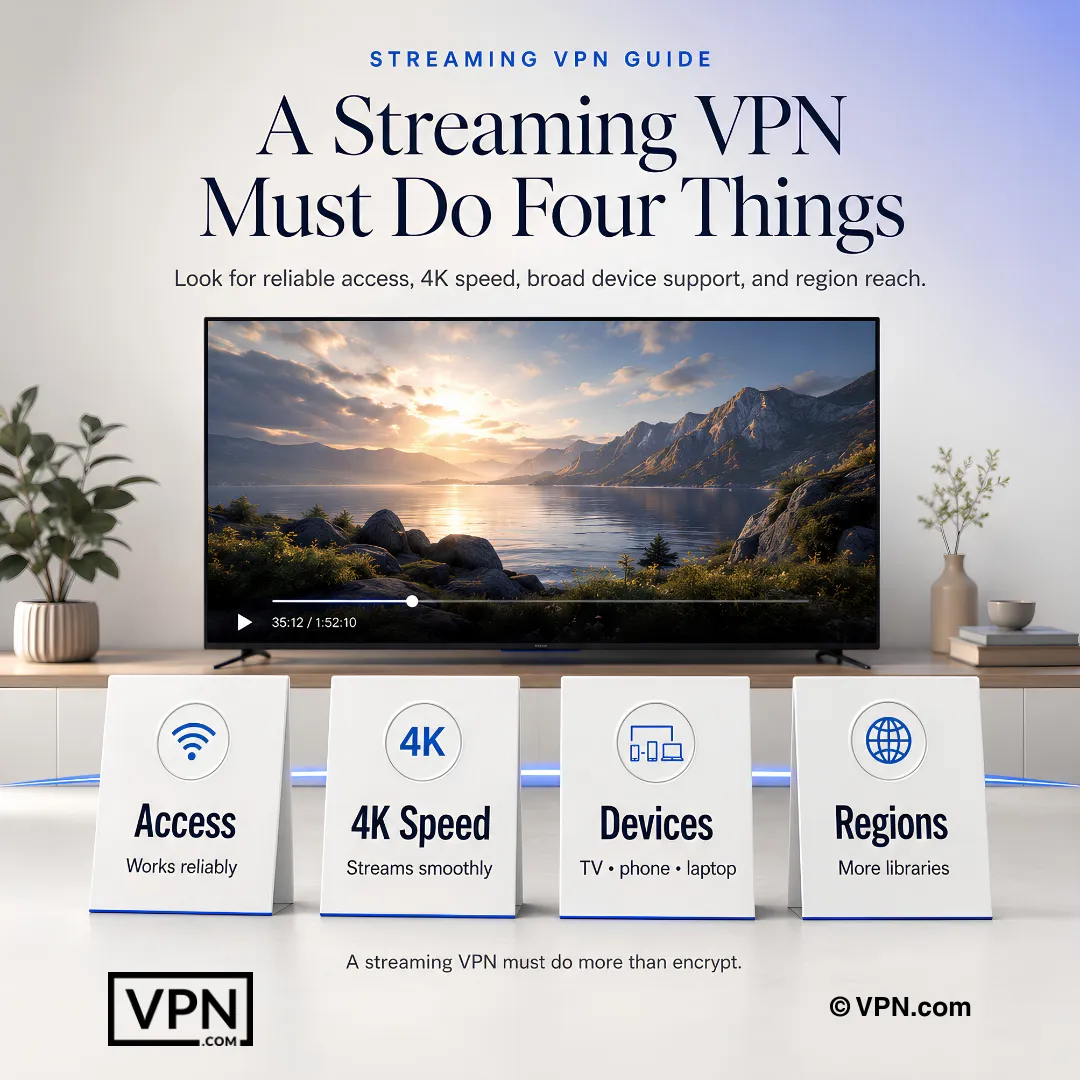
A strong streaming VPN must keep access reliable, preserve 4K performance, support the right devices, and reach the required regions.