ExpressVPN Pricing: Plans from $3.26/Month
Compare ExpressVPN pricing across Basic, Advanced, and Pro plans. Save up to 78% with longer commitments and get a 30-day money-back guarantee.
Compare VPN Pricing



How Much Does ExpressVPN Cost?
ExpressVPN costs $12.99 to $19.99 per month on monthly billing. The 2-year plan drops costs to $3.26/month for Basic and $6.99/month for Pro. All three tiers (Basic, Advanced, Pro) include a 30-day money-back guarantee. Longer commitments access discounts up to 78%.
ExpressVPN Plans and Pricing Breakdown
ExpressVPN splits its service into three tiers: Basic, Advanced, and Pro. Each tier offers monthly, 1-year, and 2-year billing cycles.
Basic covers the core VPN with no extras. Monthly billing runs $12.99. The 1-year plan costs $59.88 total ($4.99/month), saving 69%. The 2-year plan costs $78.18 total ($3.26/month), saving 78%.
Advanced adds identity protection tools like a data breach monitor and password manager. Monthly billing costs $13.99. The 1-year plan runs $71.88 ($5.99/month) at 65% off. The 2-year plan totals $100.58 ($4.19/month) at 74% off.
Pro bundles the VPN with identity theft insurance and credit monitoring. Monthly billing hits $19.99. The 1-year plan costs $107.88 ($8.99/month) at 64% off. The 2-year plan totals $167.78 ($6.99/month) at 70% off.
Intro vs. Renewal Pricing: What You Actually Pay
The discounted rates shown above apply to your first billing cycle only. This is the detail most buyers miss. ExpressVPN renewal rates climb back toward standard pricing after year one or two.
Renewal pricing typically matches or sits close to monthly rates annualized. A Basic 1-year plan at $59.88 the first year could renew near $99 to $120. ExpressVPN does not prominently advertise renewal rates on its pricing page.
Check your account settings 2 weeks before renewal to confirm exact charges. You can cancel auto-renewal and re-subscribe during a promotional period to recapture introductory pricing. This strategy saves 30% to 50% compared to passive renewal.
Best Plan for Each User Type
Casual Users
Pick the Basic 2-year plan at $3.26/month. You get the full VPN with 3,000+ servers across 105 countries. Casual browsing, streaming, and public Wi-Fi protection require nothing beyond the core VPN.
Power Users
The Advanced 1-year plan at $5.99/month fits frequent travelers and security-conscious professionals. You get password management and breach alerts alongside the VPN. The 1-year commitment lets you reassess competitors annually without a 2-year lock-in.
Families and High-Risk Users
The Pro 2-year plan at $6.99/month makes sense for households needing identity theft insurance. Credit monitoring adds tangible value when multiple family members share the account. ExpressVPN allows up to 8 simultaneous device connections across all tiers.
Payment Methods Available
ExpressVPN accepts a wider range of payment methods than most competitors. Credit and debit cards include Visa, Mastercard, American Express, and Discover.
Digital wallets like PayPal are supported for recurring billing. Cryptocurrency payments through Bitcoin provide an anonymous option but limit refund flexibility. Regional options include UnionPay, iDeal, Sofort, and other localized processors depending on your country.
Prepaid gift cards from retailers can also fund your account in some cases. Choose PayPal or credit card if you want the simplest refund path through the 30-day guarantee.
Seasonal Discount Patterns
ExpressVPN runs its deepest promotions during 4 predictable windows each year. Black Friday and Cyber Monday in November consistently deliver the lowest published prices. Holiday sales in late December through early January offer similar markdowns.
Back-to-school promotions appear in August and September with moderate discounts. Occasional flash sales surface during spring, typically lasting 48 to 72 hours. The 2-year plan discounts during Black Friday have historically matched or beaten 78% off.
Set a price alert or bookmark the pricing page in October to catch the best window. Signing up mid-cycle on a monthly plan and switching during a sale wastes money.
ExpressVPN vs. Competitor Pricing
ExpressVPN sits at the premium end of the VPN market. Here is how its lowest effective rate compares to competitors on their cheapest long-term plans.
| Provider | Cheapest Monthly Rate | Billing Period | Servers |
|---|---|---|---|
| ExpressVPN Basic | $3.26/mo | 2-year | 3,000+ |
| NordVPN Basic | $2.99/mo | 2-year | 6,400+ |
| Surfshark Starter | $2.19/mo | 2-year | 3,200+ |
| Private Internet Access | $2.03/mo | 3-year | 35,000+ |
| Proton VPN Plus | $4.49/mo | 2-year | 4,800+ |
ExpressVPN costs 9% to 60% more than budget competitors at the lowest tier. The premium buys you consistently fast speeds, a proven no-logs audit history, and reliable streaming accessing. Users prioritizing raw cost savings should consider Surfshark or PIA instead.
Money-Back Guarantee and Refund Process
All ExpressVPN plans include a 30-day money-back guarantee with no usage restrictions. You can use the full service for 30 days and still receive a complete refund. There are no data caps or feature limitations during the trial window.
To request a refund, contact ExpressVPN support through 24/7 live chat. State that you want to cancel and receive your refund. Representatives process most requests within 5 to 10 minutes without aggressive retention tactics.
Refunds typically land back in your account within 5 to 7 business days for credit cards. PayPal refunds arrive within 3 days. Bitcoin payments cannot be refunded to the original wallet, so the company issues account credit or alternative payment.
Resources for this page
Charts and reference images from our testing, free to view and share.
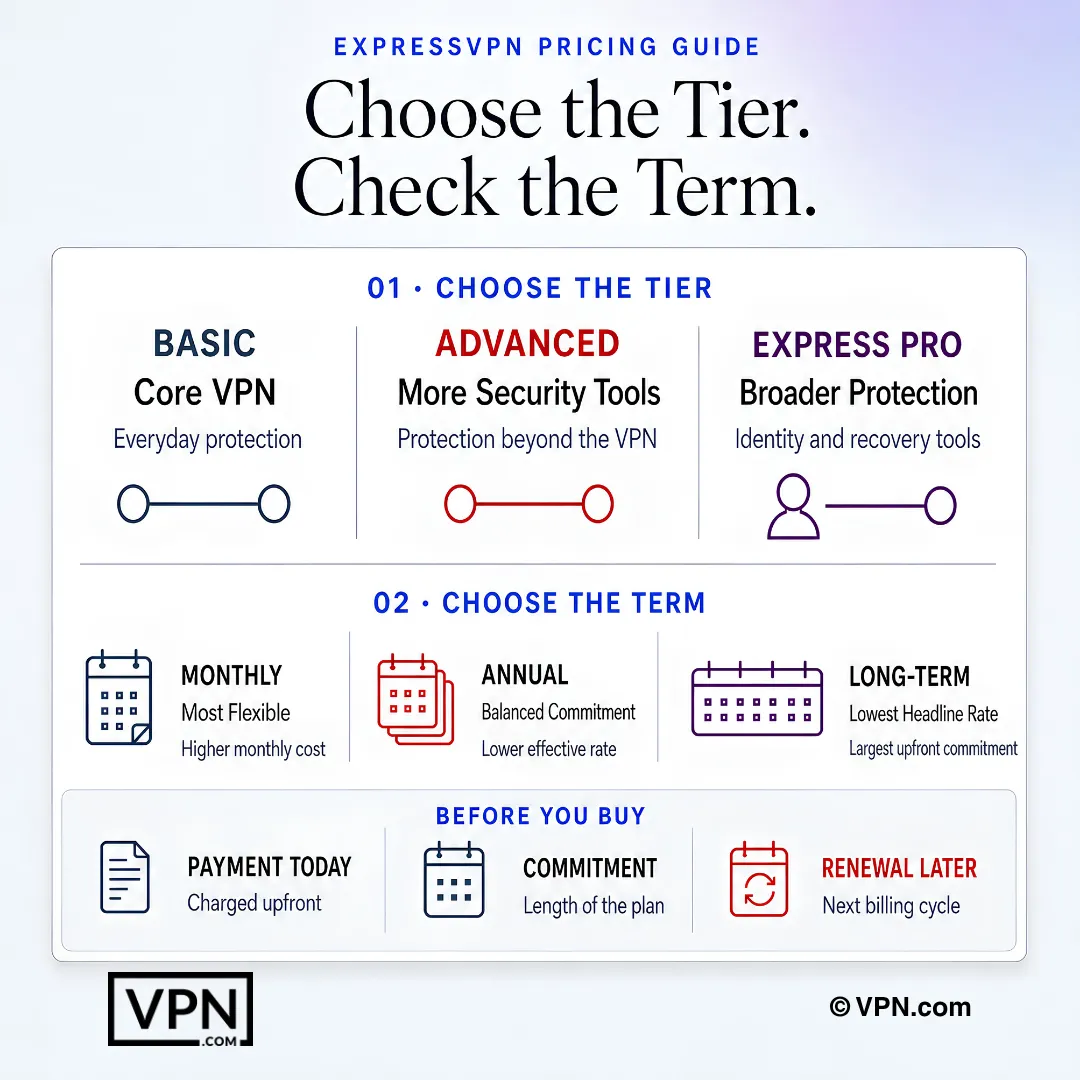
ExpressVPN pricing depends on both the protection tier and billing term, so buyers should compare the upfront charge and renewal conditions.
Frequently Asked Questions
How much does ExpressVPN cost per month?
ExpressVPN’s lowest effective rate is $3.49 a month on its longest-term commitment, per our pricing data. Billed monthly with no commitment, Basic runs $12.99, Advanced $13.99, and Pro $19.99. Every tier, regardless of billing length, includes a 30-day money-back guarantee, so testing the discounted rate carries no long-term risk.
What’s the difference between ExpressVPN’s Basic, Advanced, and Pro plans?
Basic is VPN-only with no extras at $12.99/month billed monthly. Advanced layers in a password manager and a lighter identity-protection bundle for $13.99/month. Pro bundles identity theft insurance and credit monitoring for $19.99/month, plus the highest device allowance of the three tiers. All three drop sharply in price on 1-year or 2-year terms.
Why does ExpressVPN’s renewal price jump after the first term?
The discounted rate you sign up at, including the 2-year Basic plan’s 78% off, applies only to your first billing cycle. ExpressVPN doesn’t prominently advertise renewal pricing on its site, and rates climb back toward the standard monthly rate once that term ends. Check your account settings about two weeks before renewal to confirm the actual upcoming charge.
How does ExpressVPN’s pricing compare to NordVPN and Surfshark?
ExpressVPN’s cheapest rate is $3.49/month on its longest-term plan, matching NordVPN’s own $3.49 floor, while Surfshark undercuts both at $1.99/month. ExpressVPN runs 3,000+ servers in 105 countries, smaller than NordVPN’s 8,900+ servers in 129+ countries but comparable to Surfshark’s 3,200+ servers in 100+ countries. The premium buys a longer audit history and consistent streaming access.
Can I get a full refund if ExpressVPN doesn’t work for me?
Yes. Every ExpressVPN plan, including multi-year terms, carries a 30-day money-back guarantee with no usage restrictions, so you can use the full service for 30 days and still receive a complete refund. Request it via 24/7 live chat; representatives typically process the cancellation within 5 to 10 minutes, and the refund itself lands in 5 to 7 business days for card payments or 3 days via PayPal.
Which payment method gives the smoothest refund experience with ExpressVPN?
Credit card and PayPal offer the simplest refund path within the 30-day guarantee: card refunds land in 5 to 7 business days, PayPal in about 3 days. Bitcoin payments can’t be refunded to the original wallet, so ExpressVPN issues account credit or an alternate payment method instead. Choose card or PayPal if refund flexibility matters more to you than payment anonymity.
How many devices can I connect on each ExpressVPN plan?
Device limits scale with the tier: ExpressVPN supports 10 to 14 simultaneous connections depending on plan, with Pro offering the widest allowance and Basic the narrowest. Every plan runs on Windows, macOS, Linux, Android, and iOS using the same core VPN. Families opting for Pro get the highest device coverage bundled with identity theft insurance and credit monitoring.
When is the best time to buy ExpressVPN for the biggest discount?
Target the four windows ExpressVPN discounts most deeply: Black Friday and Cyber Monday in November, holiday sales stretching from late December into early January, back-to-school promotions in August and September, and periodic 48-to-72-hour flash sales in spring. Historically, Black Friday 2-year deals have matched or beaten the standard 78% discount on the Basic plan.
How do I avoid getting stuck at ExpressVPN’s high renewal rate?
Cancel auto-renewal before your term ends, then re-subscribe during one of ExpressVPN’s promotional windows, such as Black Friday or the holiday sale period, to recapture introductory pricing. This tactic can save 30% to 50% versus letting the plan renew passively at standard rates. Check your account settings about two weeks ahead to confirm the exact renewal date first.
What happens if I paid with Bitcoin and want a refund?
Bitcoin payments can’t be refunded to the original wallet under ExpressVPN’s 30-day guarantee. Instead, the company issues account credit or arranges an alternative payment method to complete the refund. If preserving the option of a straightforward cash refund matters, pay via credit card or PayPal instead, since both refund directly within 5 to 7 business days or 3 days respectively.
Does ExpressVPN’s British Virgin Islands jurisdiction affect its pricing value?
ExpressVPN is based in the British Virgin Islands, outside most mandatory data-retention treaties, and pairs that jurisdiction with a no-logs policy verified by independent auditors including PwC and Cure53. That audit history is part of what justifies its premium pricing, which runs roughly 9% to 60% higher than budget competitors like Surfshark or Private Internet Access at the lowest tier.
Does ExpressVPN’s higher price actually translate into faster performance?
Partly. ExpressVPN ranks #8 of 22 in our Speed Lab, aggregated from independent labs, a mid-pack result rather than the fastest available. The premium over budget competitors like Surfshark buys a longer independently audited no-logs history and Lightway protocol support more than it buys raw throughput. Users chasing the top speed ranking alone may get more value from a cheaper, higher-ranked competitor instead.