



Why a VPN for privacy?
A VPN encrypts your connection and replaces your IP address with the VPN server’s. That changes who can see what:
- Your ISP: It sees an encrypted connection to one server, not the sites you visit.
- Public Wi-Fi: Open networks are shared with strangers. A VPN encrypts your traffic so session hijacking gets much harder.
- Sites and advertisers: They see the VPN’s IP address instead of yours, which makes it harder to link your activity across sites. Cookies and logins still identify you.
- The VPN itself: It can see your traffic, which is why the policy and the audit behind it matter more than any feature.
A VPN is one layer of privacy, not invisibility. Accounts you sign in to still know who you are.
What the FBI says about paying for a VPN
“Consider paying for a VPN service. Many VPN apps are free to you because they make money by sharing your information with third parties.”
FBI Portland Field Office, October 29, 2019[1]
The FBI publishes criteria and does not endorse any provider.
What a private VPN looks like
A VPN’s privacy is only as strong as its weakest link. These features separate privacy-focused providers from marketing-only claims:
5/9/14 Eyes explained: The Five Eyes alliance (US, UK, Canada, Australia, New Zealand) is an intelligence-sharing agreement that can compel VPN providers in member countries to hand over user data. Nine Eyes adds France, Denmark, Netherlands, and Norway. Fourteen Eyes extends further into Europe. VPNs based in Panama, Switzerland, or the British Virgin Islands sit outside these alliances, so they are not covered by the same legal frameworks.
- Verified no-logs policy: The provider keeps no records of activity, connection times, or IP addresses. Look for a named independent firm and a published report, since a policy alone is only a claim.
- Strong encryption: AES-256 is the industry standard. Paired with a modern protocol like WireGuard or OpenVPN, it has no practical attack against it today.
- Privacy-friendly jurisdiction: VPNs based outside the 5, 9 and 14 Eyes surveillance[2] alliances face fewer legal obligations to surrender user data.
- Kill switch: Cuts your internet if the VPN connection drops, preventing accidental IP exposure.
- DNS and IP leak protection: Stops your real IP or DNS requests from escaping the encrypted tunnel.
- RAM-only servers: Wipe all data on every reboot, so nothing persists to hand over during a seizure.
- Anonymous payment options: Cryptocurrency or cash payments let you sign up without linking your identity to the account.
Top no-logs VPNs compared
| Provider | Jurisdiction | No-logs audit | RAM-only servers | Anonymous payment | Open-source apps |
|---|---|---|---|---|---|
| NordVPN | Panama | Says it has been audited | Yes | Crypto | No |
| ExpressVPN | British Virgin Islands | KPMG assurance report (2025) | Yes | Bitcoin | Partial (Lightway protocol) |
| Proton VPN | Switzerland | Says it has been audited | Partial | Cash, Crypto | Yes (all apps) |
NordVPN: best all-round pick for privacy
NordVPN says its no-logs claims have been independently audited. Panama’s legal framework has no mandatory data retention, and all servers have run in RAM-only mode since 2020. It covers 10 devices on one plan and has apps for every major platform, which is why it is the pick for most people.
ProtonVPN: strongest design for anonymity
Proton VPN publishes open-source code for every app, so independent researchers can review its claims, and Swiss privacy law is among the strictest in the world. Secure Core routing sends traffic through a privacy-friendly country before it exits, adding a second hop. The trade-offs are a shorter audit record than NordVPN’s and RAM-only servers on only part of its network.
Which one? For everyday privacy, NordVPN’s RAM-only setup and no-logs policy are enough for most users. If your threat model is higher risk, such as journalism or activism, ProtonVPN’s open-source apps and Secure Core are the better fit. Neither makes you anonymous on its own.
ExpressVPN: most proven in the real world
Turkish authorities seized an ExpressVPN server in 2017 and recovered no usable data. KPMG issued a 2025 assurance report on its TrustedServer infrastructure, which runs entirely in RAM, with no exceptions on the control objective covering user-activity logging.
Can free VPNs protect your privacy?
Most free VPNs log activity and sell data to advertisers, which defeats the purpose of encryption. A few trusted exceptions exist with strict limits: Proton VPN Free has no data cap and no ads but restricts server locations. See our free VPN rankings for data caps, logging policies, and hidden risks across every major free provider.
Privacy red flags to avoid
- Free VPNs from unknown providers. Many log and sell user data to fund operations.
- VPNs based in 5/9/14 Eyes countries without a proven, audited no-logs track record.
- Providers that skip independent audits. Marketing claims without third-party verification mean little.
- VPNs that require personal information beyond an email address to create an account.
- Closed-source software from new or unverified companies. You cannot audit what you cannot read.
How to strengthen privacy beyond the VPN tunnel
A VPN alone does not make you invisible. Combine it with smart habits. To compare providers on security infrastructure, our most secure VPN guide ranks them by encryption, audits, and server architecture.
- Use a privacy-focused browser like Brave or Firefox with hardening extensions.
- Enable DNS-over-HTTPS or use your VPN’s private DNS servers.
- Pay anonymously with cryptocurrency or prepaid cards where the provider allows it.
- Turn on the kill switch in your VPN app to prevent leaks during connection drops.
- Clear cookies and use private browsing to limit cross-site tracking.
- Use end-to-end encrypted messaging apps like Signal for sensitive conversations.
- Combine VPN with Tor for high-risk situations.
Privacy VPN myths
- “VPNs make you completely anonymous.” They hide your IP and encrypt traffic. But logging into accounts or visiting tracking-heavy sites still creates an identifiable trail.
- “All VPNs protect privacy equally.” Logging policies, jurisdiction, and audit history vary widely between providers.
- “Incognito mode is enough.” It only hides local browsing history. Your ISP, network admin, and websites still see your activity.
- “Paid VPNs always log you.” NordVPN says its no-logs policy has been audited, and ExpressVPN holds a 2025 KPMG assurance report on TrustedServer.
Matching a privacy VPN to your threat model
- Journalism, activism, or high-risk use: Proton VPN with Secure Core enabled, or Tor over VPN. Swiss jurisdiction and open-source apps allow independent review.
- Daily browsing with strong privacy defaults: NordVPN’s Panama jurisdiction, RAM-only servers, and no-logs policy (which NordVPN says has been audited) cover most users.
- Public Wi-Fi: Any of the top three with a kill switch enabled.
- Private torrenting: NordVPN’s P2P-optimized servers paired with its audited no-logs policy.
- Maximum anonymity: Proton VPN paid plan combined with Tor, anonymous crypto payment, and a hardened browser.
References
- Federal Bureau of Investigation. 2019. Oregon FBI's Tech Tuesday: Building a Digital Defense Using Virtual Private Networks. FBI Portland Field Office, press release (October 29, 2019). Retrieved September 30, 2026 from https://www.fbi.gov/contact-us/field-offices/portland/news/press-releases/oregon-fbis-tech-tuesday-building-a-digital-defense-using-virtual-private-networks.Archived: Wayback Machine snapshot
- VeePN Research Lab. 2022. 5/9/14 Eyes Alliance: What You Need to Know. Retrieved September 30, 2026 from https://veepn.com/blog/5-9-14-eyes-alliance/.Archived: Wayback Machine snapshot
- Tor Project. n.d. The Tor Project | Privacy & Freedom Online. Retrieved September 30, 2026 from https://www.torproject.org.Archived: Wayback Machine snapshot
Resources for this page
Charts and reference images from our research, free to view and share.
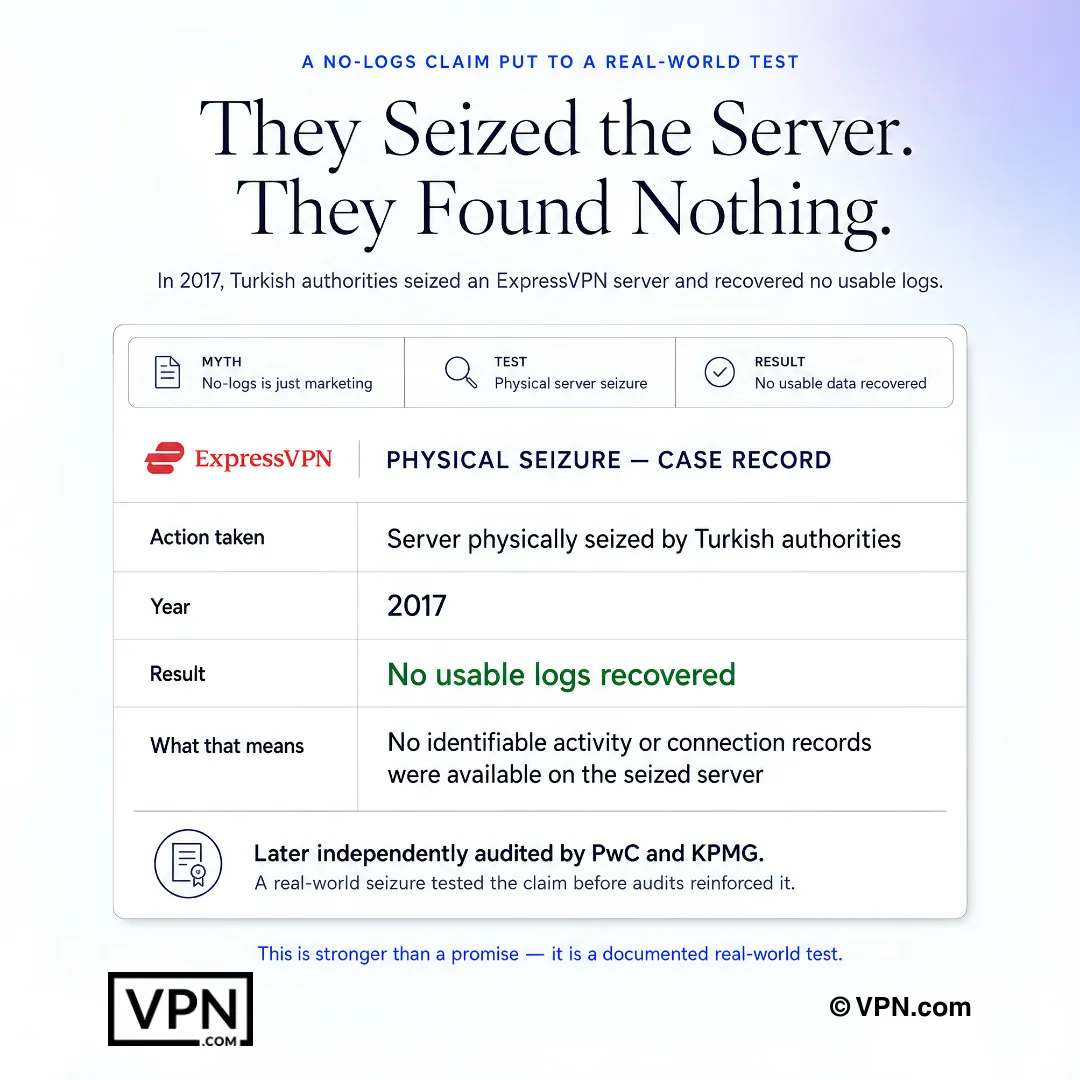
A documented server seizure can test a no-logs claim more strongly than marketing alone.