FreeLimited free tier
Best for Very light usage only — severely restricted at 500MB/month
- 500MB Data Per Month
- 1 Device
- Basic VPN Protection
1-yearChoose Free

53 out of 100, built from two weighted parts
Researched Oct 3, 2026Claims checked: 16Independent sources: 3Scores updated Nov 6, 2026
Acceptable only as a bundle add-on for existing McAfee antivirus users who do not prioritize privacy.
Visit websiteRead the full review ↓Bottom line
McAfee VPN ranks #22 of 22 on our Trust Score. Plans start from $1.67/mo.
TL;DR
In plain English
You can protect up to 5 devices at once. If it does not suit you, you can get your money back within 30 days.
Our Assessment
Trust Score 53 out of 100, #22 of 22 providers. Each criterion is scored from the evidence shown with it. How we score
McAfee Safe Connect is cheapest as part of the McAfee Total Protection bundle. The standalone VPN is significantly more expensive for what's offered.
Same plan, same features. Only the renewal term changes.
All plans and add-ons
Pick a billing period and compare every tier side by side.
Best for Very light usage only — severely restricted at 500MB/month
Best for Existing McAfee users who want to add VPN
Best for Users who primarily want McAfee antivirus and get VPN as an add-on
A plain-language breakdown of everything in the plans above: what each feature is, who it helps, and whether it is worth paying for.
All plans include:
Compared
Swap any column to see how McAfee VPN stacks up against another provider.
| This review | ||||
|---|---|---|---|---|
| Trust Score | 53/100 | 93/100 | 88/100 | 87/100 |
| Price from | $1.67/mo | $3.09/mo | $2.99/mo | $2.49/mo |
| Devices | 5 | 10 | 10 | Unlimited |
| Servers | 2,000+ | 7,229 | 3,000+ | 4,500+ |
| Countries | 48+ | 150 | 113 | 100+ |
| Money-back guarantee | 30-day money-back guarantee | 30-day money-back guarantee | 30-day money-back guarantee | 30-day money-back guarantee |
| Get started | Visit website | Get NordVPN | Get ExpressVPN | Get Surfshark |
 NordVPN93
 ExpressVPN88
 Surfshark87
 PIA85
 IPVanish83
 ProtonVPN83
 CyberGhost81
 Bitdefender VPN80
 Hide.me78
 Windscribe VPN77
 Mullvad VPN76
 PureVPN76
 Norton VPN75
 Hotspot Shield72
 PrivadoVPN66
 TunnelBear64
 TotalVPN63
 VyprVPN63
 Astrill VPN59
 Avast VPN57
 IVPN56
No providers match
McAfee VPN (branded as McAfee Safe Connect) is a bundled add-on to McAfee Total Protection, not a purpose-built VPN. McAfee has owned TunnelBear since 2018 and said it would integrate TunnelBear’s technology into Safe Connect, though we could not confirm what infrastructure it runs on today. The effective cost drops to roughly $1.67 per month when bundled, but price is the only area where it competes. With a trust score of 53/100 and no independent audit, it falls short of every serious VPN benchmark.
Most VPN providers build and operate their own server networks. McAfee does not say whose infrastructure Safe Connect runs on today. A 2020 teardown by TechRadar found TunnelBear’s service and libraries in the Windows client, but that is a dated observation, not a current fact. McAfee’s own privacy policy governs what gets logged, and no independent audit exists for this specific product, so you are taking McAfee at its word.
The result is a VPN that exists primarily to pad out an antivirus subscription. It checks a box on a feature list. It does not deliver the privacy, speed, or streaming access that dedicated VPN users expect.
We do not run our own speed tests on McAfee VPN. Its 53/100 Trust Score draws on published third-party test data and places it near the bottom of the 22 providers we review.
Expect daily frustration with demanding tasks. The connection handles basic browsing and standard-definition streaming without obvious issues. But 4K streaming requires a sustained 25 Mbps minimum, and any additional household traffic competes for limited throughput. Latency makes video calls choppy and online gaming borderline unusable.
McAfee does not disclose which VPN protocol Safe Connect uses by default. Without clarity on whether it runs WireGuard, OpenVPN, or a proprietary protocol, users cannot troubleshoot or optimize performance. Most leading VPNs let you switch protocols in settings. McAfee does not offer this option.
Long-distance connections suffer even more. Connecting to servers in Asia or Oceania from North America typically adds latency on top of the already elevated baseline. For anyone outside the US or Western Europe, performance degrades further because the 2,000+ server footprint spans only 48 countries, leaving large geographic gaps.
McAfee is headquartered in the United States, a founding member of the Five Eyes intelligence alliance. US-based VPN providers can be compelled to hand over user data through National Security Letters, which often include gag orders preventing disclosure. This jurisdiction alone warrants caution for privacy-focused users.
The logging question is harder to settle than the jurisdiction. McAfee’s January 2026 Privacy Notice says its VPN does not collect originating IP addresses, DNS queries or the sites and apps you use while connected. That is McAfee’s own statement, not an independent finding. Review sites have alleged IP logging, but we could not verify that, so we do not state it as fact.
We found no independent audit of McAfee Safe Connect. Mullvad publishes third-party audit results, and NordVPN and Surfshark say they commission no-logs audits. McAfee has not done this for Safe Connect, and TunnelBear’s Cure53 security audits do not cover it. Without an audit, users must take McAfee at its word.
The kill switch only works on Windows. Android, macOS, and iOS users get no automatic protection if the VPN connection drops. A dropped connection without a kill switch exposes your real IP address instantly to your ISP and any website you are visiting. This is a critical gap on mobile platforms where network switching between Wi-Fi and cellular happens frequently.
Encryption details are sparse. McAfee states it uses AES-256 encryption but does not specify the cipher mode, handshake protocol, or key exchange method. Without these details, the encryption claim is marketing rather than a verifiable security specification.
Streaming is one of McAfee VPN’s weakest areas. Netflix works intermittently, meaning it might access US Netflix today and fail tomorrow. Disney+ and BBC iPlayer are blocked outright. User reports describe the same blocks.
McAfee does not offer specialty streaming servers, Smart DNS, or obfuscation features. Dedicated VPN providers like ExpressVPN and NordVPN maintain teams that actively rotate IP addresses to stay ahead of streaming platform blocks. McAfee appears to invest nothing in this area.
With only 48 countries covered, content library options are limited even when connections succeed. Users looking to access catalogs from smaller markets like South Korea, Brazil, or Turkey will likely find no server available in those regions.
Sports streaming and live events demand both low latency and consistent connections. With high latency and unreliable accessing, McAfee VPN is a poor fit for live content. Buffering and geo-block errors during a live match are not acceptable tradeoffs.
McAfee Safe Connect supports Windows, macOS, Android, and iOS. That covers the four major platforms but excludes Linux, routers, smart TVs, and gaming consoles. The 5-device simultaneous connection limit falls below the industry standard; most competitors now offer 8 to 10, and several provide unlimited connections.
The Windows app is the most functional version. It includes a kill switch and basic server selection. The macOS and iOS apps strip away the kill switch entirely. Android lacks it as well. This creates a tiered experience where Windows users get a minimally acceptable VPN, and everyone else gets a less secure product.
There are no browser extensions for Chrome, Firefox, or Edge. Router-level installation is not supported, which means you cannot protect devices like Apple TV, Roku, or PlayStation through your home network. Five connections with no router support means a household with multiple devices will run out of slots quickly.
App design is straightforward but shallow. The interface offers a connect button and a server list. There are no split tunneling options, no protocol selection, no multi-hop connections, and no custom DNS settings. Users who want any level of control over their VPN behavior will find nothing to adjust.
McAfee VPN fits one specific profile: existing McAfee Total Protection subscribers who want basic Wi-Fi encryption on public networks and have zero interest in privacy, streaming, or performance. If you already pay for McAfee antivirus and treat the VPN as a free bonus feature for coffee shop browsing, it does its minimal job.
Everyone else should look elsewhere. Privacy-conscious users need a provider with verified no-logs policies and a kill switch on every platform. McAfee fails both requirements. Streamers need reliable accessing across Netflix, Disney+, and regional libraries. McAfee fails here too.
Remote workers who handle sensitive data should avoid a VPN with an unverified no-logs claim and US jurisdiction. Its limited throughput and high latency make it unsuitable for bandwidth-heavy tasks like large file transfers or video conferencing over VPN.
Gamers, torrenters, and travelers in restrictive countries will find nothing useful here. No obfuscation, no port forwarding, no protocol flexibility. If your use case extends beyond “encrypt my connection at Starbucks,” McAfee VPN is not built for you.
Charts and reference images from our research, free to view and share.
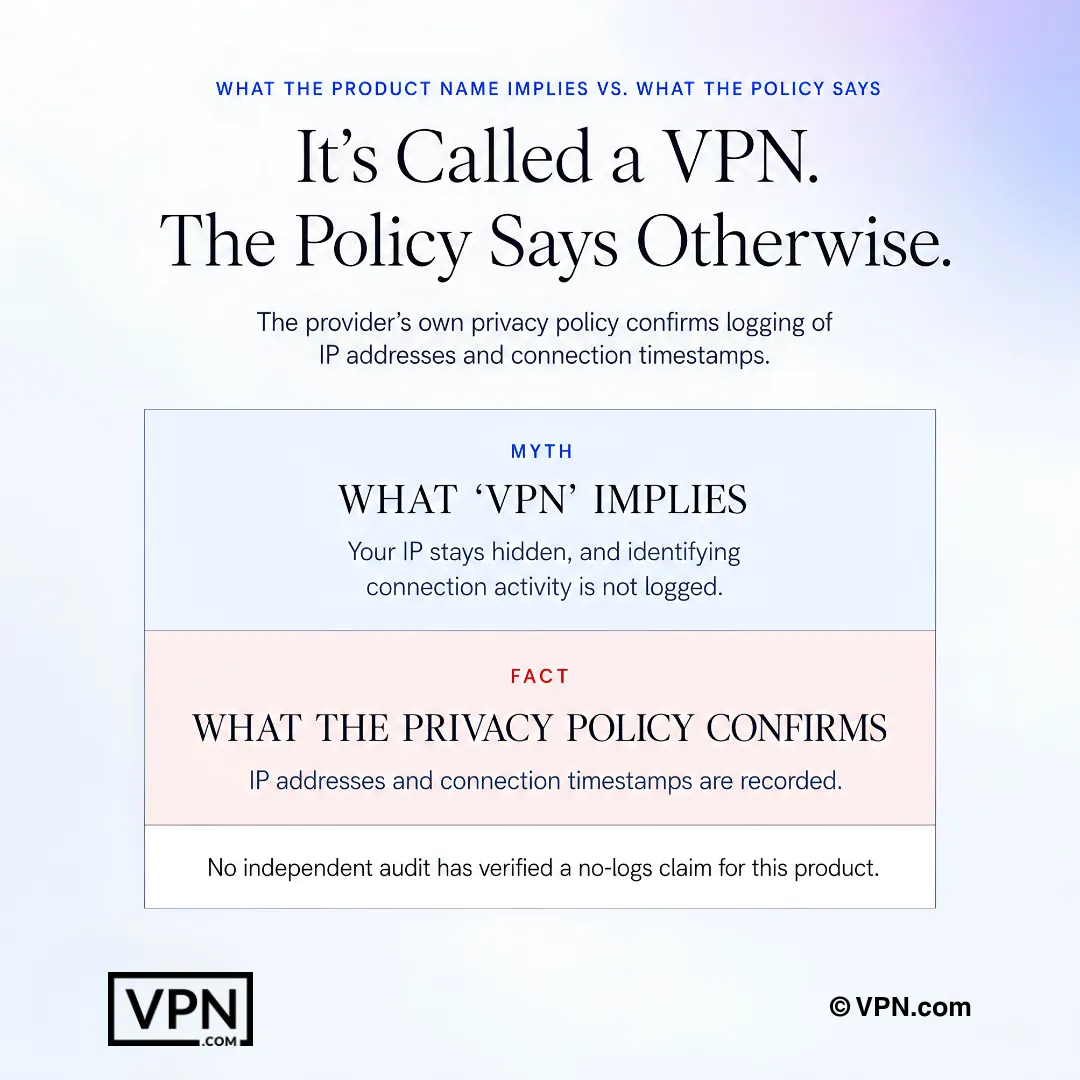
McAfee’s January 2026 Privacy Notice says its VPN does not collect originating IP addresses, DNS queries or the sites and apps you use while connected, but that is McAfee’s own statement and we found no independent audit to back it. Combined with a 53/100 trust score in our review and a Windows-only kill switch, this makes it unsuitable for anyone who needs verified anonymity. Treat it as basic Wi-Fi encryption, not a privacy tool.
McAfee is headquartered in the United States, a founding Five Eyes member, meaning it can be compelled to hand over user data via National Security Letters that often include gag orders. Paired with a no-logs claim that nobody has independently audited, this jurisdiction adds legal risk on top of the unanswered questions about what McAfee’s VPN actually stores.
McAfee has not said publicly which servers Safe Connect runs on today. McAfee has owned TunnelBear since 2018 and said it would integrate TunnelBear’s technology into Safe Connect, and a 2020 TechRadar teardown found TunnelBear’s service and libraries in the Windows client, but we found nothing newer that confirms the current arrangement. No independent audit of Safe Connect has been published, so users must rely on McAfee’s own privacy policy.
McAfee VPN scores 53/100 on our Trust Score, one of the lowest of the 22 providers we review, which draws on published third-party test data. We do not run our own speed tests. In practice basic browsing and standard-definition streaming hold up, but 4K streaming, video calls, and online gaming all suffer, especially over long-distance connections to servers in Asia or Oceania.
Streaming is inconsistent at best. Netflix US works intermittently, loading one day and failing the next, while Disney+ and BBC iPlayer do not work at all. McAfee offers no Smart DNS or dedicated streaming servers, and with only 48+ countries covered, smaller-market catalogs like South Korea or Brazil are largely unreachable too.
McAfee VPN’s cheapest rate is $1.67/month on its longest-term plan, but that price only applies when bundled into McAfee Total Protection; the standalone VPN costs considerably more for the same 2,000+ servers across 48+ countries. Price is essentially the only place McAfee competes, since the standalone product delivers no privacy or streaming advantage to offset the cost.
Yes, McAfee backs its VPN with a 30-day money-back guarantee. Given the lack of an independent audit, a no-logs claim that is McAfee’s own and one of the lowest Trust Scores of the 22 providers we review, this window is worth using if the service doesn’t deliver the encryption or streaming access you expected. Request a refund directly through McAfee support before the 30 days lapse.
McAfee’s free tier caps data at 500MB per month on a single device, suiting only very light, occasional use like quickly encrypting a public Wi-Fi session. Paid plans lift the limit to 5 simultaneous connections and remove the data cap, but even paid tiers carry the same lack of independent audit found on the free version.
Paid McAfee VPN plans cover up to 5 simultaneous devices across Windows, macOS, Android, and iOS, falling short of the 8 to 10 connections many competitors now offer. There’s no Linux support, no router-level installation, and no browser extensions, so a multi-device household with a smart TV or gaming console will quickly run out of usable slots.
McAfee Safe Connect uses AES-256 encryption, but McAfee does not say which VPN protocol it runs. A 2020 TechRadar teardown of the Windows client found OpenVPN with AES-256-GCM, and we could not confirm that this still holds. Users cannot switch to WireGuard or OpenVPN since McAfee offers no protocol selection at all, leaving the encryption details unverifiable.
The kill switch only functions on Windows, so disconnect your Wi-Fi mid-session on a Windows device to confirm traffic stops rather than falling back to your unprotected connection. On macOS, iOS, and Android, no kill switch exists at all, meaning a dropped connection on those platforms exposes your real IP address instantly with no safeguard.
Your real IP address is exposed immediately, since McAfee’s kill switch works on Windows only and offers no automatic protection on macOS, iOS, or Android. Network switching between Wi-Fi and cellular, common on mobile, makes this drop scenario frequent. Reconnecting manually after any drop is the only safeguard available on these platforms.
Not as far as we can verify. McAfee’s January 2026 Privacy Notice says its VPN does not collect originating IP addresses, DNS queries or the sites and apps you use while connected, but that is McAfee’s own statement. Review sites have alleged IP logging, which we could not confirm. No independent audit has verified McAfee’s practices, unlike Mullvad, which publishes third-party audit results, and NordVPN or Surfshark, which say they commission no-logs audits.
The January 2026 Privacy Notice of McAfee says its VPN service does not collect originating IP addresses, DNS queries or the sites and apps used while connected. Its general notice lists IP address among data collected automatically across its services, and a 2020 review found no logging statement specific to its VPN at that time. These are statements by McAfee, not findings of an audit.
Our VPN Service may collect certain telemetry, but does not collect your originating IP address, DNS queries, or information about the applications, services, or websites you use while connected to the VPN.We may collect certain information automatically when you use our Services, such as your Internet Protocol (IP) address, user settings, MAC address, cookie identifiers, mobile carrier,There's no information on what the company might collect solely via Safe Connect, though.McAfee Corp., the parent of McAfee, was taken private on 1 March 2022 by an investor group led by Advent International and Permira, with Crosspoint, CPP Investments, GIC and ADIA; SEC filings of that day record the change in control and the delisting.
8-K filed 2022-03-01, items 1.01,1.02,2.01,3.01,3.03,5.01,5.02,5.03,8.01,9.01; 25-NSE filed 2022-03-01McAfee Corp. (NASDAQ:MCFE, “McAfee”), a global leader in online protection, today announced the completion of its acquisition by an investor group led by Advent International Corporation (“Advent”) and funds advised by Permira,Advent and Permira-led investor group completes McAfee buyoutThe all-cash deal will see ownership of the firm transferred to an investor group led by Advent International Permira Advisers LLC,McAfee announced the acquisition of Toronto-based TunnelBear on 8 March 2018, saying it would integrate the technology of TunnelBear into its Safe Connect VPN; a 2020 review reported that Safe Connect used the service, API and software libraries of TunnelBear. Whether the current McAfee VPN still runs on TunnelBear infrastructure was not established.
Security giant McAfee is acquiring Canadian VPN provider TunnelBear. Terms of the deal haven’t been disclosed.McAfee said that it plans to integrate TunnelBear’s technologies into the company’s own VPN product, Safe Connect.TunnelBear will operate as a separate team within McAfee, continuing to develop the bear-filled products you’ve come to know and love.Although McAfee is using TunnelBear's service, underlying API and software libraries, for instance, its apps are different, and not fully covered by the TunnelBear audit.The VPN of McAfee is run by McAfee, LLC, a Delaware company headquartered in San Jose, California; its Canada notice warns that personal information may be accessible to US courts, law enforcement and national security authorities. This describes legal exposure, not a finding that McAfee keeps logs.
McAfee, LLC, a Delaware limited liability company, with offices located at 6220 America Center Drive, San Jose, California 95002, USAPersonal Information may be accessible to the courts and the law enforcement and national security authorities of the United States.We may share your Personal Information with law enforcement or governmental or judicial authorities in relation to the prevention or detection of crime and fraud, for national security purposes,Now that McAfee owns TunnelBear, the VPN service will have to comply with U.S. laws.TunnelBear is now part of McAfee, a US based company, which we recognize comes with increased privacy pressure and expectations.Published speed results and expert reviews for every major VPN.
NordVPN
Our top-rated VPN
Trust Score rank
#1 / 22
View full review →
ExpressVPN
Lightning-fast speeds
Trust Score rank
#2 / 22
View full review →
Surfshark
Unlimited devices
Trust Score rank
#3 / 22
View full review →
PIA
Open source and transparent
Trust Score rank
#4 / 22
View full review →
IPVanish
Unlimited devices, no restrictions
Trust Score rank
#5 / 22
View full review →
ProtonVPN
Swiss privacy meets unlimited bandwidth
Trust Score rank
#5 / 22
View full review →