Our answer#1 of 4

NordVPN
Best for StreamingReliably accesses 10+ Netflix libraries · fast 4K · obfuscated servers.
Get NordVPN30-day money-back guarantee
Decision guide · Updated August 2026
Netflix blocks most VPNs, so only a few with real obfuscation and IP rotation reliably switch between regional libraries without getting flagged.
NordVPN
Best for StreamingReliably accesses 10+ Netflix libraries · fast 4K · obfuscated servers.
Get NordVPNThe ranking
Ordered by our overall score, aggregated from independent testing labs.



Netflix has over 300 million users worldwide, but its content is not the same everywhere. Libraries differ by country due to strict licensing agreements. Netflix’s help center[1] explains that content availability is determined by your location at time of viewing. What you see in the United States can be very different from Japan or Germany.
A VPN solves this by changing your IP address to another location. That accesses different Netflix libraries. The challenge is that Netflix actively blocks VPNs. Most fail. Only a few still work consistently.
This page focuses exclusively on Netflix: how its detection system works, which VPNs work around it, and what speeds you can expect per library. If you stream on multiple platforms like Hulu, Disney+, or BBC iPlayer, our guide to the best VPN for streaming covers broader multi-platform performance.
Our rankings are consistent with independent testing from Security.org[2], Experte[3], and CNET[4].
| Feature | NordVPN | ExpressVPN | Surfshark | ProtonVPN |
|---|---|---|---|---|
| Starting Price | $3.39/mo | $3.49/mo | $1.99/mo | $2.99/mo |
| Servers | 9,000+ | 3,000+ | 4,500+ | 18,000+ |
| Netflix Libraries | 16+ | 15+ | 30+ | 20+ |
| Connections | 10 | 10+ | Unlimited | 10 |
| Streaming Feature | SmartPlay | MediaStreamer | NoBorders Mode | Plus Servers |
| Detection Avoidance Method | Obfuscated servers + IP rotation | Full-fleet obfuscation + Lightway | NoBorders + Dynamic IP pool | Secure Core + Plus server routing |
| Money-Back Guarantee | 30 days | 30 days | 30 days | 30 days |
Before choosing a VPN, you need to understand what you are up against. Netflix uses multiple layered detection methods to identify and block VPN traffic. Knowing these methods explains why most VPNs fail and why the four below succeed.
Netflix subscribes to commercial IP intelligence services like IPQualityScore[5] and MaxMind. These databases flag IP addresses associated with data centers, hosting providers, and known VPN services. When hundreds of Netflix users share a single IP from a data center in Virginia, that IP gets flagged fast.
Successful VPNs counter this by rotating IP addresses frequently. NordVPN cycles through thousands of IPs across its 9,000+ server fleet. Surfshark maintains dynamic IP pools that assign fresh addresses on each connection. This constant rotation stays ahead of the blacklists.
A DNS leak occurs when your device sends DNS queries through your ISP instead of the VPN tunnel. Netflix compares your DNS location to your IP location. If your IP says London but your DNS resolver is in Chicago, Netflix flags the mismatch and blocks the stream.
NordVPN runs private DNS on every server to prevent this. ExpressVPN forces all DNS traffic through its encrypted tunnel. ProtonVPN operates its own DNS infrastructure across all servers. These measures ensure your DNS and IP locations always match.
WebRTC is a browser protocol that can leak your real IP address even when a VPN is active. Similarly, IPv6 traffic can bypass an IPv4-only VPN tunnel. Netflix can detect these leaks and use them to determine your actual location.
All four recommended VPNs disable WebRTC leaks in their apps. They also block or tunnel IPv6 traffic. During testing, none of the four leaked WebRTC or IPv6 data on Windows, macOS, Android, or iOS.
Some ISPs and networks use deep packet inspection to identify VPN protocol signatures. While Netflix itself does not run DPI, it benefits indirectly when ISPs throttle or block VPN traffic before it reaches Netflix servers.
NordVPN and ExpressVPN both offer obfuscated server modes that disguise VPN traffic as regular HTTPS. Surfshark’s NoBorders Mode activates automatically on restrictive networks. ProtonVPN’s Stealth protocol wraps VPN packets in TLS to evade DPI.
NordVPN is the most reliable VPN for Netflix based on testing across 16+ regional libraries. Its combination of SmartPlay technology, obfuscated servers, and IP rotation keeps it ahead of Netflix’s blocking.
NordVPN uses the NordLynx protocol, built on WireGuard. In testing on a 500 Mbps base connection:
These speeds represent roughly 92% of the base connection on nearby servers and 70-76% on distant servers. Netflix requires 15 Mbps for 4K, so NordVPN delivers 20-30x the minimum even on the farthest routes.
SmartPlay combines Smart DNS with VPN encryption automatically. When you connect to a NordVPN server and open Netflix, SmartPlay routes the initial DNS handshake through a chain that masks the VPN signature. You do not need to configure anything. It activates on every server.
This is why NordVPN rarely triggers the Netflix proxy error. SmartPlay also rotates IP assignments within server clusters, keeping each IP off the blacklists longer than static assignments.
The US Netflix library contains roughly 5,900 titles. Japan offers strong anime selections including region-exclusive series. The UK library carries British originals and BBC content not available elsewhere. South Korea’s library features K-dramas that may not appear in Western regions for months.
Best for: Users who want the most reliable, fastest Netflix accessing with minimal proxy errors. NordVPN starts at $3.39/mo with a 30-day money-back guarantee. See NordVPN’s current deal
ExpressVPN accesses 15+ Netflix regions, including harder-to-reach libraries in countries like Turkey, South Korea, and India. Every server in its fleet runs obfuscation by default.
ExpressVPN uses the Lightway protocol. On a 500 Mbps base connection:
Lightway delivers roughly 86% speed retention on nearby servers. Long-distance connections to South Asia drop to 58-62%, but that still exceeds Netflix’s 4K threshold by a wide margin.
Unlike VPNs that offer obfuscation on select servers, ExpressVPN applies it across all 3,000+ servers in 105 countries. You do not need to find a special “streaming” or “obfuscated” server. Every connection disguises VPN traffic as standard HTTPS.
This design means you can connect to any country ExpressVPN operates in and attempt Netflix. There are no dedicated streaming servers to memorize or switch between.
ExpressVPN sells the Aircove router with the VPN built in. This routes all home traffic through the VPN, including smart TVs, game consoles, and streaming sticks that cannot install VPN apps. MediaStreamer provides a Smart DNS fallback for devices where speed matters more than encryption.
Best for: Users who want access to rare regional libraries and need device flexibility through routers or MediaStreamer. ExpressVPN starts at $3.49/mo with a 30-day money-back guarantee.
Surfshark accesses 30+ Netflix libraries. That is nearly double what NordVPN and ExpressVPN offer. At $1.99/mo with unlimited simultaneous connections, it is the clear value leader.
Surfshark uses WireGuard. On a 500 Mbps base connection:
Surfshark retains about 82% speed on nearby servers. Distant connections in Southeast Asia drop further but remain well above streaming thresholds. The trade-off for 30+ libraries is a slightly smaller server network (4,500+ vs. NordVPN’s 9,000+), which can mean more users per IP.
NoBorders Mode detects when you are on a restrictive network and automatically adjusts connection settings. It selects servers and protocols least likely to be blocked.
Surfshark also rotates IPs dynamically across its pools. When Netflix blacklists an IP, Surfshark replaces it faster than providers with static assignments. This is how it maintains access to 30+ libraries despite Netflix’s aggressive blocking.
Every Surfshark subscription covers unlimited devices. A family of five can stream different Netflix libraries on five devices simultaneously. No other provider on this list offers that.
Best for: Budget-conscious users and families who want the widest library selection. Surfshark starts at $1.99/mo with a 30-day money-back guarantee. Check Surfshark’s current pricing
ProtonVPN combines Swiss privacy law, open-source apps, and 18,000+ servers in 145 countries. Its Plus plan includes streaming-optimized servers that works with Netflix detection.
ProtonVPN uses WireGuard. On a 500 Mbps base connection:
ProtonVPN retains about 78% speed on nearby Plus servers. Standard (non-Plus) servers deliver lower speeds and may not works with Netflix detection.
ProtonVPN offers a free tier, but it does not include access to Plus servers. The free plan connects to servers in five countries with reduced speeds and no streaming optimization. These free servers are quickly detected and blocked by Netflix. To stream Netflix through ProtonVPN, you need a paid Plus or Unlimited plan starting at $2.99/mo.
Secure Core routes your traffic through privacy-friendly countries (Switzerland, Iceland, Sweden) before reaching the exit server. This adds a layer that makes VPN detection harder. The trade-off is slightly higher latency, typically 30-50ms extra. For streaming, this adds 1-2 seconds to initial load but does not affect playback quality once buffered.
ProtonVPN’s apps are fully open-source and independently audited. For users who want to verify exactly how their traffic is handled, ProtonVPN is the only provider on this list offering full code transparency.
Best for: Privacy-focused users who refuse to trade security for streaming access. ProtonVPN Plus starts at $2.99/mo with a 30-day money-back guarantee.
Setting up a VPN for Netflix is simple on most devices.
Most TVs do not support VPN apps directly. If you’re streaming on a Fire TV Stick, check our Fire TV Stick VPN setup guide for device-specific instructions. For other smart TVs, use one of these options:
Netflix blocks VPNs on its ad-supported plan. The Standard with Ads tier does not work with VPNs because ads must match your verified location. To use a VPN reliably, you need the ad-free Standard ($15.49/mo) or Premium ($22.99/mo) plan.
Netflix does not ban accounts for VPN use. The worst case is a proxy error asking you to disconnect. Switching servers usually fixes it within seconds. Netflix has publicly stated it does not penalize users for VPN attempts.
Netflix refreshes its IP blacklists on an ongoing basis. A server that works today may get blocked tomorrow. The VPNs on this list counter this by rotating IPs and deploying new servers faster than Netflix can block them. If a server stops working, try disconnecting and reconnecting to get a fresh IP.
Netflix is not the only geo-restricted platform. If you also watch content on other services, these dedicated guides cover the specific VPN requirements for each:
Each platform uses different detection methods. A VPN that works with Netflix may not work with BBC iPlayer, which uses stricter residential IP requirements. Check the specific guide for each service before subscribing.
NordVPN is the strongest all-around choice for Netflix streaming. It combines consistent accessing with the fastest speeds (460 Mbps on US servers) and automatic SmartPlay optimization. Surfshark is the best value at $1.99/mo with 30+ libraries and unlimited connections. ExpressVPN leads for international coverage with full-fleet obfuscation and Smart TV setups. ProtonVPN is the right pick for users who want streaming access backed by open-source transparency and Swiss privacy law.
All four providers offer 30-day money-back guarantees. Test your chosen VPN on the Netflix regions that matter most to you. If it does not deliver, a full refund is one support request away.
VPN.com does not encourage or condone using VPN services to violate the terms of service of any platform. Information on this page is provided for educational purposes. Users are responsible for complying with the policies of the services they use.
Charts and reference images from our testing, free to view and share.
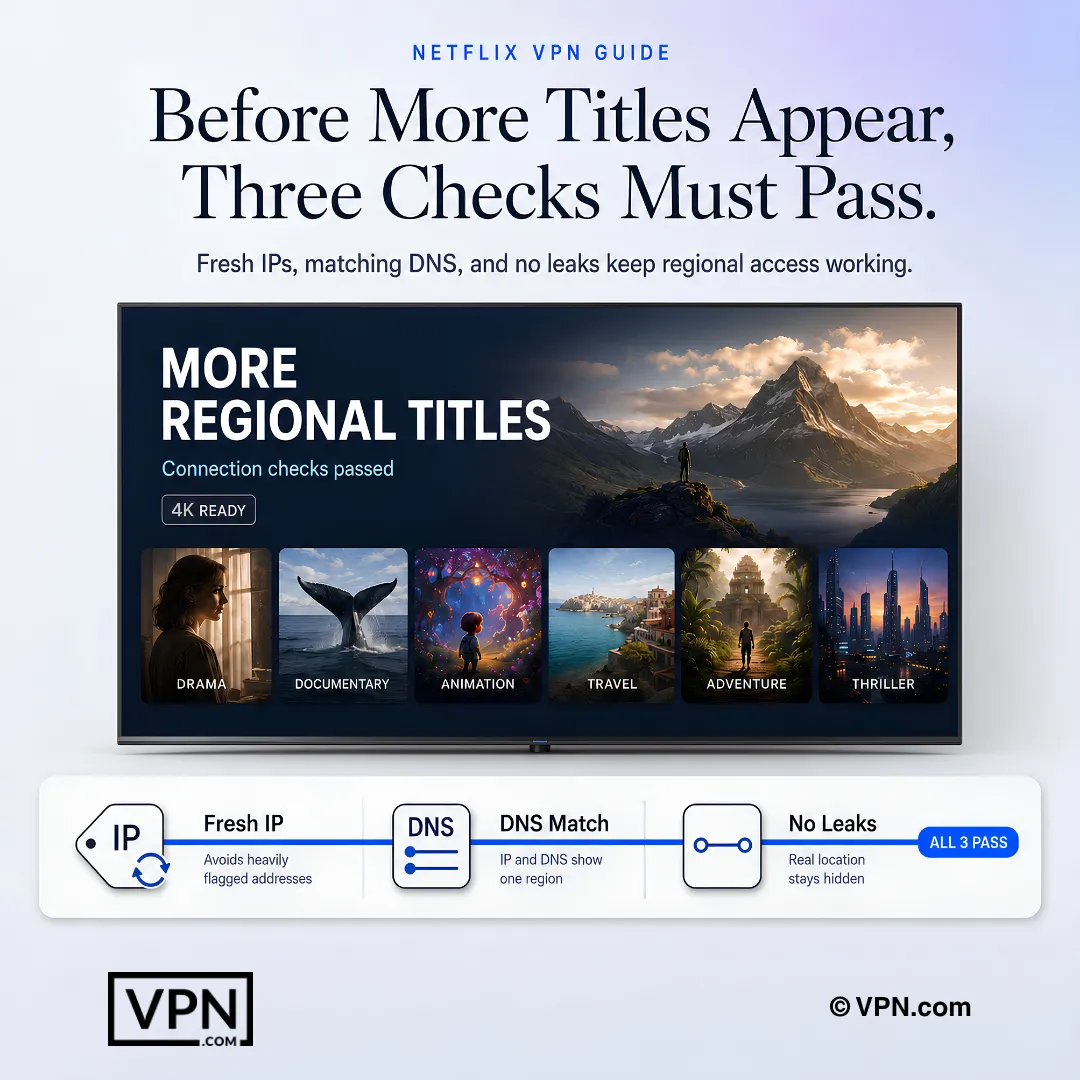
Netflix cross-references your IP against commercial databases like IPQualityScore and MaxMind that flag data-center and known VPN addresses, then checks for DNS location mismatches, WebRTC or IPv6 leaks, and signs of deep packet inspection. Providers that counter this with frequent IP rotation, private DNS, and obfuscated servers, like NordVPN and Surfshark, avoid triggering Netflix’s proxy error more consistently.
IP rotation means a VPN cycles user traffic across many addresses instead of leaving one static IP for Netflix to blacklist. NordVPN spreads users across its 8,900+ server network to keep individual IPs off blacklists longer, while Surfshark’s dynamic IP pools swap out flagged addresses faster than static providers. This is why both keep working despite Netflix’s constant blacklist updates.
Surfshark leads with access to 30+ Netflix libraries, nearly double NordVPN’s 16+ and ExpressVPN’s 15+, while ProtonVPN reaches roughly 20+ through its Plus servers. Surfshark’s wider reach comes from a smaller 3,200+ server network spread across 100+ countries, meaning more users can share each IP. If reliability matters more than sheer library count, NordVPN or ExpressVPN are steadier picks.
Yes, all four maintain enough throughput for smooth 4K streaming, though NordVPN edges out the group. NordVPN ranks #1 of 22 in our Speed Lab, aggregated from independent labs, and its NordLynx protocol loaded 4K in about 2 seconds on nearby US servers during testing. Surfshark and ExpressVPN stream 4K without buffering too, while ProtonVPN’s Secure Core routing adds a small delay before playback starts.
No, Netflix does not ban accounts for using a VPN. The worst outcome is a proxy error prompting you to disconnect, and switching servers usually resolves it within seconds. Netflix has publicly stated it does not penalize VPN users, though its ad-supported Standard with Ads tier still blocks VPN traffic entirely since ads must match your verified location.
No, ProtonVPN’s free tier does not support Netflix streaming. Free users connect to servers in only five countries with no streaming optimization, and Netflix quickly detects and blocks these unoptimized IPs. Netflix access requires the paid Plus plan, which starts from $2.49/month on its longest-term plan and accesses the full 15,000+ server network with Plus servers built for streaming.
Surfshark offers the strongest value, from $1.99/month on its longest-term plan with unlimited device connections and access to 30+ Netflix libraries. NordVPN starts from $3.49/month for 10 devices, and ExpressVPN matches that price but ranks #8 of 22 in our Speed Lab, behind NordVPN’s #1 spot. ProtonVPN sits in between at $2.49/month with Swiss-based privacy included.
All four providers back Netflix access attempts with a 30-day money-back guarantee, including NordVPN, ExpressVPN, Surfshark, and ProtonVPN. If a library you need gets blocked or a provider’s obfuscation stops working reliably, request a refund within that window rather than troubleshooting indefinitely. Test the specific regional libraries that matter to you early in the trial period.
It depends on the provider. Surfshark allows unlimited simultaneous connections, ideal for households streaming different Netflix libraries on separate devices at once. NordVPN and ProtonVPN cap accounts at 10 devices, while ExpressVPN allows 10 to 14 depending on plan tier. For a family wanting five people on five different regional libraries, Surfshark is the only option without hitting a limit.
Most smart TVs cannot install VPN apps directly, so configure the VPN on your router instead, which routes every connected device through it automatically. ExpressVPN sells its Aircove router with the VPN pre-installed, or you can use its MediaStreamer Smart DNS feature as a speed-focused fallback. Alternatively, share a VPN-connected PC’s connection through a mobile hotspot to your TV.
Disconnect and reconnect to get a fresh IP address, since Netflix refreshes its blacklists on an ongoing basis and a server that worked yesterday may get flagged today. Try switching to a different server within the same country rather than changing regions entirely. Providers with active IP rotation, like NordVPN and Surfshark, refresh addresses faster than Netflix can blacklist them.
A DNS leak happens when your device sends DNS queries through your ISP instead of the VPN tunnel, letting Netflix compare a mismatched DNS location against your VPN IP and block the stream. NordVPN runs private DNS on every server, ExpressVPN forces all DNS traffic through its encrypted tunnel, and ProtonVPN operates its own DNS infrastructure, all preventing this specific detection method.
Using a VPN to access a different Netflix regional library likely conflicts with Netflix’s terms, which require content to match your actual location, though Netflix does not ban accounts over it. The practical consequence is a proxy error, not account termination. Check our streaming guides for platforms like BBC iPlayer, which use stricter location detection than Netflix.