21,184 chose our top pick this month.
 NordVPN
NordVPN's privacy and security record is strong on process and mixed on proof
94 out of 100, built from two weighted parts
Researched Oct 3, 2026Claims checked: 31Separate source groups: 23Scores updated Oct 4, 2026
We gather third-party evidence and score it editorially. VPN.com does not run a testing lab.
Our recommendation
Take the 2-year, then spend a month deciding whether you would have paid for it.Take the 2-year. It never gets cheaper than this, and you can still walk away.Take the 2-year. It is the best price here and the same product as every other term.Take the 2-year anyway. The best one here happens not to be the expensive one.
Here’s why
The 2-year locks the lowest rate NordVPN offers. You are not committing $94.23 on faith: the refund window is the trial. Run it on your own connection, decide whether it earns its place, and cancel inside 30 days if it does not.
Worth doing the arithmetic: buying monthly to “just test it” costs $14.99 and is not refundable. The same 30 days on the 2-year costs nothing if you cancel.
- Cheaper VPNs exist, and we rank them. This is the least we would pay for one we trust.
- 21,184 people took this through us in the last 30 days.
Our recommendation
Put on the one show you actually care about, tonight. That is the only test that counts.
The services people ask us about most
- Netflix
- HBO Max
- Apple TV
- Paramount+
- and whatever else you watch
Here’s why
It ranks first for speed of the 22 we rank, and speed is what protects a 4K stream from buffering. Access is the other half of the job, and it shifts as services change their detection, so the only test that counts is your service on your connection.
Free tiers rarely fail on speed. They fail on the meter: the smallest caps at 2 GB a month and most others at 10 GB. Netflix puts HD at roughly 3 GB an hour, so a whole month of the most generous free tier is about 3 hours of television.
Being straight: no VPN guarantees every service, every week. That is what the 30-day window is for. Check your service first, not last.
- Ranked #1 for speed of the 22 we rank, from published third-party test results.
- 43% say more shows is a top reason they use a VPN. Security.org, 2025
Our recommendation
Judge it on ping, not download speed. Ping is the part you feel in a match.
Here’s why
It ranks first for latency of the providers we rank. That is the difference between a VPN you forget is running and one you turn off before you queue.
Physics still applies: connecting to a distant country will always cost you ping. Use a nearby server unless you are deliberately playing on a foreign region.
- Ranked #1 for latency of the 22 we rank, from published third-party test results.
- Your real IP stops being visible to everyone else in the lobby.
Our recommendation
Pick on the audit, not the promise. Every VPN claims no logs.
Who can see the sites you visit
- No VPNYour provider, and anyone it sells to
- A free VPNThe app’s owner, and the FBI says often its buyers
- NordVPNNobody, by its own no-logs policy
Here’s why
The question worth asking is not whether a provider claims no logs. They all do. It is whether anyone independent has checked. This provider says an outside firm has, and we publish the evidence behind that claim so you can weigh it yourself.
What it does not do: a VPN moves trust, it does not remove it. You stop trusting your network provider and start trusting this one. The audit evidence behind its no-logs claim is part of why we rank it where we do.
- No-logs policy it says an outside firm has audited, not just a promise on a policy page.
- Providers collect browsing and location data to target ads. FTC, 2021
Federal Bureau of Investigation
Consider paying for a VPN service. Many VPN apps are free to you because they make money by sharing your information with third parties.
What we take from that
A VPN is not an extra. It is the cheapest line in your security, and the numbers are not close.
Here’s why
The same agency publishes what this actually costs people. In 2025 its crime centre logged 1,008,597 complaints and $20.877 billion in reported losses, a 26% rise on 2024. Its own figure for the average loss per complaint is $20,699.
For a business the number is larger again. IBM puts the average data breach at $4.44 million globally and $10.22 million in the United States.
Loss figures: FBI IC3 2025 Annual Report. Breach costs: IBM Cost of a Data Breach 2025.
Our recommendation
Not sure what you need it for? Start with the one that wins on everything.
Here’s why
It scores highest overall of the 22 we rank, so it is the safe default when you do not yet know which single thing matters most to you.
If you already know your one priority, a cheaper specialist may suit you better. Tell us what you need and we will change the answer.
- Highest overall score of the 22 we rank, from published third-party test results.
- 16% of breaches start with stolen logins. IBM, 2024
Our recommendation
Install it on your device, and on everything else you own, with one subscription.
Apps for
- Windows
- macOS
- iOS
- Android
- Linux
And everything behind your router
- Your router
- Xbox
- PlayStation
- Switch
Here’s why
One subscription covers 10 devices at once, and most households use three or four. The spare slots do not expire and they do not cost anything, so they can sit on your partner’s phone, your kid’s laptop or your parents’ tablet.
If you are only setting one thing up today, make it the phone. That is the device that joins networks you do not control: cafés, airports, hotels, hospital waiting rooms. The laptop mostly sits on home broadband, where there is less to worry about.
Consoles and smart TVs have no VPN app of their own. You cover them by installing on the router instead, which protects everything on the network at once and uses a single slot rather than one each.
- 6 spare slots for the people you live with, on the same subscription, at no extra cost.
- Most public Wi-Fi carries no encryption, and the FTC advises using a VPN on it.
Federal Bureau of Investigation
Consider paying for a VPN service. Many VPN apps are free to you because they make money by sharing your information with third parties.
What we take from that
A VPN is not an extra. It is the cheapest line in your security, and the numbers are not close.
Here’s why
The same agency publishes what this actually costs people. In 2025 its crime centre logged 1,008,597 complaints and $20.877 billion in reported losses, a 26% rise on 2024. Its own figure for the average loss per complaint is $20,699.
For a business the number is larger again. IBM puts the average data breach at $4.44 million globally and $10.22 million in the United States.
Loss figures: FBI IC3 2025 Annual Report. Breach costs: IBM Cost of a Data Breach 2025.
$94.23 billed once · 30-day money-back guarantee
We may earn a commission on purchases through our links; it never changes the ranking.
Why a VPN mattersWhy a VPN matters for streamingWhy a VPN matters for gamingWhy a VPN matters for privacyWhy a VPN matters for securityWhy a VPN matters for torrentingBefore you settle for freeWhy a VPN matters for teams
Your privacy, security, and access are only as strong as the network you're on.
The networks you use, like your internet provider and public Wi-Fi, can see and record what you do online.
A VPN scrambles your traffic, so they only see one encrypted connection, not the sites you visit.
- Internet providers collect large amounts of your browsing, app, and location data to target ads. (FTC, 2021)
- Stolen logins were the way in for 16% of data breaches, and public Wi-Fi is one place they get taken. (IBM, 2024)
Streaming apps only show the titles licensed for your country, which is often just a slice of everything they have.
Connect through another country and your same account lets you watch a much bigger library, at no extra cost.
- The same streaming account shows a different set of titles depending on which country you connect from. (uNoGS / Statista)
- Getting more shows and movies is one of the top reasons people use a VPN. (Security.org, 2025)
In online games, other players can see your real IP address. Someone can pay about $30 to use it to knock you offline or find where you live.
With a VPN, other players see an IP address from the VPN instead of yours, so they cannot target your home connection.
- Gamers get hit by connection-flooding (DDoS) attacks more than any other group, and attacks on games jumped 94% in a year. (Akamai, 2024)
- Services that flood a target's connection cost as little as $30 and can find them from their in-game info. (FBI)
Your internet provider can see and record every site you visit, and since 2017 there is no US rule stopping them from using it for ads.
A VPN scrambles your traffic, so your provider only sees that you connected to one server, not the sites you actually visited.
- Internet providers collect huge amounts of your browsing, app, and location data to target ads. (FTC, 2021)
- In 2024 the FTC stopped several data brokers from selling people's exact location. (FTC)
On public Wi-Fi, other people on the same network can try to grab what you send, like passwords and messages.
A VPN scrambles everything you send, so the network only sees gibberish it cannot read.
- Most public Wi-Fi networks are not encrypted, and the FTC recommends using a VPN on them. (FTC)
- Stolen logins were the way in for 16% of data breaches, and public Wi-Fi is one place they get taken. (IBM, 2024)
Without a VPN, your IP address (which can be used to pinpoint your rough location) is out in the open. Everyone you download from, and everyone downloading from you, can see it.
With a VPN, those people see an IP address from the VPN instead of yours, and your provider only sees scrambled traffic, not what you are sharing.
- Companies join these file-sharing groups and record IP addresses to send automated copyright notices. One study even flagged devices that never downloaded anything. (University of Washington)
- A VPN hides your IP address from others. It does not change what is legal to download. (VPN.com)
Free VPNs are slower, cap your data, and give you only a handful of servers. You never really see what a good VPN can do.
Try NordVPN with its 30-day money-back guarantee. Use it in full, and if it does not justify the cost, cancel for a complete refund. The premium experience, at no real risk.
Get NordVPN →- Every NordVPN plan comes with a 30-day money-back guarantee, so you can try it in full and cancel for a refund if it is not for you. (NordVPN)
- A free plan is fine to start, but premium is faster, has no data caps, and handles the streaming, gaming, and torrenting that free tiers block. (VPN.com)
When people work from home, they often reach company systems over home or public Wi-Fi, where logins can be stolen.
A VPN puts that connection inside one secure, encrypted tunnel instead of the open internet.
- The average data breach cost $4.88M in 2024, and stolen logins were the most common way in. (IBM, 2024)
- A well-run VPN is basic protection for remote work, but an out-of-date one is a risk, so keep it updated. (Verizon, 2024)
The top VPNs, comparedThe top VPNs compared for securityThe top VPNs compared for streamingThe top VPNs compared for gamingThe top VPNs compared for teamsThe top VPNs compared for privacyThe top VPNs compared for torrentingThe top VPNs compared for speedThe top VPNs compared for free plans
- Editorially reviewedRanked for securityRanked for streamingRanked for gamingRanked for teamsRanked for privacyRanked for torrentingPicked for speedRanked for free plans
- Top-rated in your region
- Optimized for every device
| # | Provider | Trust Score | Reviews | PriceFree plan | Best DealBest paid plan | |
|---|---|---|---|---|---|---|
| 1 | ★ Best for Security★ Best for Streaming★ Best for Gaming★ Best for Privacy★ Best for Torrenting★ Best for SpeedNordVPN | NordVPN's privacy and security record is strong on process and mixed on proof 94 out of 100, built from two weighted parts Trust & Value30% of the score26/30 VPN Performance70% of the score68/70 Researched Oct 3, 2026Claims checked: 31Separate source groups: 23Scores updated Oct 4, 2026 We gather third-party evidence and score it editorially. VPN.com does not run a testing lab. | 4.66(2.0M) | $14.99/mo | $3.49/mo2-year plan | Read Review |
| 2 | ★ Best Free VPN ProtonVPN ProtonVPN | 88 out of 100, built from two weighted parts Trust & Value30% of the score27/30 VPN Performance70% of the score61/70 Researched Oct 3, 2026Claims checked: 23Separate source groups: 19Scores updated Oct 4, 2026 We gather third-party evidence and score it editorially. VPN.com does not run a testing lab. | 4.61(1.2M) | $9.99/mo✓ | $3.49/mo2-year plan $3.49/mo$9.99/mo | Read Review |
| 3 |  Mullvad VPN Mullvad VPN | 86 out of 100, built from two weighted parts Trust & Value30% of the score26/30 VPN Performance70% of the score60/70 Researched Oct 3, 2026Claims checked: 29Separate source groups: 12Scores updated Oct 4, 2026 We gather third-party evidence and score it editorially. VPN.com does not run a testing lab. | 4.14(9K) | $5.50/mo | $5.50/mo1-month plan | Read Review |
| 4 |  CyberGhost CyberGhost | 85 out of 100, built from two weighted parts Trust & Value30% of the score25/30 VPN Performance70% of the score60/70 Researched Oct 3, 2026Claims checked: 23Separate source groups: 18Scores updated Oct 4, 2026 We gather third-party evidence and score it editorially. VPN.com does not run a testing lab. | 4.23(207K) | $12.99/mo | $2.19/mo2-year plan | Read Review |
| 5 |  ExpressVPN ExpressVPN | 85 out of 100, built from two weighted parts Trust & Value30% of the score25/30 VPN Performance70% of the score60/70 Researched Oct 3, 2026Claims checked: 27Separate source groups: 27Scores updated Oct 4, 2026 We gather third-party evidence and score it editorially. VPN.com does not run a testing lab. | 4.68(889K) | $12.95/mo | $2.99/mo2-year plan | Read Review |
| 6 |  PIA PIA | 85 out of 100, built from two weighted parts Trust & Value30% of the score25/30 VPN Performance70% of the score60/70 Researched Oct 3, 2026Claims checked: 24Separate source groups: 22Scores updated Oct 4, 2026 We gather third-party evidence and score it editorially. VPN.com does not run a testing lab. | 4.69(255K) | $11.95/mo | $2.03/mo3-year plan | Read Review |
| 7 |  Surfshark Surfshark | 85 out of 100, built from two weighted parts Trust & Value30% of the score25/30 VPN Performance70% of the score60/70 Researched Oct 3, 2026Claims checked: 32Separate source groups: 19Scores updated Oct 4, 2026 We gather third-party evidence and score it editorially. VPN.com does not run a testing lab. | 4.71(397K) | $16.45/mo | $2.49/mo2-year plan | Read Review |
| 8 |  PureVPN PureVPN | 83 out of 100, built from two weighted parts Trust & Value30% of the score24/30 VPN Performance70% of the score59/70 Researched Oct 3, 2026Claims checked: 28Separate source groups: 14Scores updated Oct 4, 2026 We gather third-party evidence and score it editorially. VPN.com does not run a testing lab. | 4.36(50K) | $12.45/mo | $2.14/mo2-year plan | Read Review |
| 9 |  Windscribe VPN Windscribe VPN | 82 out of 100, built from two weighted parts Trust & Value30% of the score25/30 VPN Performance70% of the score57/70 Researched Oct 3, 2026Claims checked: 27Separate source groups: 17Scores updated Oct 4, 2026 We gather third-party evidence and score it editorially. VPN.com does not run a testing lab. | 4.64(324K) | $9.00/mo✓ | $5.75/mo1-year plan $5.75/mo$9.00/mo | Read Review |
| 10 |  IPVanish IPVanish | 80 out of 100, built from two weighted parts Trust & Value30% of the score22/30 VPN Performance70% of the score58/70 Researched Oct 3, 2026Claims checked: 23Separate source groups: 15Scores updated Oct 4, 2026 We gather third-party evidence and score it editorially. VPN.com does not run a testing lab. | 4.55(174K) | $14.99/mo | $2.39/mo2-year plan | Read Review |
| 11 |  Hide.me Hide.me | 77 out of 100, built from two weighted parts Trust & Value30% of the score22/30 VPN Performance70% of the score55/70 Researched Oct 3, 2026Claims checked: 20Separate source groups: 8Scores updated Oct 4, 2026 We gather third-party evidence and score it editorially. VPN.com does not run a testing lab. | 4.52(45K) | $11.99/mo✓ | $2.69/mo2-year plan $2.69/mo$11.99/mo | Read Review |
| 12 |  Bitdefender VPN Bitdefender VPN | 75 out of 100, built from two weighted parts Trust & Value30% of the score22/30 VPN Performance70% of the score53/70 Researched Oct 3, 2026Claims checked: 19Separate source groups: 22Scores updated Oct 4, 2026 We gather third-party evidence and score it editorially. VPN.com does not run a testing lab. | 4.81(68K) | $6.99/mo✓ | $2.50/mo1-year plan $2.50/mo$6.99/mo | Read Review |
| 13 |  TotalVPN TotalVPN | 74 out of 100, built from two weighted parts Trust & Value30% of the score25/30 VPN Performance70% of the score49/70 Researched Oct 3, 2026Claims checked: 21Separate source groups: 11Scores updated Oct 4, 2026 We gather third-party evidence and score it editorially. VPN.com does not run a testing lab. | 4.28(3K) | $14.92/mo | $1.59/mo1-year plan | Read Review |
| 14 |  Astrill VPN Astrill VPN | 71 out of 100, built from two weighted parts Trust & Value30% of the score22/30 VPN Performance70% of the score49/70 Researched Oct 3, 2026Claims checked: 18Separate source groups: 8Scores updated Oct 4, 2026 We gather third-party evidence and score it editorially. VPN.com does not run a testing lab. | 3.75(8K) | $30.00/mo | $12.50/mo2-year plan | Read Review |
| 15 |  Norton VPN Norton VPN | 70 out of 100, built from two weighted parts Trust & Value30% of the score22/30 VPN Performance70% of the score48/70 Researched Oct 3, 2026Claims checked: 25Separate source groups: 12Scores updated Oct 4, 2026 We gather third-party evidence and score it editorially. VPN.com does not run a testing lab. | 4.45(427K) | $4.99/mo | $3.33/mo1-year plan | Read Review |
| 16 |  PrivadoVPN PrivadoVPN | 70 out of 100, built from two weighted parts Trust & Value30% of the score20/30 VPN Performance70% of the score50/70 Researched Oct 3, 2026Claims checked: 17Separate source groups: 7Scores updated Oct 4, 2026 We gather third-party evidence and score it editorially. VPN.com does not run a testing lab. | 3.38(11K) | $10.99/mo✓ | $1.11/mo24-month + 3 free $1.11/mo$10.99/mo | Read Review |
| 17 |  TunnelBear TunnelBear | 70 out of 100, built from two weighted parts Trust & Value30% of the score21/30 VPN Performance70% of the score49/70 Researched Oct 3, 2026Claims checked: 24Separate source groups: 8Scores updated Oct 4, 2026 We gather third-party evidence and score it editorially. VPN.com does not run a testing lab. | 4.68(409K) | $10.99/mo✓ | $3.33/mo3-year plan $3.33/mo$10.99/mo | Read Review |
| 18 |  Hotspot Shield Hotspot Shield | 68 out of 100, built from two weighted parts Trust & Value30% of the score17/30 VPN Performance70% of the score51/70 Researched Oct 3, 2026Claims checked: 25Separate source groups: 17Scores updated Oct 4, 2026 We gather third-party evidence and score it editorially. VPN.com does not run a testing lab. | 4.57(2.0M) | $12.99/mo✓ | $7.99/mo1-year plan $7.99/mo$12.99/mo | Read Review |
| 19 |  IVPN IVPN | 65 out of 100, built from two weighted parts Trust & Value30% of the score23/30 VPN Performance70% of the score42/70 Researched Oct 3, 2026Claims checked: 30Separate source groups: 9Scores updated Oct 4, 2026 We gather third-party evidence and score it editorially. VPN.com does not run a testing lab. | 4.06(2K) | $6.00/mo | $5.00/mo1-year plan | Read Review |
| 20 |  VyprVPN VyprVPN | 62 out of 100, built from two weighted parts Trust & Value30% of the score19/30 VPN Performance70% of the score43/70 Researched Oct 3, 2026Claims checked: 16Separate source groups: 12Scores updated Oct 4, 2026 We gather third-party evidence and score it editorially. VPN.com does not run a testing lab. | 4.7(94K) | $10.00/mo | $4.00/mo1-year plan | Read Review |
| 21 |  Avast VPN Avast VPN | 51 out of 100, built from two weighted parts Trust & Value30% of the score12/30 VPN Performance70% of the score39/70 Researched Oct 3, 2026Claims checked: 22Separate source groups: 16Scores updated Oct 4, 2026 We gather third-party evidence and score it editorially. VPN.com does not run a testing lab. | 4.68(250K) | $6.99/mo | $3.99/mo2-year plan | Read Review |
| 22 |  McAfee VPN McAfee VPN | 48 out of 100, built from two weighted parts Trust & Value30% of the score14/30 VPN Performance70% of the score34/70 Researched Oct 3, 2026Claims checked: 16Separate source groups: 7Scores updated Oct 4, 2026 We gather third-party evidence and score it editorially. VPN.com does not run a testing lab. | 4.72(1.1M) | $6.99/mo✓ | $1.67/mo1-year plan $1.67/mo$6.99/mo | Read Review |
Our Methodology
Providers are ranked by VPN.com Trust Score — our 100-point editorial assessment across 11 criteria in two categories: Trust & Value (30 pts — user satisfaction, pricing, guarantee, support) and VPN Performance (70 pts — speed, servers, devices, protocols, streaming, security). Click any column header to re-sort.
Speed data compiled from third-party tests published by Security.org, Cybernews, All About Cookies, and VPN Mentor (2025–2026). All tests conducted on WireGuard where available.How we score
22 providers · Last updated April 2026
Best choice for you: NordVPNsecurity: NordVPNstreaming: NordVPNgaming: NordVPNteams: NordVPNprivacy: NordVPNtorrenting: NordVPNfree plans: ProtonVPN
Our overall #1 pick: NordVPN earned a 94/100 trust score in our rankings, with a no-logs policy it says is independently audited, and the fastest speeds in our rankings.Our #1 security pick: NordVPN posted the strongest encryption and threat-protection scores in our rankings, earning a 94/100 trust score.Our #1 streaming pick: NordVPN posted the fastest streaming speeds in our rankings, with a 94/100 trust score.Our #1 gaming pick: NordVPN held the most stable connections under load in our rankings, with a 94/100 trust score.Our #1 teams pick: NordVPN delivered the most reliable connections in our rankings, with a 94/100 trust score.Our #1 privacy pick: NordVPN earned a 94/100 trust score and says its no-logs policy has been independently audited.Our #1 torrenting pick: NordVPN posted top P2P speeds in our rankings, with a no-logs policy and a 94/100 trust score.Our #1 free pick: ProtonVPN offers a genuinely usable free plan with unlimited data, and holds a 88/100 trust score.
NordVPN's privacy and security record is strong on process and mixed on proof
94 out of 100, built from two weighted parts
Researched Oct 3, 2026Claims checked: 31Separate source groups: 23Scores updated Oct 4, 2026
We gather third-party evidence and score it editorially. VPN.com does not run a testing lab.
Top trust score in our rankings
Says its no-logs policy is independently audited
The fastest average speeds in our rankings
30-day money-back guarantee
NordVPN's privacy and security record is strong on process and mixed on proof
94 out of 100, built from two weighted parts
Researched Oct 3, 2026Claims checked: 31Separate source groups: 23Scores updated Oct 4, 2026
We gather third-party evidence and score it editorially. VPN.com does not run a testing lab.
Top encryption and threat-protection scores in our rankings
Says its no-logs policy is independently audited
Built-in threat protection blocks trackers and malware
30-day money-back guarantee
NordVPN's privacy and security record is strong on process and mixed on proof
94 out of 100, built from two weighted parts
Researched Oct 3, 2026Claims checked: 31Separate source groups: 23Scores updated Oct 4, 2026
We gather third-party evidence and score it editorially. VPN.com does not run a testing lab.
Bandwidth for 4K
Reliable regional access
Harder to throttle
30-day money-back guarantee
NordVPN's privacy and security record is strong on process and mixed on proof
94 out of 100, built from two weighted parts
Researched Oct 3, 2026Claims checked: 31Separate source groups: 23Scores updated Oct 4, 2026
We gather third-party evidence and score it editorially. VPN.com does not run a testing lab.
Hides your real IP
Stable under load
Harder to throttle
30-day money-back guarantee
NordVPN's privacy and security record is strong on process and mixed on proof
94 out of 100, built from two weighted parts
Researched Oct 3, 2026Claims checked: 31Separate source groups: 23Scores updated Oct 4, 2026
We gather third-party evidence and score it editorially. VPN.com does not run a testing lab.
Easy team rollout
Reliable connections
Every device encrypted
30-day money-back guarantee
NordVPN's privacy and security record is strong on process and mixed on proof
94 out of 100, built from two weighted parts
Researched Oct 3, 2026Claims checked: 31Separate source groups: 23Scores updated Oct 4, 2026
We gather third-party evidence and score it editorially. VPN.com does not run a testing lab.
Says its no-logs policy is independently audited
Privacy-first by design
Your ISP sees only encrypted traffic to one server
30-day money-back guarantee
NordVPN's privacy and security record is strong on process and mixed on proof
94 out of 100, built from two weighted parts
Researched Oct 3, 2026Claims checked: 31Separate source groups: 23Scores updated Oct 4, 2026
We gather third-party evidence and score it editorially. VPN.com does not run a testing lab.
Top P2P speeds in our rankings
Hides your IP from everyone else sharing the file
A no-logs policy for file sharing
30-day money-back guarantee
88 out of 100, built from two weighted parts
Researched Oct 3, 2026Claims checked: 23Separate source groups: 19Scores updated Oct 4, 2026
We gather third-party evidence and score it editorially. VPN.com does not run a testing lab.
Unlimited data on the free plan
Says its no-logs policy is audited yearly
No credit card required to start
Free plan, no credit card required
VPN Learning Center
Bottom Line: A VPN encrypts your internet connection and hides your IP address, protecting your activity from ISPs, advertisers, and hackers on public networks. For streaming, remote work, and everyday privacy, it is one of the highest-impact security tools available. Choose a provider with a clear no-logs policy (ideally one an outside firm has audited), WireGuard protocol support, and servers in locations you need.
A VPN is one of the most powerful tools for protecting your online privacy, securing sensitive data and accessing the internet without restrictions.
Every time you browse the web, your activity can be tracked by your internet service provider (ISP), websites and even attackers on public networks. A VPN solves this by encrypting your connection and hiding your identity.
What is a VPN?
A VPN is software that encrypts your internet traffic and hides your real IP address by routing your connection through a private server. This keeps your online activity private and lets you browse as if you’re in a different location entirely.
For a complete technical breakdown, see our guide on what a VPN is and how it works.
Why You Need a VPN?
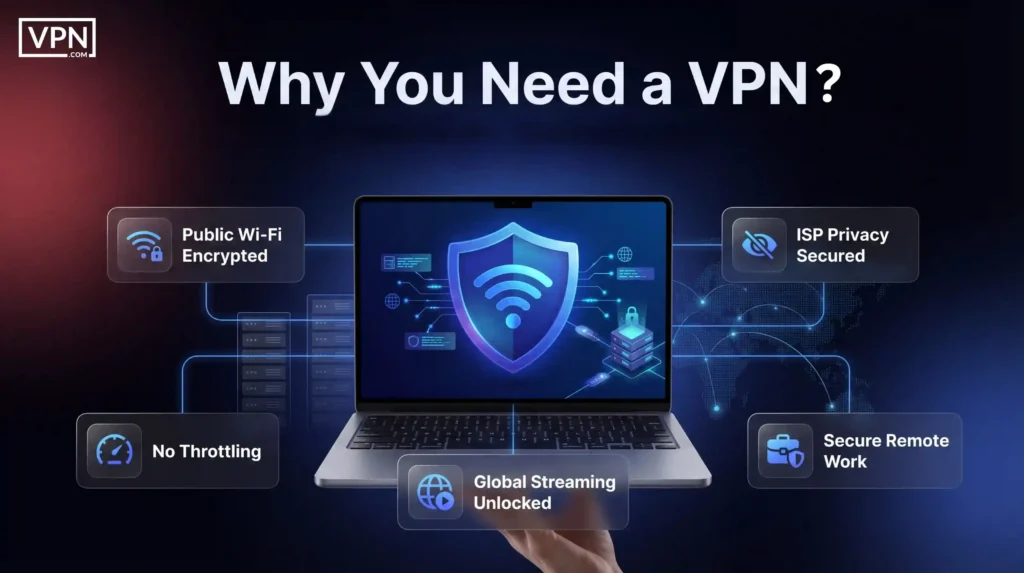
VPNs solve five critical problems that affect every internet user:
- Public Wi-Fi protection: Unsecured coffee shop and airport networks expose your passwords, banking credentials, and messages to nearby hackers in real time. A VPN encrypts everything, making it unreadable even on compromised networks.
- ISP privacy: Your internet provider logs every site you visit and sells that data to advertisers and data brokers. A VPN hides your browsing activity from your ISP, keeping your online habits private.
- Streaming access: Geo-blocks prevent you from watching your shows while traveling abroad. The best VPN for streaming lets you connect to a server in your home country, making it appear you’re still there and accessing access.
- Bandwidth throttling prevention: Some ISPs intentionally slow your connection speed during peak usage. A VPN hides what you’re doing online, so your ISP has no reason to throttle your connection.
- Remote work security: When you work from public locations or use unfamiliar networks, accessing company files and systems is risky. A VPN encrypts all work-related traffic, protecting sensitive data from interception.
VPN vs Proxy vs Tor: Key Differences
VPNs, proxies and Tor all hide your IP but work differently and suit different needs. Our VPN vs proxy guide breaks down the key differences, including when you’d choose one over the other.
How Does a VPN Work?
When you activate a VPN, your connection is encrypted and routed through a private server; the website you visit sees the server’s IP, not yours. Our VPN setup guide covers installation on every device.
How to Choose the Right VPN?
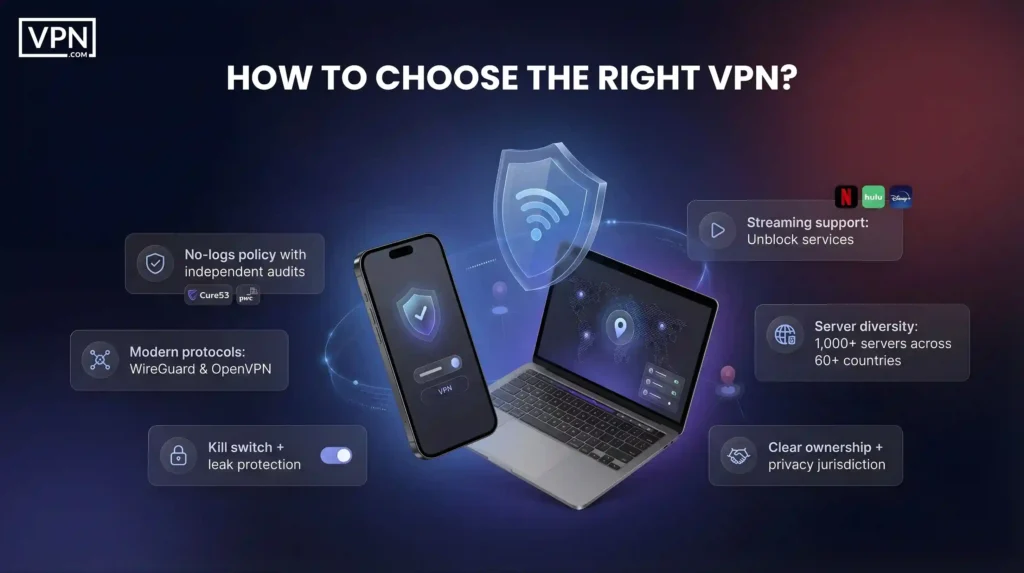
The most important factors when choosing a VPN (from no-logs audits to kill switches and jurisdiction) are covered in our “How to Choose a VPN” guide.
For specific use cases, see:
VPN Speed: How the Top Providers Rank
Our Speed Lab ranks 50+ VPN providers using aggregated published third-party test data. Here’s how the top three rank:
| VPN Provider | Speed Lab Rank |
|---|---|
| NordVPN | #1 of 22 |
| Surfshark | #4 of 22 |
| ExpressVPN | #8 of 22 |
Modern VPNs using WireGuard add little overhead on broadband connections. The privacy benefit far outweighs the minor speed reduction for most users.
VPN Security & Privacy: What You Should Know
A VPN is a strong privacy tool, but it has important limits. Understanding what it protects and what it doesn’t is critical.
A VPN protects you from:
- Your ISP sees which sites you browse
- Hackers on public Wi-Fi are stealing your passwords
- Websites identifying your real location
- Your activity logs are being sold to advertisers
A VPN does not protect against:
- Malware or viruses on your device
- Phishing attacks that trick you into giving up information
- Browser fingerprinting techniques
- Third-party cookies and tracking pixels
A VPN works best as part of a broader security strategy that includes strong passwords, two-factor authentication and reputable antivirus software. For complete online security guidance, see our cybersecurity hub.
It’s also worth knowing where VPNs are legal before relying on one.
The Bottom Line
A VPN encrypts your data, hides your IP address and protects your privacy on any internet connection. For public Wi-Fi security, streaming access, remote work and everyday browsing, a VPN is one of the best security investments you can make.
Choose a service with modern encryption (AES-256), a clear no-logs policy, ideally one an outside firm has audited, and servers in locations you actually need. Test one with a money-back guarantee to see how it fits your life.
Ready to protect your privacy? Compare top-rated VPN providers and find the right service for your needs.
Best VPNs: FAQs
Is it legal to use a VPN?
Do VPNs slow down your internet?
Can I use a free VPN?
Which VPN protocol is best?
Should I use a VPN for torrenting?
Resources for this page
Charts and reference images from our research, free to view and share.
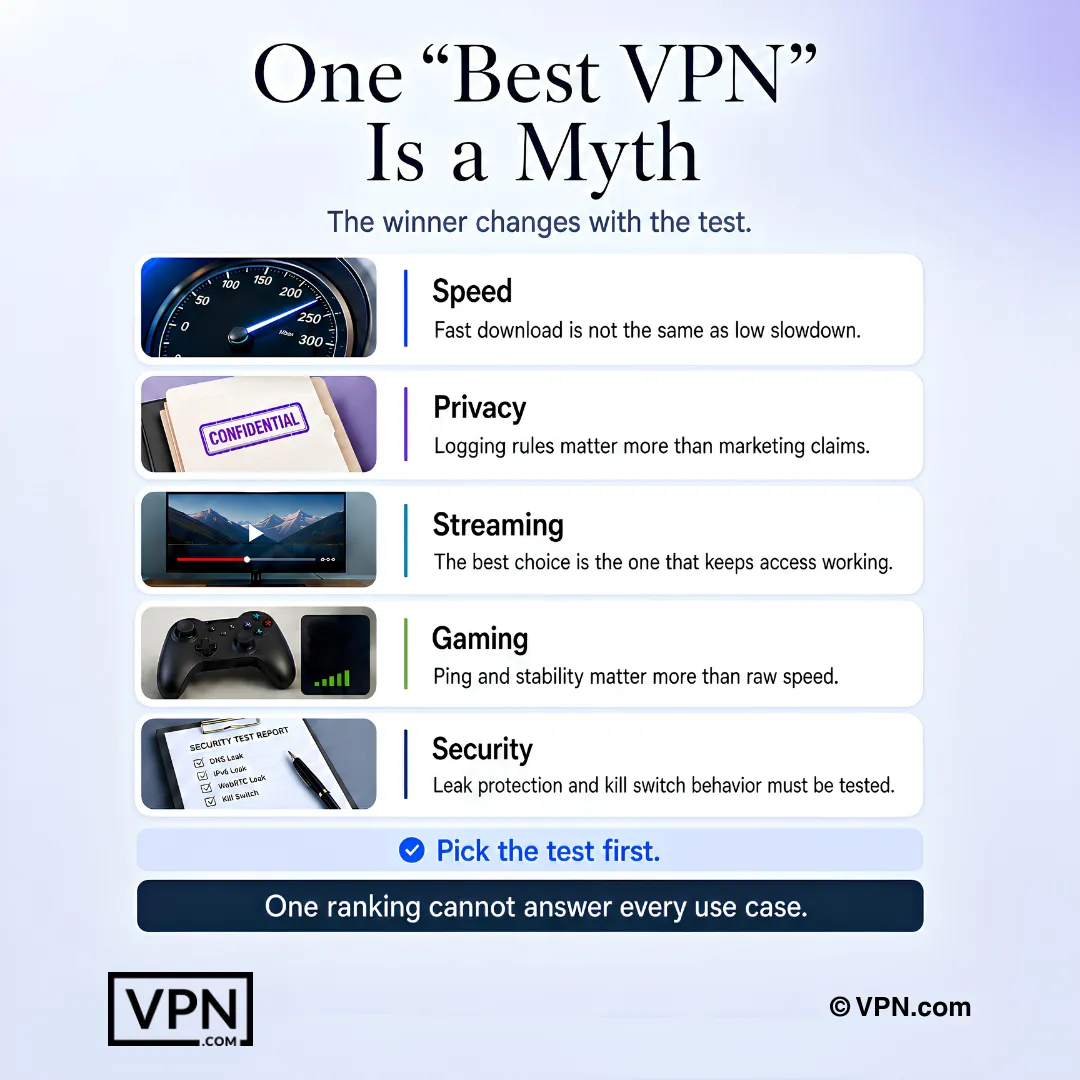
One ranking cannot answer every VPN use case; the right test determines the winner.
- VPN Guide Worksheet Checkpoint 1 Multiple Choice ChallengePDF · 0.6 MB
- VPN Guide Worksheet Checkpoint 2 True or False ChallengePDF · 0.6 MB
- VPN Guide Worksheet Checkpoint 3 Key Term InsertionPDF · 0.6 MB
- VPN Guide Worksheet Checkpoint 4 Network Concept MatchPDF · 0.6 MB
- VPN Guide Worksheet Checkpoint 5 Crossword PuzzlePDF · 0.6 MB
- VPN Guide Worksheet Checkpoint 6 Hidden Word SearchPDF · 0.6 MB
- VPN Guide Worksheet Checkpoint 7 Scrambled Word ChallengePDF · 0.6 MB
- VPN Guide Worksheet Checkpoint 8 VPN Case Studies & CipherPDF · 0.6 MB
- VPN Guide WorksheetPDF · 0.8 MB
Latest VPN Guides
CyberGhost Free Trial: 7 Days on Mobile + 45-Day Guarantee
Try CyberGhost free for 7 days on Android and iOS, or use the 45-day money-back guarantee on longer plans. Full access, no payment required upfront.
CyberGhost Pricing: Plans, Costs & Best Deals
Compare CyberGhost plans and pricing. Intro vs renewal rates, seasonal discounts, and which plan offers the best value for your needs.
Is CyberGhost Safe? Security, Privacy & Audit Analysis
Is CyberGhost safe? Audit disclosures, encryption protocols, jurisdiction analysis, kill switch testing, and no-logs policy verification.
CyberGhost Speed Test Rank: #10 of 22 in Our Speed Lab
Where CyberGhost sits in the VPN.com Speed Lab, what its rank covers, which protocol to choose, and how to fix a slow connection.
ExpressVPN Free Trial: 30-Day Money-Back Guarantee
ExpressVPN doesn't offer a traditional free trial, but you get 30 days risk-free with its money-back guarantee. Full access across 8 devices.
ExpressVPN Pricing: Plans from $3.26/Month
Compare ExpressVPN pricing across Basic, Advanced, and Pro plans. Save up to 78% with longer commitments and get a 30-day money-back guarantee.